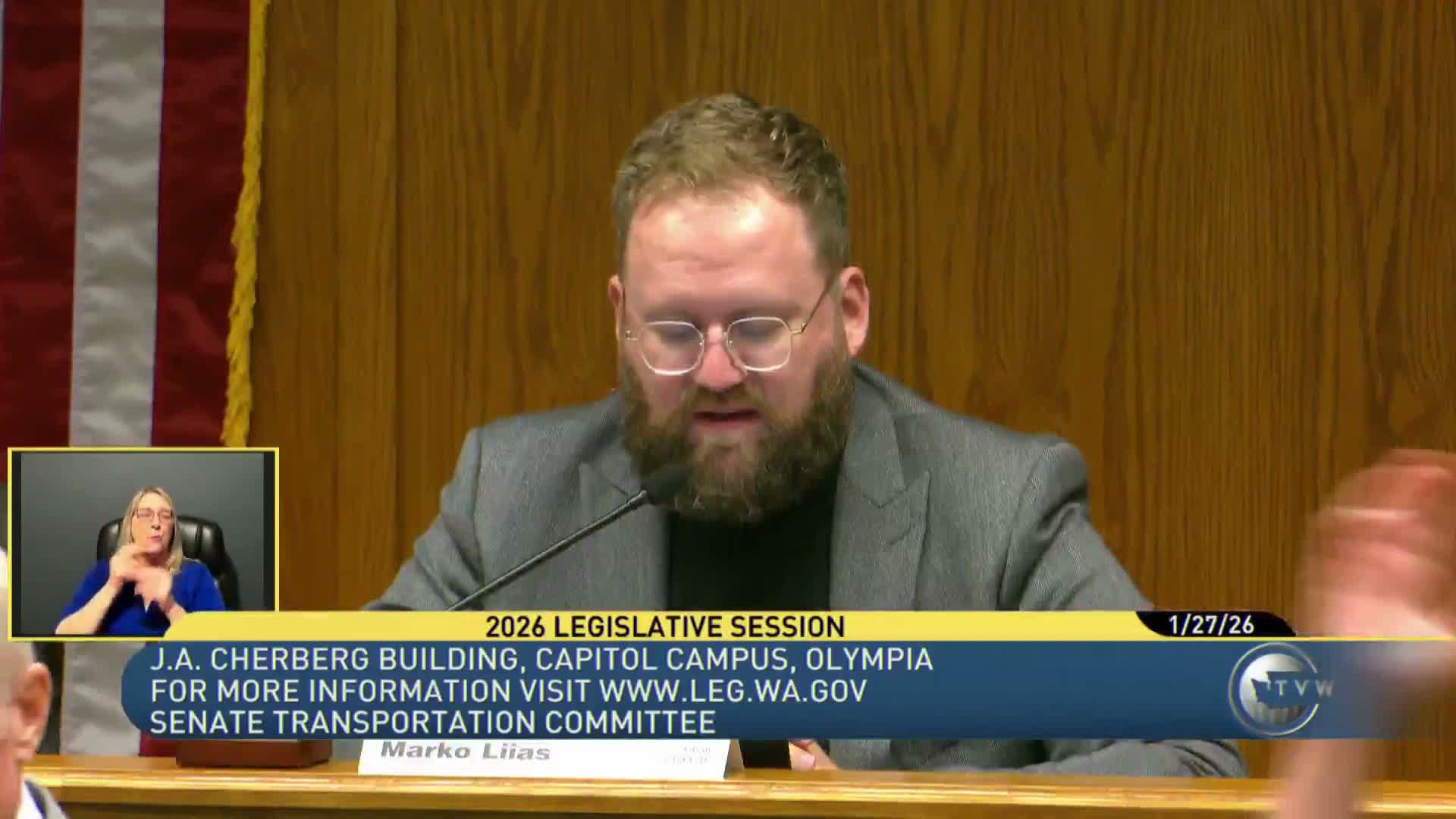
Senate hearing spotlights economic and safety toll of Fairfax (SR 165) bridge closure as lawmakers weigh emergency powers for WSDOT
Get AI-powered insights, summaries, and transcripts
SubscribeSummary
Witnesses and local officials told the Senate Transportation Committee that deferred maintenance left the 105‑year‑old Fairfax Bridge unsafe, severing access to Mount Rainier’s Carbon River corridor; SB 5987 would declare an emergency and give the transportation secretary temporary waiver authorities to restore SR 165 access.
Senate Transportation Committee members heard testimony January 27 that the permanent closure of the Fairfax (Carbon River) Bridge on State Route 165 has produced immediate safety, economic and public‑access harms for gateway communities and visitors.
Mayor Jamie Piloli of Wilkeson told the committee the bridge’s failure was foreseeable after “nearly 20 years of inspection reports documenting advanced corrosion” and that the closure has cut off a town of about 500 residents from routine commerce, emergency routing and access to Mount Rainier National Park. “This failure was not sudden,” Piloli said, “and waiting is and was no longer an option.”
Melissa Littleton, a government‑relations specialist for Pierce County, told lawmakers that deferred maintenance and aging design were factors in several recent bridge incidents in the county. Littleton said preservation and modernization are both required: “When we delay preservation and maintenance, we increase the likelihood of emergency closures rather than planned investments.”
Steve Rourke, WSDOT’s Olympic Region Administrator, described the agency’s planning study and next steps. He said the Carbon River Bridge is about 105 years old, failed permanently after a support‑column collapse and was weight‑limited to 8 tons in July 2024. WSDOT evaluated seven alternatives, and staff recommended either no‑build or a new bridge north of the existing alignment pending geotechnical analysis. Rourke said the project is in a three‑phase sequence—pre‑NEPA geotechnical and design work, an anticipated NEPA environmental review (likely an environmental assessment) and construction. He estimated construction could take “24 months plus or minus” once NEPA and permitting are complete.
Several local residents and recreation advocates urged faster action. Avery Cesarano of Buckley and organizations including the Pacific Northwest 4 Wheel Drive Association and Foothills Rails to Trails Coalition described lost access to trailheads, the Evans Creek ORV area and Carbon River entrances to Mount Rainier as a statewide public‑access problem. Jack Pence, a Wilkeson landowner, said the community needs “a much more timely, not years and years restoration.”
At the hearing staff presented proposed substitute Senate Bill 5987, which declares the Fairfax Bridge closure an emergency, directs WSDOT to restore access across SR 165 “as soon as possible,” and grants the transportation secretary certain emergency authorities to waive specific statutory obligations listed in the bill. The substitute also exempts restoration activities from Executive Order 25‑07 labor‑agreement steps and contains an emergency clause for immediate effect. Committee staff said the bill itself would have no fiscal impact; the bridge work would have separate fiscal costs.
WSDOT offered a cautionary note: Allison Kreutzinger (Department of Transportation) said the agency supports restoration but warned that many critical processes, including NEPA and certain federal approvals, are outside the secretary’s unilateral control. She cautioned the bill could create “false expectation and false hope” for an accelerated timeline that federal rules may not permit.
Mayor Piloli and others asked the legislature to pair any statutory emergency authority with short‑term stabilization measures—a secondary egress, stipends or other business support while the project proceeds—saying Wilkeson had received no direct relief to date. Committee staff acknowledged receipt of a Wilkeson stabilization package for review.
The public hearing drew widespread pro testimony (staff recorded approximately 55 pro submissions, 0 con) but produced no committee action that day. The committee then proceeded to a separate bill hearing.
What happens next: SB 5987 was heard; committee members may refer it to executive session for amendment and possible committee vote following the amendment deadline and posting schedule announced by staff.