Get Full Government Meeting Transcripts, Videos, & Alerts Forever!
Get email alerts on the Human Rights Memorial topic
No spam. Unsubscribe anytime.
Committee hears emotional, sharply contested testimony on joint memorial seeking U.S. investigation into killing of Aishanur Ezgi Egi
Summary
Supporters, including family members and eyewitnesses, urged the committee to pass SJM 8014 calling for a U.S.-led independent investigation into the killing of Washington resident Aishanur Ezgi Egi; opponents challenged factual context and urged accuracy and balance in any legislative statement.
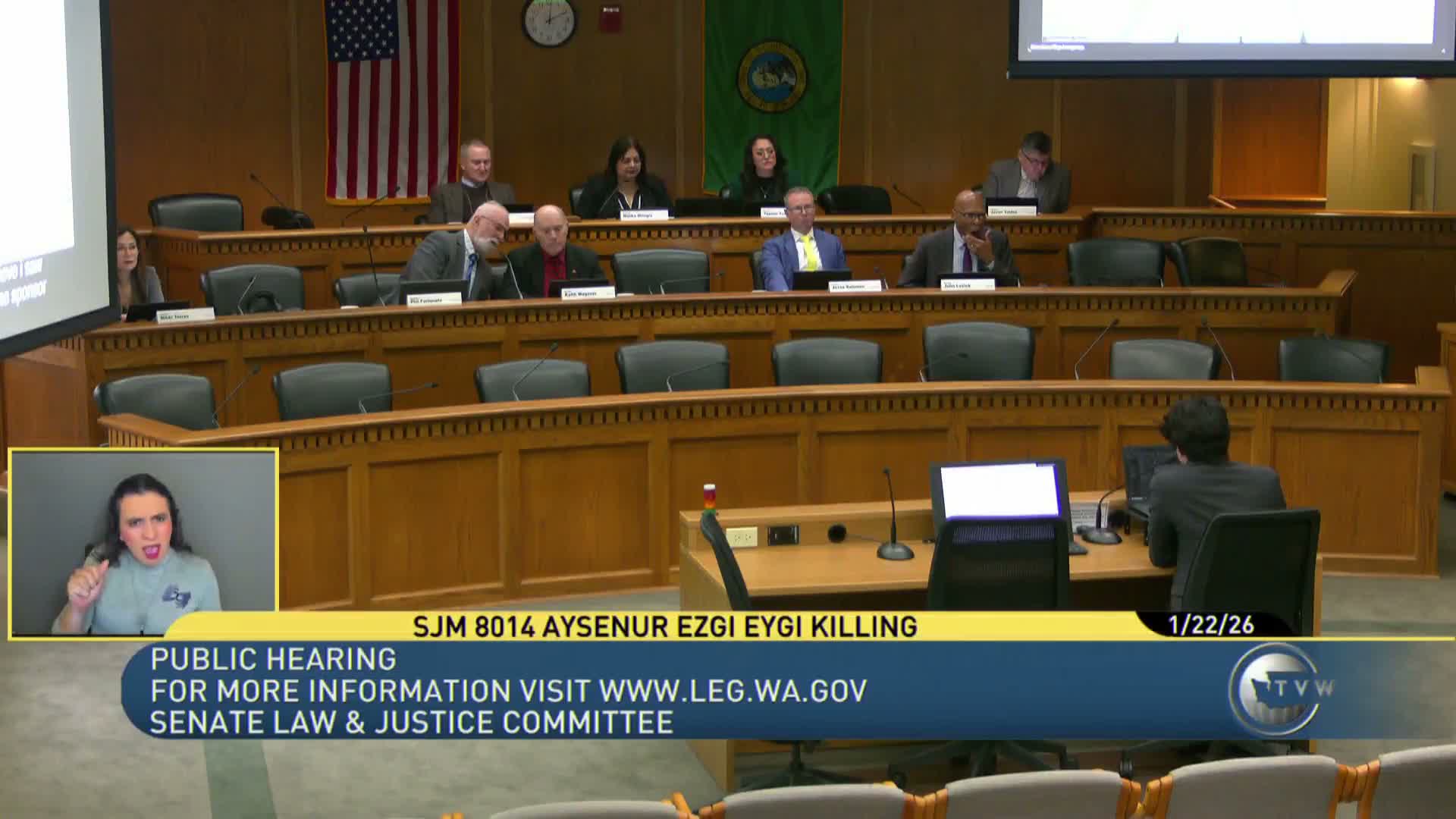
The Law and Justice Committee took public testimony on Senate Joint Memorial 8014, a memorial requesting that the U.S. government open an independent, transparent investigation into the killing of Aishanur Ezgi Egi.
Staff briefing: Ryan Giannini summarized the memorial’s request for a U.S.-led investigation and the memorial’s intended transmittal to federal leaders, including the president and the Department of Justice.
Proponents’ testimony: Family members and supporters described the personal loss and urged accountability. Cindy Corey, mother of Rachel Corey (another activist killed in Gaza), described the family’s view that Israeli military investigations have not been adequate and said the memorial would support the family’s push for a U.S. investigation. Craig Corey (father) recounted efforts to pursue congressional attention and framed the memorial as standing up for victims and for future families. Hamid Ali (husband of the deceased) recounted the morning he learned of his wife’s death and said prior U.S. statements calling the killing “unprovoked and unjustified” did not lead to an investigation; he asked the committee to pass the memorial. Multiple witnesses (students, scholars, community advocates and eyewitnesses) described the victim’s character, recounted witnessing or contextualizing the event, and urged that the state call for a federal investigation.
Opponents’ testimony: Jake Bennett and Ari Hoffman testified in opposition, urging caution. Bennett said the memorial rests on an incomplete factual premise, and stated that the memorial omitted context about the deceased’s activist affiliations; Hoffman said the memorial singled out one death while omitting other cases (he cited Chaim Katzmann) and questioned consistency in the sponsors’ approach.
Committee engagement and sponsor remarks: Senator Rebecca Saldanha (prime sponsor) framed the memorial as a modest request for the federal government to apply its ordinary practices when Americans are killed abroad, emphasizing it is not a foreign-policy statement but a request for equal treatment and accountability. Congressman Brian Baird (remote) expressed support for the memorial and urged an investigation.
Outcome: The committee closed public testimony at the end of the hearing and did not record a final committee vote during the session. Members asked for written testimony from those not heard and indicated the memorial will be considered further.
Why it matters: The memorial asks the U.S. government to investigate the death of a Washington resident abroad; the item drew intense emotional testimony and contested factual claims from witnesses on both sides, highlighting both human-rights and evidentiary/accuracy disputes the legislature must weigh before issuing a formal statement.