Get Full Government Meeting Transcripts, Videos, & Alerts Forever!
Get email alerts on the Occupational Health topic
No spam. Unsubscribe anytime.
Senate committee hears bill to broaden presumption that firefighters’ and some officers’ heart problems are work‑related
Summary
The Senate Labor & Commerce Committee heard testimony on SB 6,180 (Eric Strauss Memorial Act), which would remove 72‑ and 24‑hour timing qualifiers for presuming heart problems are occupational diseases for specified firefighters and law enforcement officers; supporters said it will speed relief to families while opponents warned of large fiscal and scientific concerns.
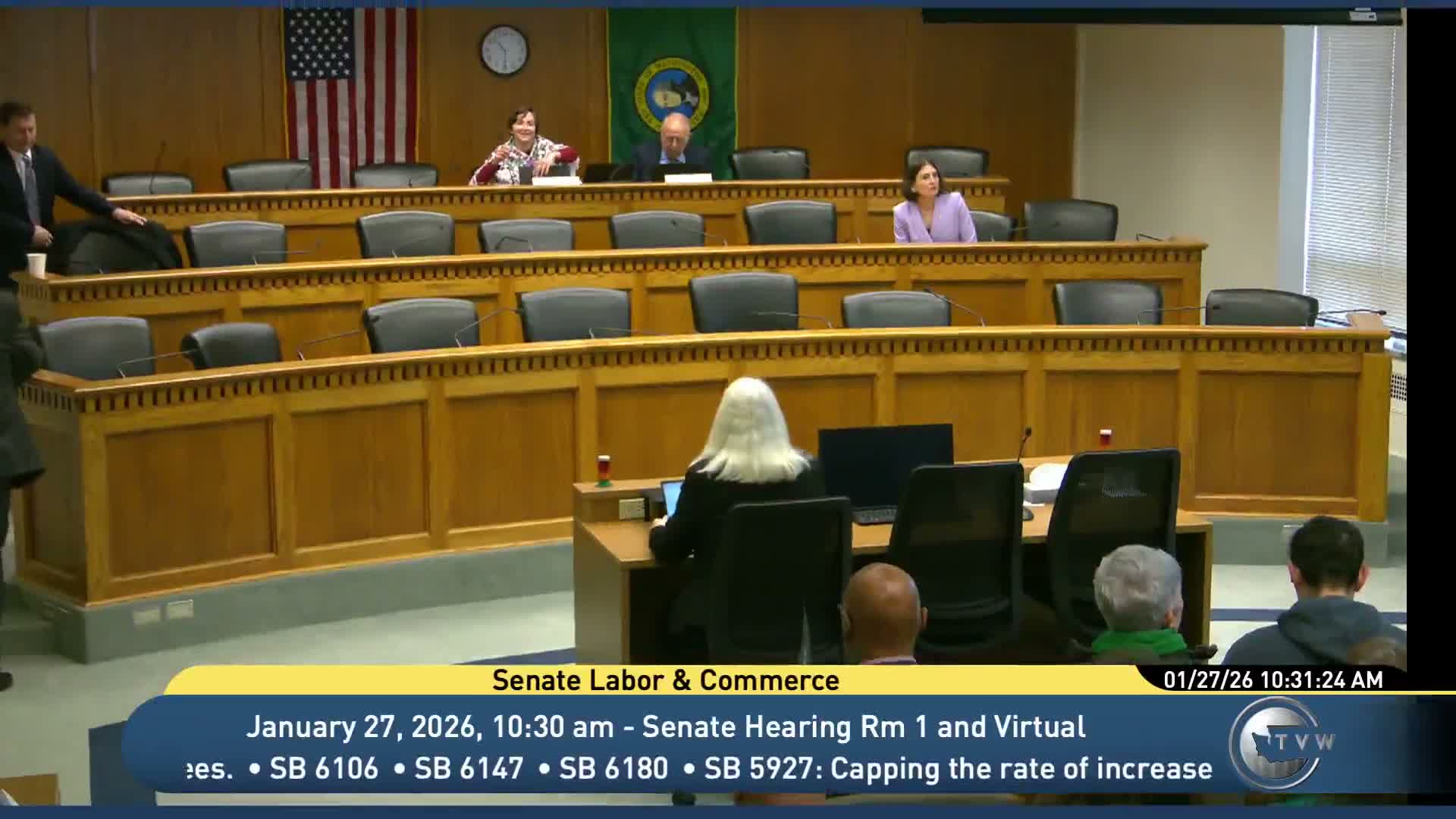
The Senate Labor & Commerce Committee on Tuesday heard testimony on Senate Bill 6,180, the Eric Strauss Memorial Act, which would remove the existing 72‑hour and 24‑hour time limits that now condition a presumption that certain heart conditions are occupational diseases for specified firefighters and law‑enforcement employees.
Committee staffer Susan Jones told the panel that the bill removes qualifiers linking presumption to recent exposure to smoke or toxic substances and to physical exertion within the current time windows. Jones said a departmental fiscal note shows roughly $210,000 of initial expenditures to accident and medical aid accounts and that Labor & Industries estimates additional annual claims of about $12 million to $27 million for 2026–2031, producing a total range of roughly $79 million to $180 million depending on scenarios. She also said the state actuary had identified a potential pension impact and the Department of Retirement Systems was preparing a fiscal note.
Sponsor Sen. John Lubbock (44th District) framed the measure as relief for families navigating appeals and denials after a loved one’s death. "Let's make the process faster for our firefighters, officers, and their families," Lubbock said, arguing that families who appeal denied claims often ultimately prevail but endure protracted legal and medical reviews.
Widows of two firefighters whose deaths fell outside current time qualifiers testified in support. Kalina Schaus, whose husband Eric died at 40, described a year of forensic reviews and appeals before Labor & Industries ultimately concluded the death was occupational. "Presumption provides a path forward for families," Schaus said, urging lawmakers not to make bereaved families endure lengthy appeals. Raquel Pleasance, whose husband Ryan died on duty at 41, described long service, repeated trauma exposures and interrupted sleep schedules and said the existing time windows were "arbitrary." Ray Seay, testifying for the Washington State Council of Firefighters, described cumulative stressors and screening measures and urged passage to spare families paperwork and delay.
Opponents and neutral witnesses urged caution. Paul Jewell of the Washington State Association of Counties said removing qualifiers would shift substantial cost risk to counties and county‑employers and could require appeals that impose legal costs. Chris Tefft of the Washington Self Insurers Association described the workers' compensation system as a balance of tradeoffs and said the bill "removes all of the linkages" that tie presumptions to epidemiology; he urged that new science be reviewed by the statutory advisory committee before the Legislature acts. Candace Bach of the Association of Washington Cities likewise asked for stronger medical evidence before expanding presumptions.
David Bonato of the Department of Labor & Industries and the SHARP program described the advisory committee's 2023 review of epidemiology, saying that while acute risks during emergency activities are well recognized, many studies show comparable long‑term rates of heart disease between first responders and comparison populations once the acute window passes. He warned that removing time qualifiers would broaden coverage to chronic cardiac conditions and likely pull in many additional cases.
The committee closed public testimony without taking a vote. The bill’s next procedural step was not announced at the hearing.