Get Full Government Meeting Transcripts, Videos, & Alerts Forever!
Get email alerts on the Sage Lakes Pud topic
No spam. Unsubscribe anytime.
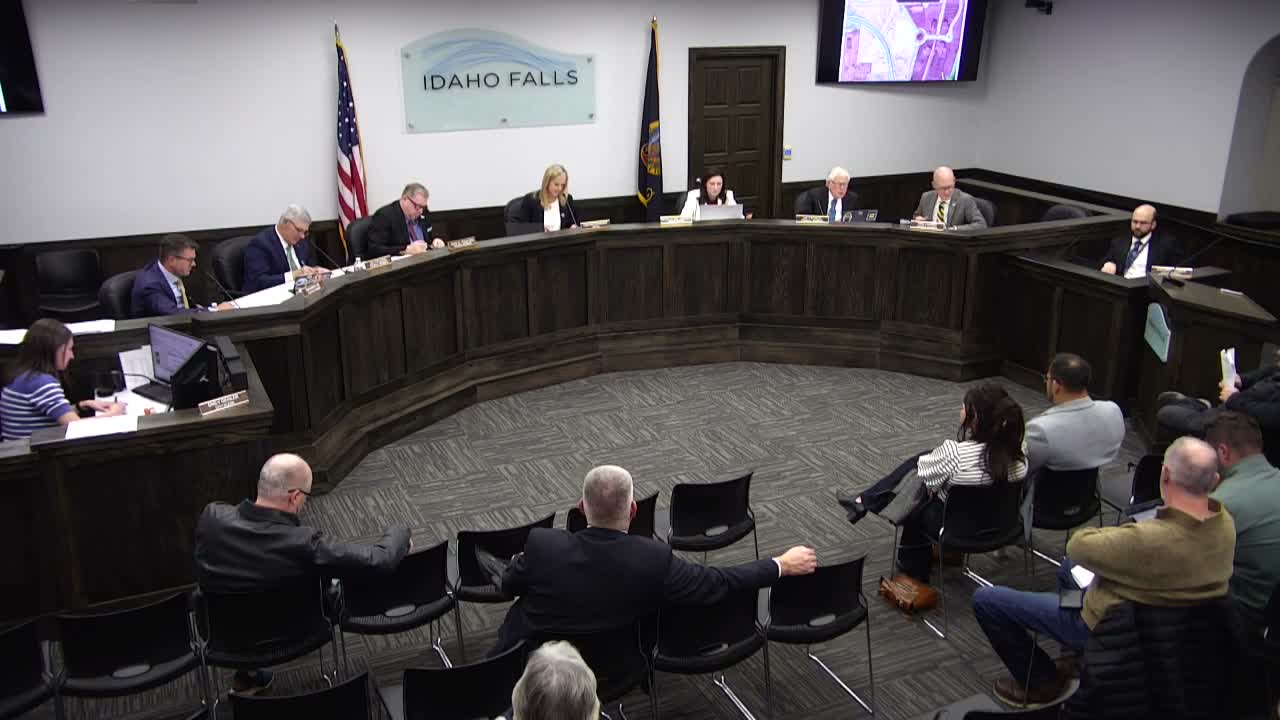
Idaho Falls Council Approves Sage Lakes PUD After Extended Hearing on Access, Water and Schools
Summary
After more than two hours of testimony and questions about water pressure, emergency access and school capacity, the Idaho Falls City Council approved the Sage Lakes planned unit development (PDV 25-003), a multi‑phase project that reduces by roughly 20% the density the developer could build by right and adds open space and trails.
The Idaho Falls City Council on [date in packet] approved the Sage Lakes planned unit development (PDV 25-003) after an extended public hearing in which neighbors pressed officials about traffic, water pressure and whether local schools can absorb new students.
Developer representatives said the project covers roughly 20 acres just west of 50 East, south of the golf course, and includes 74 previously approved single‑family lots plus a townhome component. Jared Huish, a developer representative, told the council the team reduced the project’s townhome count “down to 246 townhomes, which is a 20% reduction in density” compared with the maximum possible under existing zoning.
Neighbors urged the council to slow or reject the project unless infrastructure concerns were resolved. Allison Dickens of Fairway Estates recounted a 2017 emergency response delay and warned, “It took 17 minutes for the emergency services to get there,” and asked the council to prioritize safe, usable access before adding hundreds of homes. Other residents described narrow existing access, construction‑vehicle impacts and school overcrowding concerns.
City staff and the developer offered responses during the hearing. Director Sander (Community Development) said the developer has bonded the bridge and that the city has withheld certificates of occupancy for Division 26 until the bridge and related infrastructure are signed off. Staff also said public works verified water pressure readings meeting city standards after recent system looping and valve work; staff told the council an independent traffic study projected acceptable levels of service for nearby intersections once the Sage Lakes Boulevard connection is completed.
Council members pressed legal and practical limits on conditions the council can impose. Staff told the council that some items — such as maximum building height consistent with the base R‑2 and R‑3 zoning — may not be conditioned away without legal risk, while other mitigation (landscaping, trail connections, HOA maintenance expectations and phasing commitments) can be included in the PUD approval.
Proponents and some council members emphasized tradeoffs: the PUD reduces the by‑right density the property could ultimately realize and adds open space, sidewalks and pedestrian connections. Multiple council members noted that the PUD standard used here results in design features that are more protective of adjacent single‑family neighborhoods than the prescriptive zoning would guarantee by right.
After deliberation, Council member Bradford moved to approve the planned unit development as presented; the motion passed by roll call with councilors Bradford, Dingman, Francis, Freeman, Larson and Lee voting in favor.
What happens next: the council also approved the PUD’s reason statement and authorized the mayor to execute required documents. City staff reiterated that building permits may be issued for work under the developer’s phased plan but that certificate of occupancy for affected lots will not be released until required infrastructure, including the bonded bridge, is complete and accepted by the city.
Why it matters: the PUD reshapes anticipated development density for a growing part of northeast Idaho Falls, and the debate highlighted recurring local concerns — emergency access, seasonal water pressure and whether school capacity will keep pace with housing growth.
Quotes in context: “Allison Dickens, a Fairway Estates resident, said the area lacks reliable access and recounted a past emergency: ‘It took 17 minutes for the emergency services to get there.’” “Developer Jared Huish said the proposal reduced the maximum density and added open space: ‘We’ve reduced it down to 246 townhomes, which is a 20% reduction in density.’” “Community Development staff told the council: ‘We will not issue certificate of occupancy until the bridge is signed off and approved,’ addressing neighbors’ access concerns.”
The council’s approval is the latest in a series of land‑use decisions responding to city growth; neighbors and developers will now negotiate technical conditions and construction timing as the phased project moves toward buildout.