Get Full Government Meeting Transcripts, Videos, & Alerts Forever!
Get email alerts on the Impact Fees topic
No spam. Unsubscribe anytime.
Council upholds impact‑fee administrator denial but directs staff to negotiate informal reimbursement for Skyline Drive work
Summary
After a quasi‑judicial hearing, the council affirmed the impact‑fee administrator’s denial of the developer’s requested system‑improvement credit (lack of prior written agreement/timeliness) but upheld a prior‑use exemption and directed staff to pursue an informal reimbursement resolution using bids the developer provided.
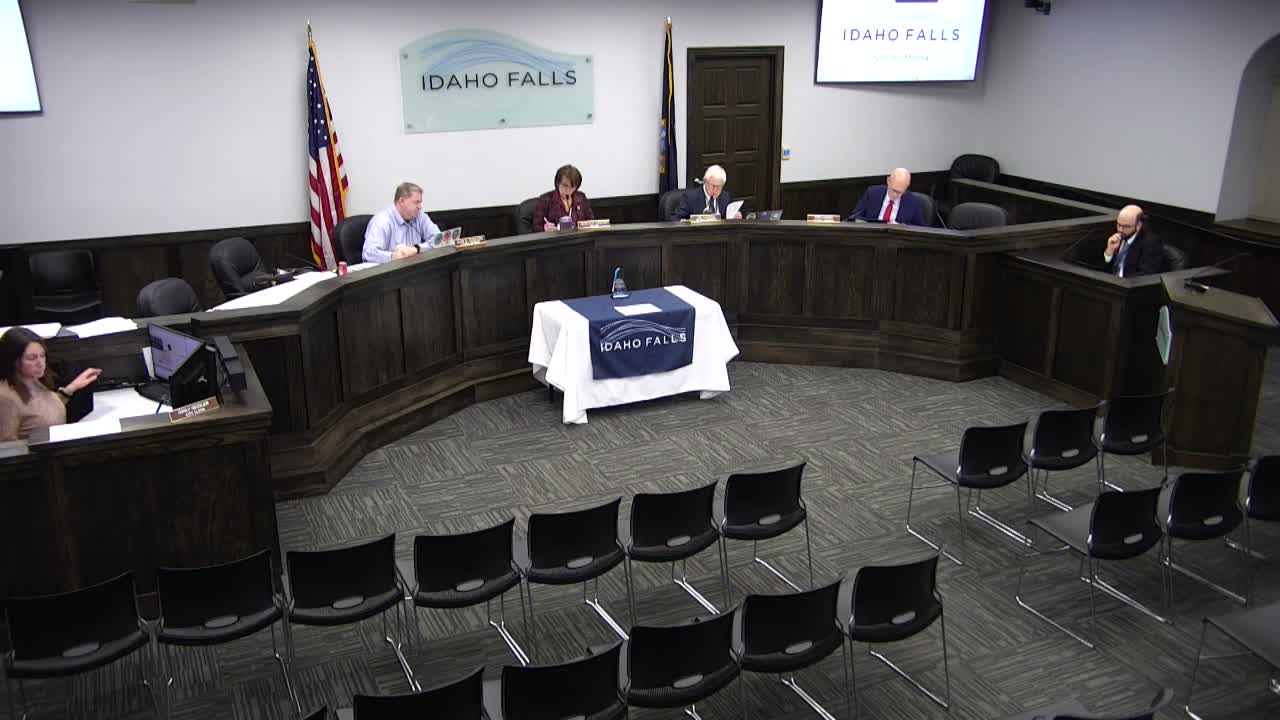
The Idaho Falls City Council on Nov. 20 heard a contested impact‑fee appeal brought by developers of the Barnwood Townhomes and Terrace Gate Condos, who sought credit or reimbursement for transportation improvements performed along Skyline Drive. The council conducted the proceeding in its quasi‑judicial capacity under the city’s impact‑fee ordinance (Title 10, Chapter 8).
Appellants Erin Bingham and Eric Reed told council they were directed during design reviews to widen Skyline Drive to 100 feet (an arterial standard) and that they completed widening work and a number of site improvements in reliance on city guidance. They submitted bids and an appraisal showing combined construction costs and land value in the hundreds of thousands of dollars and asked either a land credit and/or a construction credit against transportation impact fees they had already paid for portions of the development yet to be permitted.
Impact‑fee administrator Pam Alexander explained staff’s review and recommendation. Alexander said the city code requires a written agreement with the city specifying the credit amount prior to commencement of work on public improvements and that, where developers were to be reimbursed, the development agreement requires three contractor bids before construction. Because the appellants had not obtained an executed written reimbursement agreement before construction began, Alexander concluded the requested system‑improvement credit was untimely under the ordinance; she granted a prior‑use exemption for one demolished single‑family residence and offered an informal path forward if the developer could provide the required bids and documentation.
Appellants said they had, in fact, obtained multiple bids (they stated four bids from contractors dated Dec. 2023–Jan. 2024) and argued the city previously indicated reimbursement would be available; staff said those documents were not part of the development‑agreement process and that formal written terms were never finalized prior to construction.
City attorney and staff explained the applicable legal standards: the council reviews appeals de novo but must apply the ordinance’s timeliness and written‑agreement requirements. The council debated the law and the fairness of the outcome.
By motion, the council affirmed the impact‑fee administrator’s determination to deny the system‑improvement credit for Skyline Drive (while affirming the administrator’s grant of a prior‑use exemption for the demolished residence). At the same time, the council directed staff to pursue the informal reimbursement path outlined in the administrator’s Nov. 6 letter (staff requested bids, identified specific line items the city would consider, and offered to review submitted documentation). The council also directed the city attorney to draft a reasoned decision statement reflecting council’s findings and return that draft for council review no later than the council meeting on Jan. 8, 2026 (with a staff work session to review drafts beforehand).
The effect of the ruling is procedural: the formal code-based credit was denied because the required written agreement did not exist before work commenced, but the council authorized staff to negotiate a narrowly defined informal reimbursement consistent with municipal procurement controls so the parties can try to resolve the claim without protracted litigation.