Get Full Government Meeting Transcripts, Videos, & Alerts Forever!
Get email alerts on the SITFO Trust Fund topic
No spam. Unsubscribe anytime.
School and Institutional Trust Fund Office reports $4.4 billion portfolio, Amendment B to raise distributions about $15 million
Summary
SITFO officials told the subcommittee the office manages roughly $4.4 billion in assets and has distributed about $118 million in FY25; they said Amendment B (2024) increased the FY26 distribution by about $15 million to roughly $133 million. SITFO leaders highlighted governance, performance, adoption of AI tools, and requested no change to the FY27 requested operating budget.
Ryan Kulig, finance and operations officer for the School and Institutional Trust Fund Office (SITFO), told the Public Education Appropriations Subcommittee that the office now manages approximately $4.4 billion in assets, with cumulative distributions since 1995 of roughly $1.35 billion.
Kulig said distributions to beneficiaries in fiscal 2025 were about $118 million and that Amendment B, passed by voters in 2024 and implemented in the most recent distribution formula, increased the FY26 distribution by more than $15 million—bringing the expected distribution to roughly $133 million for the year to be distributed in FY2027.
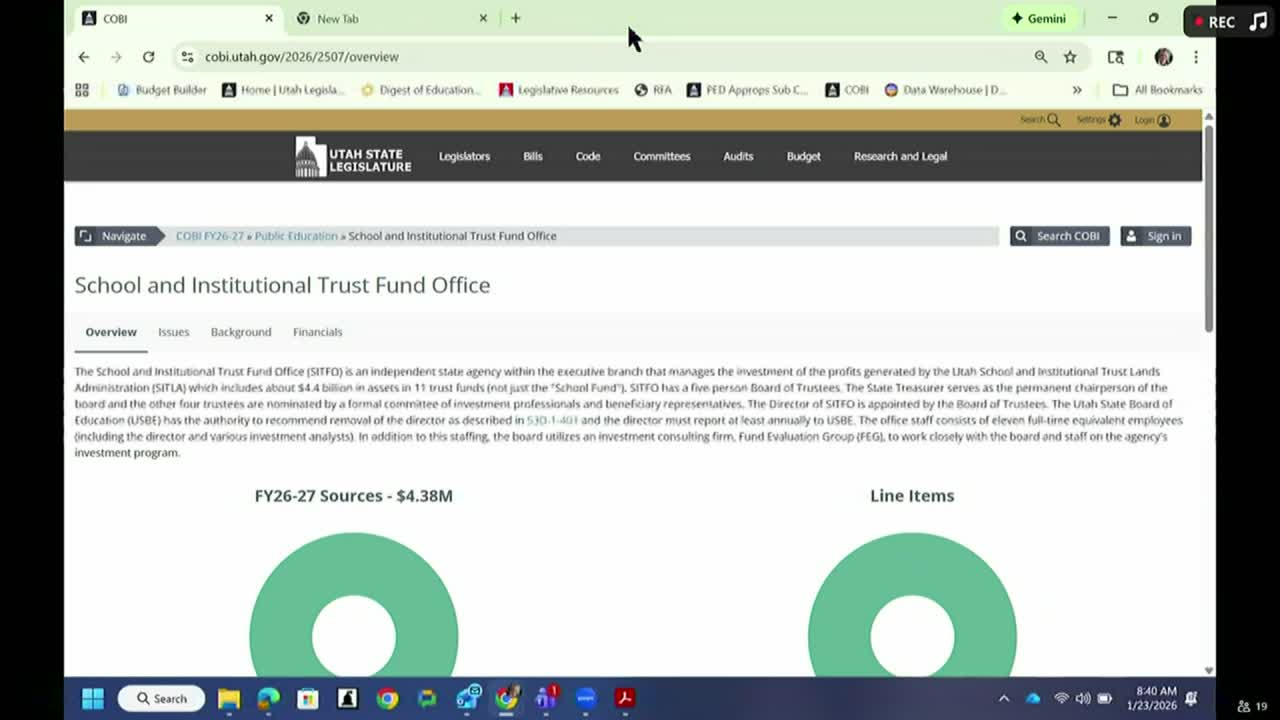
"We are over $4,400,000,000 in assets," Kulig said, noting the fund's growth and the mix of corpus and earnings in the corpus chart he displayed. He described SITFO as self‑funded—operational costs covered from investment earnings rather than the state general fund—and summarized governance (five‑member board chaired by the State Treasurer) and staffing (14 persons, with two hires pending).
Kulig also highlighted that SITFO is integrating artificial intelligence into institutional investment processes and that performance measures showed volatility below the targeted 70/30 portfolio metric and nearly 4.8% annual distribution growth from FY24 to FY25.
Committee members asked about near‑term revenue drivers (real estate, energy extraction royalties, and surface resources) and how distributions are spent at the school level. SITFO staff reiterated distributions originate from trust land revenues invested by the office and that spending choices at the school level are administered via the State Board of Education and local school councils.
Provenance: SITFO presentation began at SEG 622 with an agency introduction and continued through Kulig’s slides and Q&A; key statements about the $4.4B corpus and the Amendment B distribution effect appear in segments near SEG 713–781.