Get Full Government Meeting Transcripts, Videos, & Alerts Forever!
Get email alerts on the Minimum School Program topic
No spam. Unsubscribe anytime.
Midyear update: Minimum School Program projects $138.9 million positive balance; staff outline options to meet 5% reduction target
Summary
Legislative staff told the Public Education Appropriations Subcommittee the Minimum School Program is now projected to have about a $138.9 million positive balance for FY2026, a $12 million upward revision. Staff reviewed causes (property tax and levy behavior, enrollment patterns) and explained tools—non‑lapsing balances, prefunded stabilization dollars, and program trims—being considered to meet a requested 5% reduction planning target.
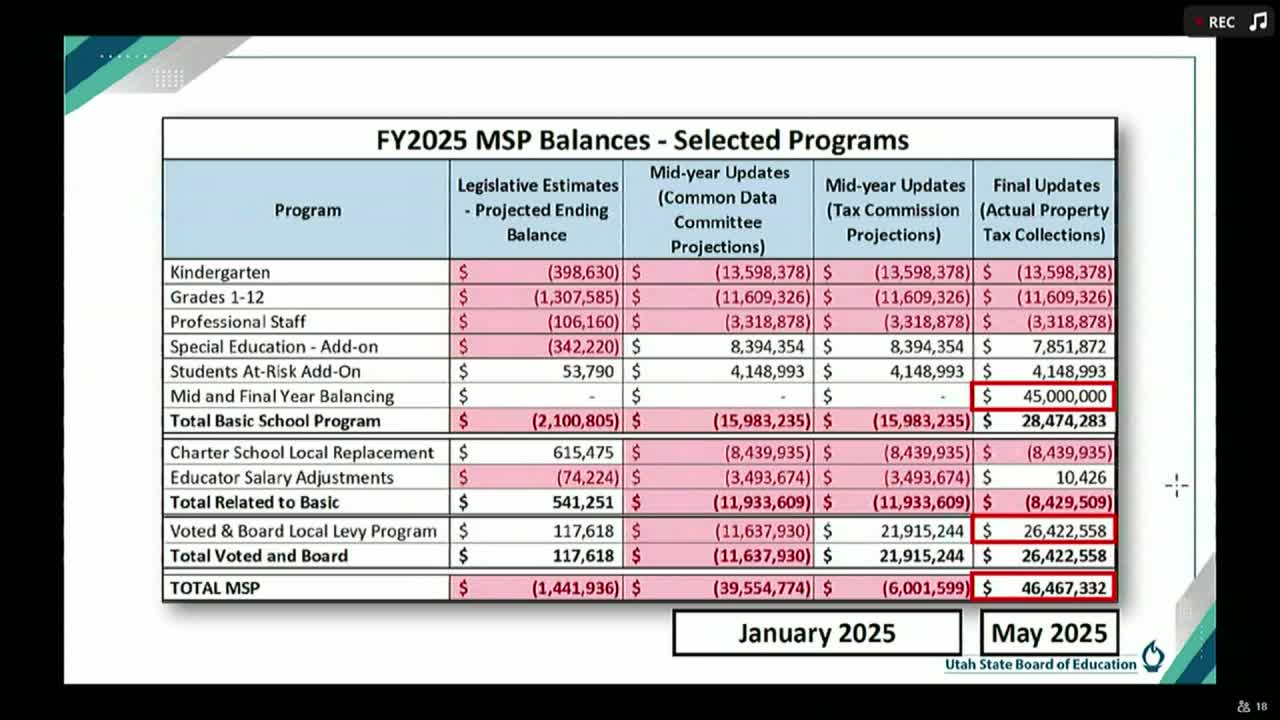
Sam Urie, school finance director, told the Public Education Appropriations Subcommittee Thursday that midyear updates using actual October 1 student and educator counts show the Minimum School Program is now projected to have a balance of roughly $138,900,000 for FY2026, about $12 million more than earlier expectations.
"We're right now projecting a balance of about 138,900,000.0 for the minimum school program this year," Urie said during the presentation. Staff attributed most of the improvement to savings in the basic school program and in the voted/board local levy equalization program, while noting offsets from charter enrollment changes.
Why it matters: the midyear review compares earlier projections to actuals so lawmakers can identify pressures and savings before final estimates. Committee members were particularly focused on how the Legislature used stabilization funds last year to prefund midyear risks and whether those prefunded dollars remain necessary as conditions changed.
Ben Leishman, legislative staff, said the Legislature prefunded midyear risk management last year with a combined $95 million from the stabilization account—$45 million for FY2025 and $50 million for FY2026—and that some of that cushion was intended to restore reserves after 2024’s midyear draws. "Part of that $95,000,000 was restoring some of that cushion that's always been in the minimum school program," Leishman said, adding that as 2025 progressed the program did not require the full prefunded amounts.
Staff reviewed the mechanics behind the voted and board local levy program: a shortened hold‑harmless period for certified rates and local property tax behavior that, in many districts, produced more local revenue than projected and thus reduced state equalization obligations. Presenters emphasized that many savings remain programmatic—i.e., they stay in the Minimum School Program—and can be reallocated only by statute or explicit legislative action.
Committee members asked detailed follow‑up questions about non‑lapsing balances, encumbrances, and whether funds are still held at the state level or have already been allocated down to LEAs. Staff said balances are often a mix—some funds are encumbered for multi‑year contracts while other balances remain unencumbered and potentially available for reassignment. Leishman characterized prefunding as deliberate risk management: by setting money aside before final decisions were made, the legislature avoided having to "unfund" priorities midyear.
What’s next: staff will supply line‑item detail in subsequent meetings so the committee can identify candidate ongoing and one‑time reductions or reallocations. Members emphasized the exercise is preliminary: the 5% target is a planning tool tied to the December Executive Appropriations revenue estimates, not a final legislative decision.
Provenance: Topic introduced by Sam Urie and staff midyear presentation; key statements appear in the midyear update presentation and Ben Leishman’s explanation of prefunding (see transcript segments beginning SEG 460 through SEG 571).