Get Full Government Meeting Transcripts, Videos, & Alerts Forever!
Get email alerts on the Jjys Correctional Health topic
No spam. Unsubscribe anytime.
Lawmakers hear pleas for more juvenile‑justice and correctional‑health funding as new housing unit opens
Summary
The committee heard JJYS and Correctional Health Services describe staffing crises, program closures under consideration and a $1.5M one‑time request to stabilize health services for a 384‑bed unit (Bear‑3); officials warned cuts to dental staffing and other reductions would increase safety risks and downstream costs.
Officials from Juvenile Justice and Youth Services and Correctional Health Services told the Social Services Appropriations Subcommittee that staffing shortfalls, rising youth complexity and a planned prison housing expansion risked service interruption unless the Legislature provides additional funds.
April Grama, director of JJYS, described a staffing crisis — turnover near 40% in FY25 — and presented reduction options that would close regional youth centers, eliminate the ALTA transitional facility and reduce contracted residential options. She warned that closures would increase travel and transportation burdens for families in rural/southern Utah and reduce local shelter capacity.
"We can't just close our beds or reduce our hours when our staff leave," Grama said, requesting $2.8 million ongoing to stabilize 24/7 detention and secure facility staffing and to reduce use of overtime and contracted labor.
Correctional Health Services Director Dr. Mark Wisner described several proposed CHS reductions (holding vacant positions, reducing prison dental staffing ratios, aligning hospital reimbursements to Medicaid rates and cutting a medical monitoring pilot). CHS reported it operates six dental clinics and currently staff dentists and dental assistants at roughly a 1:1 ratio; the division said reducing that ratio would increase wait times and raise safety concerns in dental clinics, which CHS described as among the more dangerous treatment settings in correctional facilities.
CHS requested a $1.5 million one‑time building block to staff and stabilize health services for Bear‑3, a 384‑bed housing unit the Department of Corrections plans to open. Dr. Wisner said opening similar units in the past required costly overtime and contracted nursing and urged proactive funding to avoid repeating FY24 shortfalls.
Committee staff acknowledged the need to better incorporate prison medical cost estimates into bill fiscal notes; the committee asked analysts to work with corrections and CHS to ensure fiscal impacts of sentencing and capacity bills include medical costs.
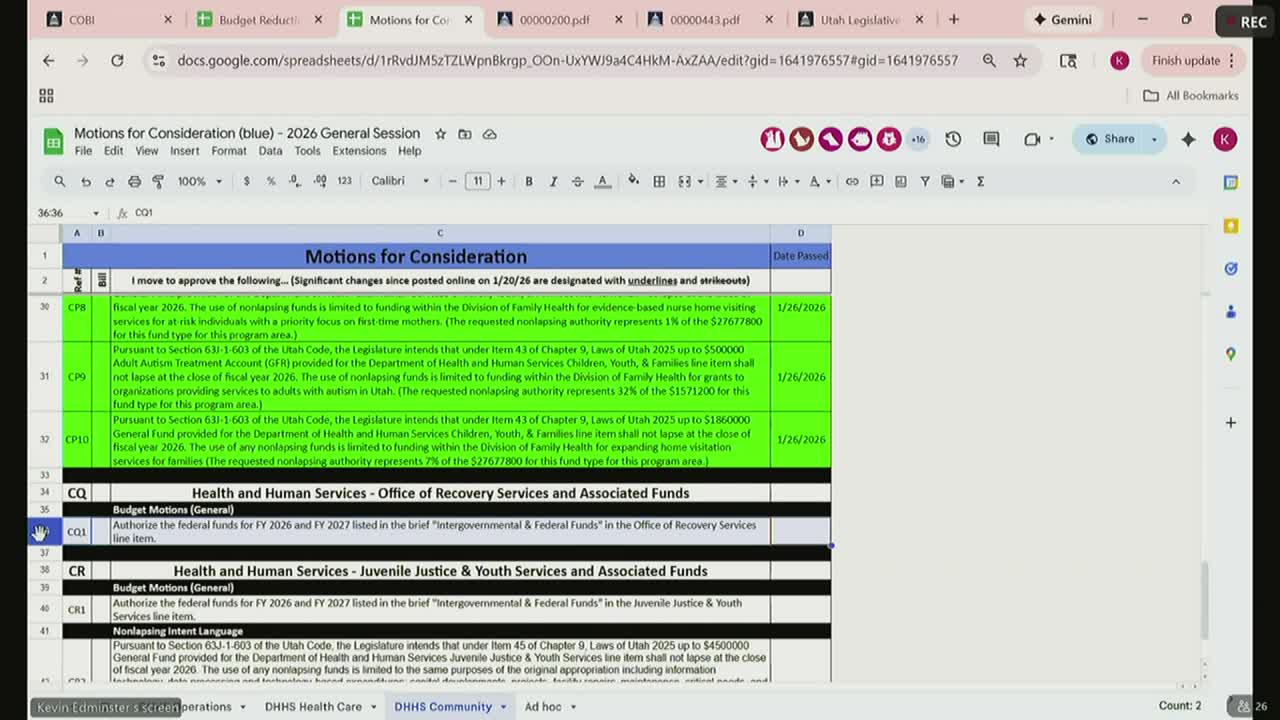
What happens next: motions to authorize CR items (federal funds and nonlapsing language) for JJYS were approved; decisions on CHS reduction proposals and the Bear‑3 building block were deferred for future consideration and for inclusion in forthcoming fiscal materials.