Get Full Government Meeting Transcripts, Videos, & Alerts Forever!
Get email alerts on the Dhhs Budget topic
No spam. Unsubscribe anytime.
Utah panel reviews DHHS cuts that would hit licensing, foster‑family supports and early intervention
Summary
The Social Services Appropriations Subcommittee reviewed proposed DHHS reductions including a $2.3 million cut to licensing/background‑check staffing, a 78‑FTE DCFS staffing proposal, and one‑time funding requests for adoption and early‑intervention programs; agency officials warned the cuts risked federal compliance and service capacity.
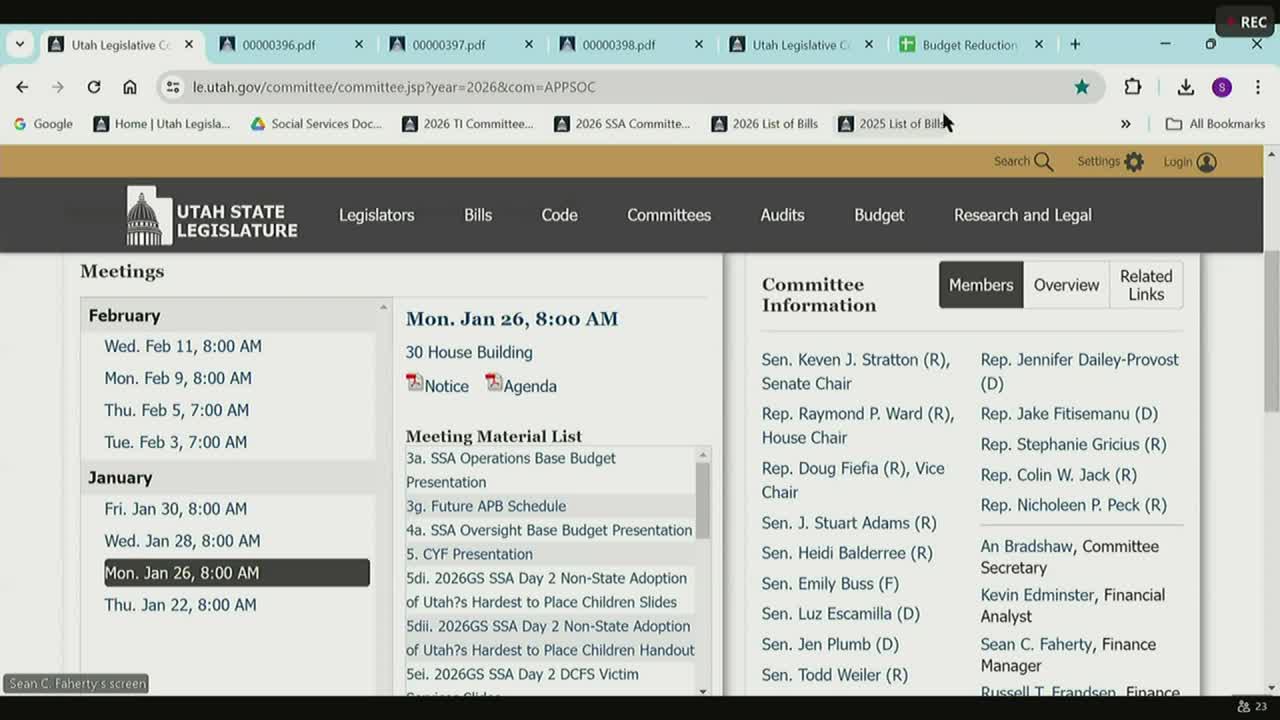
The Social Services Appropriations Subcommittee on Jan. 26 reviewed several proposed cuts to the Department of Health and Human Services budget that agency leaders said would slow licensing timelines and shrink child‑welfare supports.
Finance staff said the DHHS operations line in the FY27 base bill is $42.3 million, down about 10% from FY26 largely because one‑time capital funding was removed; oversight funding totals about $23.6 million. During a briefing on the oversight line, the committee discussed reduction item 69 — a proposed $2.3 million ongoing cut in the Division of Licensing and Background Checks accompanied by a staff recommendation to raise licensing fees to make up revenue if adopted.
"This division is responsible for licensing and conducting background checks for over 11,000 providers in the state of Utah," Amanda Slater, assistant deputy director, told the committee. She said the team is behind on survey timelines, is under a corrective action plan with CMS and has a state audit finding for those timelines. "This cut would result in staff cuts, which would delay those timelines even further," Slater said, adding that retaining fees to offset a cut would require statutory change.
Committee members pressed the agency for numbers. Staff clarified the typical background‑check cost to an individual is about $52.20 for the state portion plus roughly $32 for the FBI fingerprint—about $60 total—and said they would calculate what fee increases would be needed to cover a $2.3 million reduction.
Child and family services also drew lengthy questioning. Tanya Myroup, director of the Division of Child and Family Services, urged caution on a proposed reduction of 78 FTEs (item 15), saying a cut of that magnitude "would significantly impact our ability to meet both state and federal requirements." Myroup said DCFS has just under 1,000 employees, had reduced turnover from roughly 40% to about 28% after recent compensation investments, and reported average case loads of about 12–15 per worker with some areas considerably higher.
Myroup and agency partners described several requested additions: a $1.0 million one‑time request for intensive child‑specific adoption recruitment (Wendy's Wonderful Kids, through Raise the Future), $886,000 one‑time to bridge domestic‑violence shelter funding, and $1.5 million one‑time for Baby Watch early intervention services. Noel Texan, division director for family health, warned failing to meet the federal maintenance‑of‑effort (MOE) for early intervention would jeopardize roughly $3.0 million in federal support (a $1.5 million missing match plus associated penalties).
Several committee motions to authorize technical and non‑lapsing items (CA, CB, CD and a later CP block of motions) were brought forward and approved by unanimous voice votes; staff said no votes were being taken on the larger reduction options on Jan. 26 and additional information was requested before action.
What happens next: staff were asked to provide more granular cost estimates — including the fee increase needed to cover the licensing reduction, the breakdown of grandfamilies vs. foster‑care recipients, and the caseload impact of a 78‑FTE reduction — before the committee considers formal cuts.
The committee also set public comment dates for Jan. 30 and Feb. 9 and adjourned for lack of a quorum.