
Utah subcommittee reviews $6.7 billion Medicaid budget and dozens of proposed cuts, including site‑neutral and provider‑rate changes
Get AI-powered insights, summaries, and transcripts
Subscribe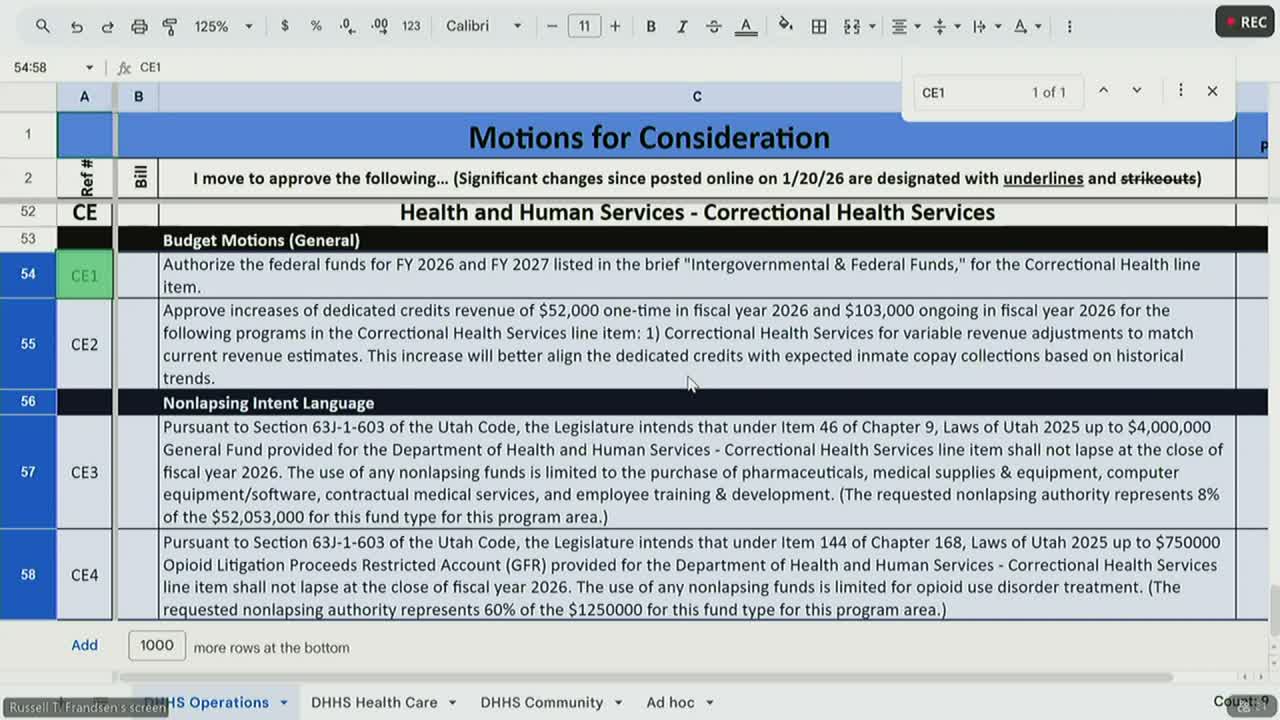
Summary
The Social Services Appropriations Subcommittee reviewed FY2025 Medicaid spending and a long list of proposed reductions and statutory changes that staff estimate could yield a range of savings; agency and OIG witnesses clashed over feasibility of using extrapolation and other recoveries while lawmakers pressed for clearer program impacts.
The Social Services Appropriations Subcommittee spent the majority of its Jan. 22 meeting examining statewide Medicaid spending and a wide menu of possible reductions and policy changes that staff say could be used to meet budget targets.
In a briefing to the committee, Legislative Fiscal Analyst Russell Franson said total fund spending on Medicaid for fiscal year 2025 was $5,600,000,000 statewide and that "a little over $1,000,000,000 came from general fund and income tax fund." Franson emphasized the concentration of spending among high‑cost groups — nursing home residents and people with disabilities — and noted that various non‑state matches (hospital assessments, sales tax add‑ons for expansion, pharmacy rebates) provide roughly $700,000,000 in matching funds.
Why it matters: Medicaid is a major portion of the state budget. Franson told the committee that about 35% of general fund spending went to Medicaid and that 10% of certain discretionary funds were used for the program when including the income tax and uniform school funds.
Proposals reviewed. Staff presented dozens of line‑item options (numbered 23–67 on the reduction list) ranging from administrative adjustments and funding swaps to programmatic rollbacks. Examples discussed in detail included: redirecting interest in the Medicaid ACA fund to general revenue (staff estimated $12.4 million ongoing); shortening retroactive eligibility for some populations (a placeholder $3 million estimate); improving data to avoid paying members enrolled in multiple states (estimated $735,000); allowing limited extrapolation of audit findings to increase recoveries (no firm savings estimate); modifying outpatient payment rules to pursue "site‑neutral" payments; and multiple provider‑rate changes (from targeted nursing‑home rollbacks to a 1% across‑the‑board provider reduction).
Agency response and legal hurdles. Deputy Director Tanya Hales and newly appointed state Medicaid Director Julie Ewing joined the hearing and raised concerns about several items. Hales introduced Julie Ewing and said the department would "share responsibility" for responses. Ewing warned the committee that the federal outpatient prospective payment system (OPPS) is a complex, bundled methodology and said converting those payments to a site‑neutral equivalent is not straightforward: "it's really difficult to unbundle…to get them to a site neutral comparison," she told lawmakers. The agency also noted that several changes would require statutory amendment or federal approval.
Inspector General on audit recoveries. Neil Erickson, interim inspector general, and Elise Knapper told the committee that current Utah law limits the office's ability to extrapolate audit samples and that about 30 other states use some form of extrapolation. Knapper said extrapolation approaches generally have been upheld by courts and recommended statutory adjustments with safeguards to avoid imposing undue retroactive liabilities on small providers.
Points of contention. Committee members pressed three recurrent concerns: (1) whether provider markets would sustain retroactive extrapolation or large retrospective recoveries, (2) the statutory and federal approvals needed for programmatic rollbacks (for instance, ending 12‑month postpartum coverage or adult autism services would likely need both state and federal action), and (3) the downstream effects on counties and local providers if the state shifted costs (for example, asking counties to resume mental‑health matches could raise property or sales tax pressures).
What passed and what did not. Several procedural motions tied to administrative transfers and non‑lapsing authority were approved in this meeting (see separate article). Committee staff emphasized that many of the reduction ideas are policy choices rather than immediate, lockable savings; several items were described by staff as "placeholder" amounts subject to further analysis and federal review.
Next steps. Staff and the department agreed to follow up on technical questions — including clearer cost estimates, statutory requirements, and county impact assessments — and some members asked staff to draft intent language where feasible. The committee signaled its interest in pursuing options that do not require federal approvals first, while also asking for more granular procedure‑level documentation for items that could affect providers' willingness to contract with Medicaid.
The subcommittee did not adopt any of the programmatic rollbacks during this meeting; the discussion concluded with staff offering to return with more detail on high‑priority items and potential legal or federal constraints.