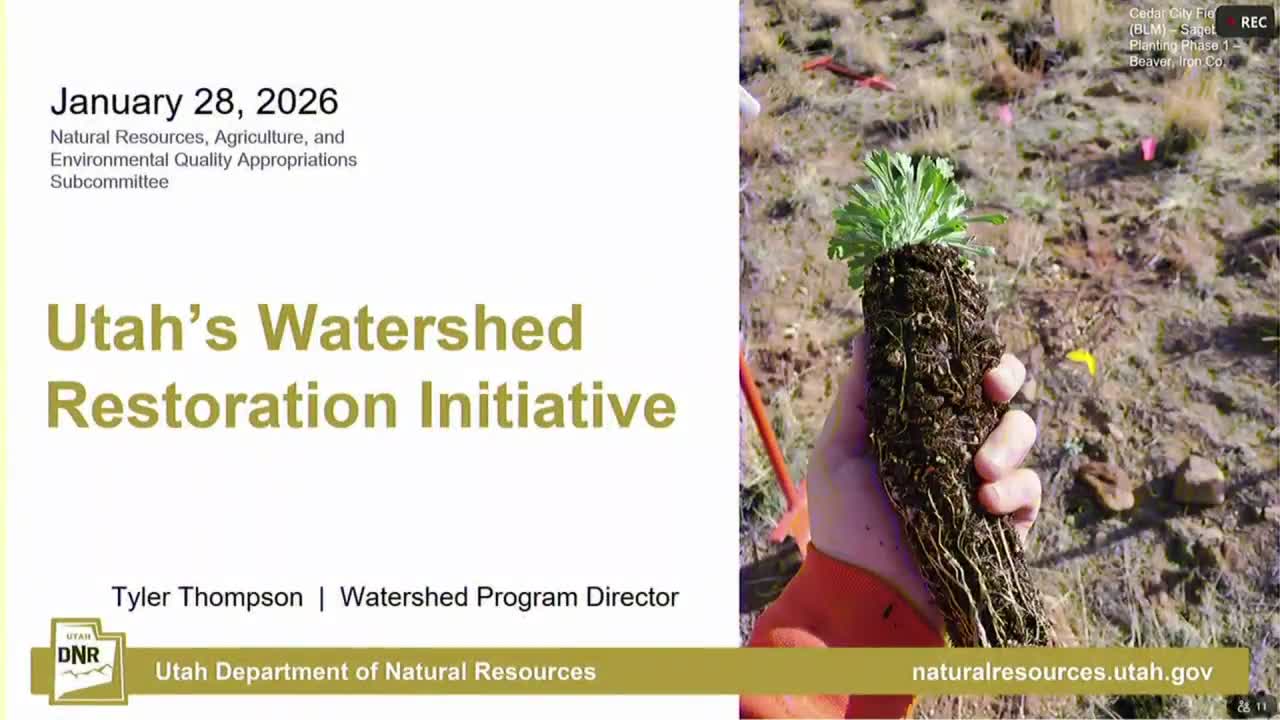
Watershed Restoration Initiative warns of shrinking acreage and seeks funding to sustain rehabilitation work
Loading...
Summary
DNR watershed program director Tyler Thompson told the appropriations subcommittee WRI has completed nearly 3,000 projects over 20 years but faces reduced acreage and federal funding; he highlighted Monroe Canyon rehabilitation as a case study and presented a pipeline of shovel‑ready projects needing funding.
Tyler Thompson, watershed program director at the Utah Department of Natural Resources, told the appropriations subcommittee that the Watershed Restoration Initiative (WRI) is entering its 20th year and has a long record of on‑the‑ground restoration work but faces funding and cost pressures that are shrinking treated acreage.
Thompson said WRI has facilitated nearly 3,000 projects and leveraged roughly $460 million from partners over two decades. He described recent performance measures: WRI completed 120 projects in the most recent year, treated about 144,000 acres (with ~13,900 acres of that from fire rehabilitation), treated roughly 142 miles of riparian area last year, and applied hundreds of thousands of pounds of seed. He said the program—s baseline state funding is about $6 million and that federal funding that historically leveraged state dollars has declined, reducing WRI—s ability to sustain prior acreage levels.
Thompson presented Monroe Canyon as a case study: preexisting WRI treatments on surrounding lands helped limit the spread of a very volatile fire. He said WRI and partners have invested more than $23 million on that landscape (Thompson provided a breakdown including state, federal and sportsmen—s contributions) and characterized the rehabilitation work as a success in reducing future risk and supporting recovery.
On staffing and partnerships, Thompson described a new outcome‑based performance measure requested by the legislative fiscal analyst and noted a new seedling partnership with the Department of Corrections greenhouses to grow about 100,000 seedlings per year at lower unit cost. WRI also reported receiving ~146 fiscal 2027 proposals requesting work on roughly 311,000 additional acres (an estimated $76 million in project value) that are shovel‑ready if funding is found.
Why it matters: WRI—s work addresses watershed health, species habitat, post‑fire recovery and water quality — areas legislators identified as having both ecological and economic value. Committee members asked about outreach to highlight WRI—s achievements and whether new state funding could reverse the downward acreage trend.
Thompson closed by asking the subcommittee to consider the WRI funding pipeline when evaluating budget priorities; the presentation generated a number of follow‑up questions but no formal appropriation in the hearing record.