Children's Justice Centers seek $470,000 bridge while victim-services study finishes
Loading...
Summary
The Children's Justice Center program told the Criminal Justice Appropriations Subcommittee that federal grants and private donations have fallen and one-time state funds are expiring; program director Tracy Tabith and Rep. Ivory requested $470,000 one-time to keep staff at 16 centers while a statewide victim-services analysis completes.
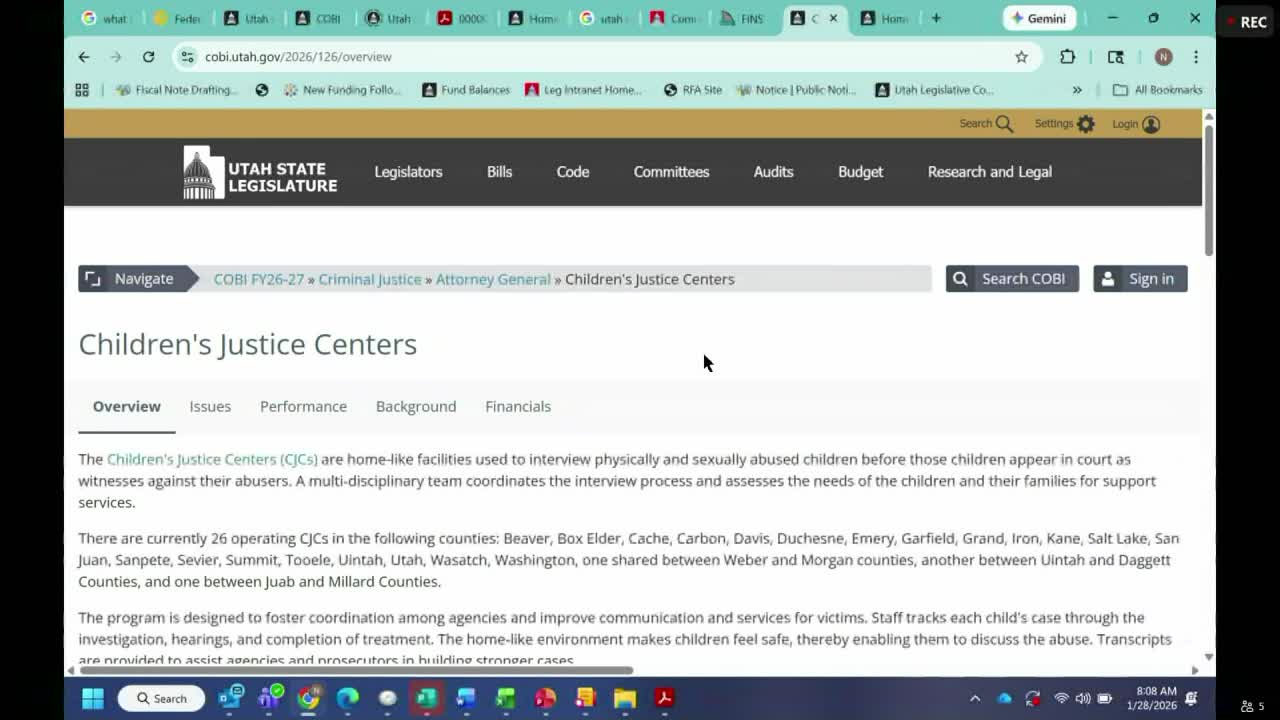
Tracy Tabith, director of the Children's Justice Center (CJC) program in the Utah Attorney General's office, told the Criminal Justice Appropriations Subcommittee that CJCs provide forensic interviews, medical exams, victim advocacy and trauma screening to children up to age 18 and coordinate multidisciplinary teams to improve case and family outcomes.
Tabith said the network has grown from three CJCs in 1994 to 25 centers serving 29 counties and that the program served 18,535 people in FY25, opening 6,643 new cases. She warned the committee that federal grant funding and private donations have dropped and that one-time legislative appropriations that supported facility improvements and personnel are drawing down. "CJCs are a life saving service," Tabith said, and stressed that losing staff would damage service continuity for children and families.
Representative Mike Ivory presented an RFA asking the committee to extend a portion of prior one-time funding for one year: $470,000 one-time to support personnel at 16 CJCs while a victim-services needs analysis is completed and funding recommendations are finalized. Tabith said the request aims to preserve frontline staff; she emphasized the program's performance measures and the fact that 16 centers handle about 83% of the state caseload.
Legislators praised the CJCs' work and urged continued support. Eric Clark, general counsel for the Utah Association of Counties (and former Washington County attorney), urged approval of the bridge funding, stressing the mix of federal, state and local funds that sustain centers and the difficulty of quickly replacing trained staff.
The RFA was presented for committee consideration; the transcript records discussion and support for pursuing a solution but no committee appropriation vote on the RFA during this meeting. Tabith asked also that the committee consider granting non-lapsing authority to retain closeout balances to cover non-personnel needs.
Next steps: the committee received the RFA and discussion occurred on the record; the victim-services study remains pending and the CJCs requested the $470,000 bridge to avoid immediate staff reductions while that work finishes.