Get Full Government Meeting Transcripts, Videos, & Alerts Forever!
Get email alerts on the Utilities topic
No spam. Unsubscribe anytime.
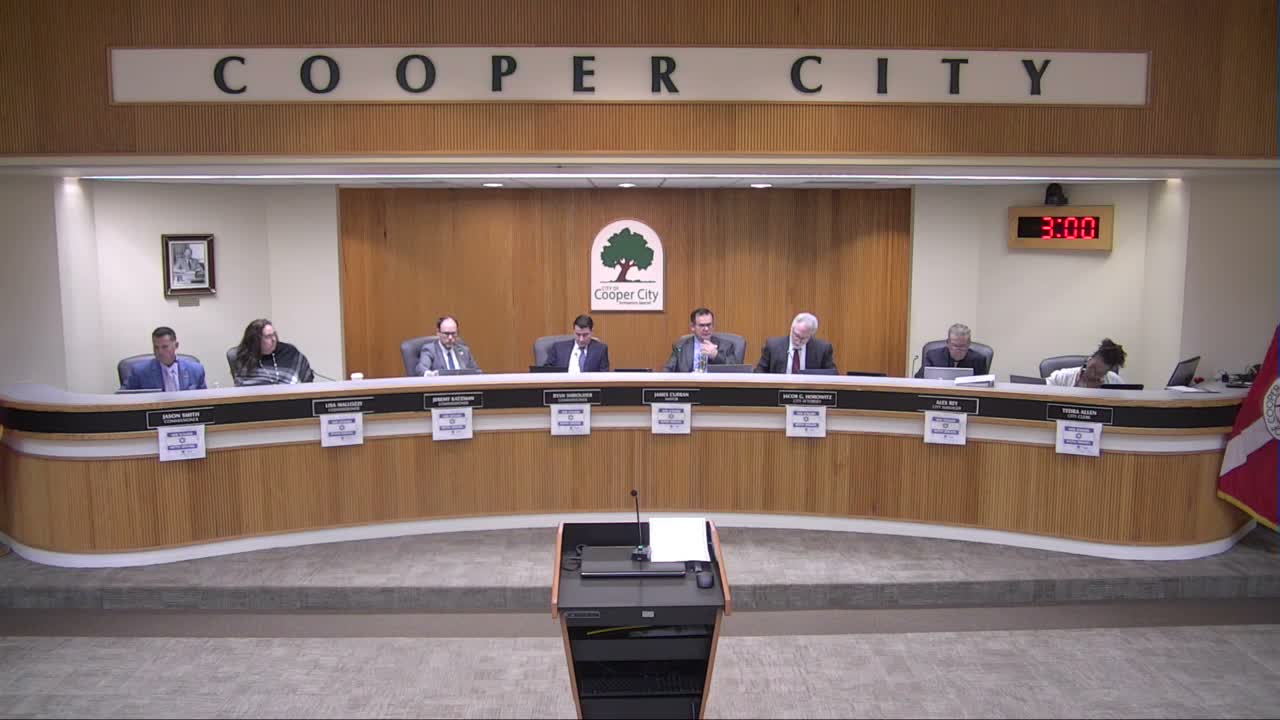
Cooper City approves one-time residential water hookup, advances utilities changes and schedules free chlorination
Summary
Commission approved a water agreement allowing a single residential ERC hookup outside city boundaries, held first reading of an ordinance amending utility connection rules, and heard a utilities report announcing a free chlorination program Feb. 17–Mar. 10 to flush and disinfect the distribution system.
The Cooper City Commission approved a resolution authorizing a one-time water-service connection for a single-family home (one equivalent residential connection) with Moore Partners LLC at a total cost of $5,302, considered under a standard agreement in the meeting packet.
Staff and the city attorney clarified that the agreement is limited to a single-family residence and does not obligate Cooper City to provide wastewater service. The city attorney reviewed statutory criteria that can compel a municipality to serve parcels outside its limits and noted the commission’s historical practice of serving single-family accounts in the area, while other legislative proposals at the state level could change those obligations.
"The agreement on the agenda this evening specifically limits the use to single family and makes no reference to commercial or any," the city attorney said, and staff said Davie's concurrence is reflected in the backup agreement when required.
The commission also held first reading of Ordinance 26-01, which would amend Chapter 19 of the city code to clarify administrative approval processes for developer agreements and utility connections and provide for certain delegations to the manager. Commissioners asked for a minor drafting adjustment for second reading (suggesting a reference to the city engineer in one clause), and staff said the ordinance will return for a second reading.
In a separate utilities report, the utilities director outlined a temporary "free chlorination" program to flush biofilm from the distribution system and maintain residual disinfectant levels. The program is scheduled to run Feb. 17 through March 10; staff said the water will remain safe to drink but residents may notice a temporary chlorine smell or taste. "The water will remain safe to drink throughout this process," the utilities director said. Staff committed to posting notices on the city website, adding messages to water bills and placing signs where appropriate.
City attorney also briefed the commission on Senate Bill 1014 and a House companion that, if passed, would add new conditions under which municipalities could be required to serve parcels outside their boundaries.
Next steps: staff will finalize the developer-connection ordinance language for second reading, complete the Moore Partners connection paperwork and begin public notification for the chlorination program.