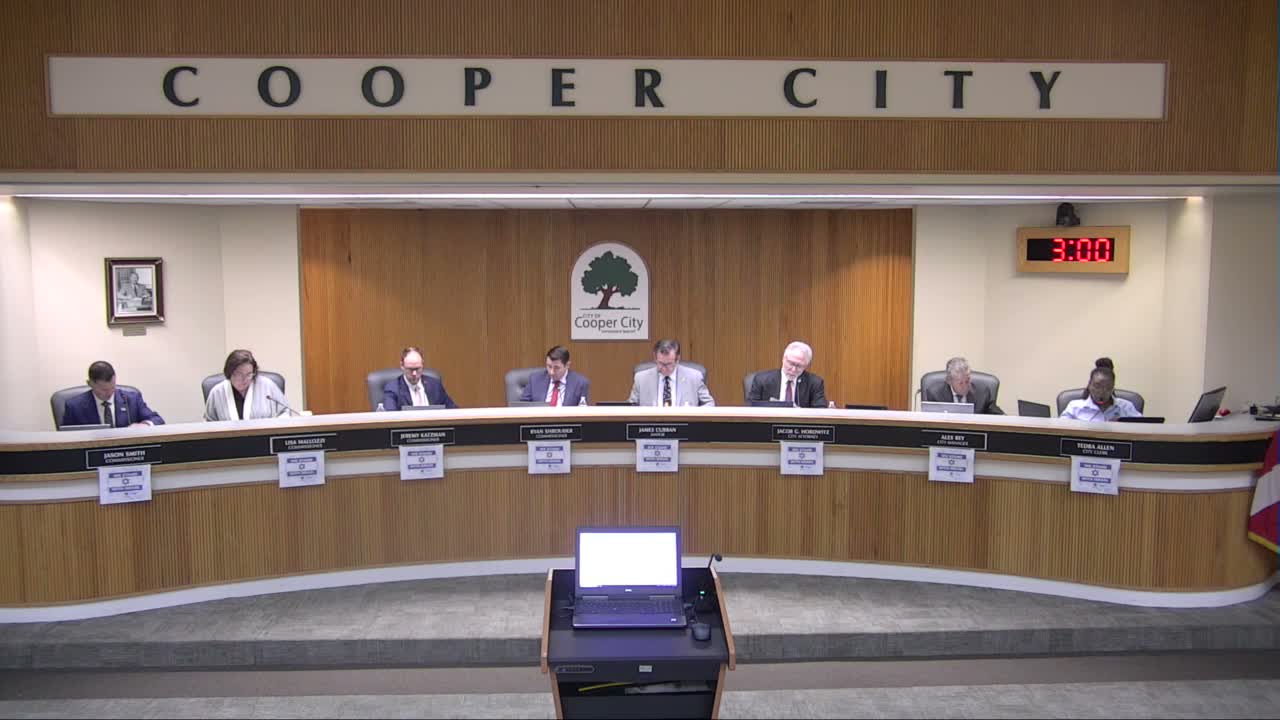
Cooper City advances micro‑mobility ordinance after hours of debate on youth safety, sidewalk speeds and education program
Loading...
Summary
The commission approved first reading of a new micro‑mobility ordinance after extended debate over age limits, sidewalk speed thresholds, fines and a proposed youth safety class. A Cooper City student who proposed a teen e‑bike course addressed the commission before the vote.
The Cooper City Commission on first reading approved an ordinance to regulate e‑bikes and e‑scooters after lengthy discussion about age restrictions, sidewalk speeds, enforcement and a proposed safety course for teens.
The ordinance, introduced as ordinance 26‑02, would create a new micro‑mobility section in the city's traffic and public‑safety codes, define device classes and set citation options and penalties. Commissioners and staff spent more than an hour debating whether to keep a 16‑year age limit in the draft, how fast devices may travel on sidewalks, how to require yielding to pedestrians and how to make rules enforceable in practice.
Why it matters: e‑bikes and micro‑mobility devices are increasingly common in Cooper City, and the commission aimed to balance rider convenience with pedestrian safety and police enforceability. The discussion also produced cross‑agency cooperation proposals, including partnering with Broward Sheriff’s Office and local advisory boards on education.
Student JT Floyd, representing Cooper City’s civics program, urged the commission to fund a formal safety course. “My proposal is for Cooper City to partner with Broward Sheriff’s Office, Fire Rescue, the Public Safety Advisory Board, and the Education Advisory Board to offer an e‑bike and e‑scooter safety course for teens,” JT Floyd said during public comment, urging training on helmet use, road rules and defensive riding.
Commissioners removed the explicit 16‑year age restriction in favor of guidance that emphasizes education and discretion, and debated a sidewalk speed cap. After discussion about crash risk and roadway visibility, several commissioners favored lowering sidewalk speeds; enforcement officers warned that very high sidewalk limits could make loss of control more likely. A ″reckless operation″ standard was proposed as a catch‑all for conduct officers can cite without speed radar.
The commission also discussed fines and alternatives that could encourage education. One commissioner proposed a lower first‑offense fine with an option to attend a safety class in lieu of a larger ticket. Staff said the ordinance can delegate implementation mechanics to management so that citation diversion or educational programs can be developed administratively.
What’s next: The ordinance passed first reading and will return for second reading after staff and legal refine the language to reflect the commission’s direction on speeds, pedestrian yielding, enforcement language and an education framework.