Get Full Government Meeting Transcripts, Videos, & Alerts Forever!
Get email alerts on the Planning Process topic
No spam. Unsubscribe anytime.
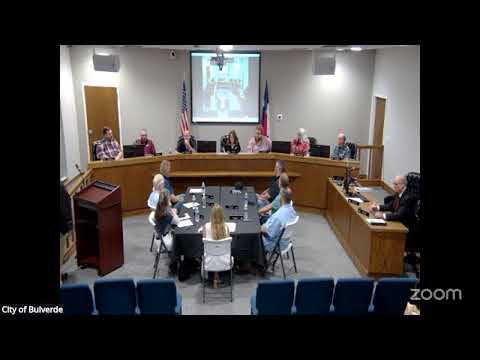
Bulverde council and planning commission hold workshop on variances, PDDs, and coordination amid fast growth
Summary
A joint Bulverde City Council and Planning & Zoning Commission workshop focused on aligning P&Z recommendations with council expectations, tightening variance and PDD procedures, pre‑application guidance for developers, and infrastructure pressures as the city grows.
City of Bulverde council members and the Planning & Zoning Commission convened a lengthy joint workshop Tuesday to discuss how the two bodies can better coordinate reviews of development applications, clarify variance standards, and respond to infrastructure pressures as the city grows.
Council members said they want planning and zoning recommendations that fully test proposals against the city’s comprehensive plan and anticipated impacts. Francesca Watson, introduced to the group during roll call, urged commissioners to place applications in the larger context of the comprehensive plan rather than treating each request as a single, isolated case.
Commissioners and councilors discussed the legal standard for variances, including the requirement to make affirmative findings that a variance is necessary because strict application of the ordinance would cause undue hardship and would not harm public health, safety or welfare. Several participants emphasized drainage and downstream impacts as recurring concerns when evaluating variances.
A recurring topic was the use of Planned Development District (PDD) applications that bundle multiple variances, which some commissioners said can obscure specific requests and complicate public review. One council member described the trade‑off: requiring separate, fully specified variance requests can add cost and complexity for developers but gives the city clearer, more precise material to evaluate. The group discussed refining application checklists and offering early, informal guidance to applicants so they can avoid expensive missteps.
Participants also focused on practical steps to improve coordination: providing clearer written rationales from P&Z when items go to council (to explain how the commission reached its recommendation), using follow‑up emails to summarize key P&Z deliberations for council members, making some council members available to watch P&Z meetings without creating quorum risks, and asking staff to provide more targeted packets so councilors can review complex items in advance.
Speakers flagged broader infrastructure concerns tied to growth—water supply, aging power distribution, TxDOT project timelines, road maintenance costs driven by heavier traffic—and urged closer coordination with regional providers and agencies. One participant captured the tenor of the discussion: “We’re not a small town anymore,” a statement used in the meeting to underline the need for more formal coordination with utilities and regional partners.
The workshop did not adopt ordinance changes but resulted in several next steps: staff will draft clearer application materials and guidance for variance/PDD submissions, council asked staff to place a future agenda item to discuss preferred forms of P&Z reporting, and officials agreed to hold follow‑up joint sessions (quarterly was suggested) to continue refining procedures.
What’s next: Staff will return with proposed procedural clarifications for variance and PDD submittals; council and P&Z will test options for written P&Z explanations to accompany recommendations to council; and staff will track infrastructure coordination needs and report back at subsequent workshops.