Get Full Government Meeting Transcripts, Videos, & Alerts Forever!
Get email alerts on the School Construction Bond Package topic
No spam. Unsubscribe anytime.
Richland-Bean Blossom board reviews $40 million bond package, debates big performing-arts build versus classrooms and maintenance
Summary
Richland-Bean Blossom C S C held a work session to weigh two construction options, bond timing and maintenance priorities. Staff presented a roughly $50–$53.5 million program that would fund performing‑arts additions, athletic upgrades, roofs and HVAC; trustees asked for revised scenarios that shift dollars toward classrooms and critical maintenance.
Unidentified Speaker 1 opened a recorded work session saying the goal was to review potential construction projects, bonding options and implementation and to seek guidance rather than take votes: "Nothing will be voted on tonight, but just give us a road map of where we go from here." (Unidentified Speaker 1)
Misha of Landshare Associates led the board through two design options for the high school performing-arts area. Option 1 would add a large east-side band and choir addition with mezzanine practice rooms, storage and new classrooms; Option 2 would convert existing band and choir space into smaller lab/classroom uses and provide fewer new classrooms. "So I'll go through a few visuals of what some of the additions and projects might look like," Misha said while describing circulation, storage and a possible second-story observation deck.
Why it matters: the two options have different trade-offs for instructional space, construction cost and future flexibility. Consultants from Skillman and financial adviser Matt (Stifel) provided line-item estimates and financing scenarios so the board could weigh programmatic priorities against available bond balances.
Key facts and figures presented - Skillman consultants estimated a combined project range of roughly $50 million to $53.5 million for the package shown to trustees; the performing‑arts addition alone was presented at about $11.4 million for the high school and roughly $6.5 million for junior-high components (combined references in presentation materials put the two at about $18 million). Staff also showed an alternate option that would convert lab/choir space for roughly $2.6 million in renovations rather than a full addition. - Athletic upgrades include turfing and substantial outbuildings (press box, concessions, locker/toilet rooms); Skillman said a $2 million discrepancy in the baseball/softball estimate was driven by those outbuildings rather than the playing surface. - Roofs and paving: a membrane-roof package was estimated at about $10 million for membrane roofs on campus; separate contractor figures for standing seam overlay were flagged as potentially high and to be reexamined. Paving repairs were shown at about $1.4 million. - Mechanical systems: a full temperature-control replacement at the high school was estimated near $1,000,000; boiler replacements and controls were flagged as additional mechanical needs, and staff proposed contingency allowances (Skillman used ~20% on late items). - Funding and bond balances: the district has two open general‑obligation bond series (2022 and 2024); staff said the 2022 bond has "a little over $3,600,000" remaining and that certain items (two buses) are already encumbered from bond proceeds. An older construction bond (2010) carried about $262,773 in remaining funds. - Program timing and bid windows: staff recommended pursuing bleacher replacement and some roofing work in months with more favorable contractor availability and pricing; the board heard that April can be a competitive month for certain work (e.g., bleachers) and that bid/timing decisions affect estimated costs.
Board questions and trade-offs Trustees pressed consultants for options that would shift money from an outsized performing-arts footprint into additional classrooms, HVAC and roof work. Several board members said the arts program is valuable but questioned whether tripling or quadrupling current band/choir square footage best served the district’s immediate instructional needs. One trustee framed the central trade-off this way: the proposed package adds limited net classroom capacity while devoting a large share of dollars to performing-arts facilities.
Staff responded that Option 2 (renovation) would yield more modest classroom additions (fewer new classrooms) and lower cost, while Option 1 (new addition) provides a larger, more durable performing-arts facility and additional support spaces. Consultants also noted that biomedical training labs — tied to outside partners and to a roughly $500,000 grant referenced in the discussion — carry a $2,000,000 spend requirement for eligibility, a condition that factored into whether the district should scale that component back.
Financing posture and next steps Matt from Stifel said the board could borrow the full $40 million without immediately increasing the district’s debt-service levy under current assumptions, but he urged trustees to consider phasing (for example, borrowing in two tranches) to avoid paying interest on unspent proceeds and to preserve borrowing capacity. He explained practical arbitrage considerations (a typical two‑year spend‑down rule for arbitrage tracking) and how projected interest-rate moves would affect capacity and costs.
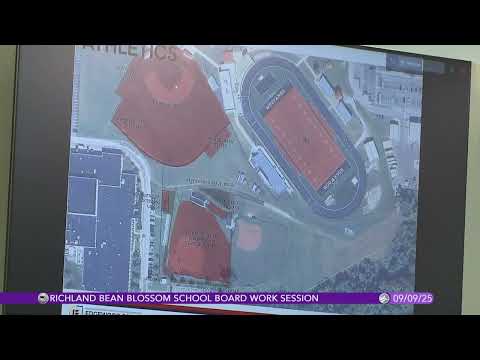
What the board directed staff to do next Trustees did not make formal motions or votes but asked staff and consultants for follow-up work: produce revised scope-and-cost scenarios that reduce the performing-arts footprint and reallocate some dollars toward classrooms, HVAC and roofs; provide clearer options for turfing and athletics that separate playing-surface costs from outbuilding costs; firm up quotes for bleacher replacement (an urgent safety item); and prepare community-facing materials showing the proposed additions so residents can review prior to any final bond resolution.
Closing and timing Staff and consultants said design and bid phases would start if the board signals which options to prioritize; roofing and other summer-season work could be bid in the winter/early spring window so construction could occur in summer months. The board signaled general interest in pursuing bonding for major work but asked staff to return with revised cost scenarios within roughly 30 days and with more detailed public presentation materials.
Direct quotes from the meeting (attributed to speakers as recorded) "Nothing will be voted on tonight, but just give us a road map of where we go from here." — Unidentified Speaker 1 "So I'll go through a few visuals of what some of the additions and projects might look like." — Misha, Landshare Associates
Ending: The work session ended with a consensus to refine options and pricing rather than a decision to proceed. Staff will return with revised scenarios that prioritize classroom and critical-maintenance needs and with materials for a public briefing before the board considers a bond resolution.