Get Full Government Meeting Transcripts, Videos, & Alerts Forever!
Get email alerts on the Water Infrastructure topic
No spam. Unsubscribe anytime.
Council delays Texas Water Company pump‑station decision, orders alternatives analysis
Summary
After residents raised concerns about height, noise and flooding, Bulverde council postponed consideration of a Texas Water Company special‑use permit for a booster pump station and directed the company to submit an alternatives and operations memorandum evaluating site options, lower‑height configurations and neighborhood compatibility.
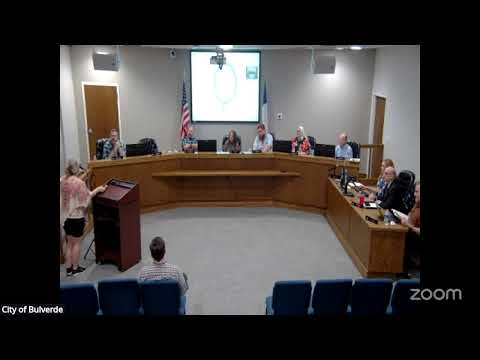
Bulverde — Council members postponed action on a proposed booster pump station and ground storage tank and ordered the applicant to provide a written alternatives and operations memorandum before the matter returns.
Texas Water Company and its engineering team presented the project as a necessary operational improvement to bring additional surface water (largely from Canyon Lake) into the western portion of the system, citing redundancy and pressure needs. The company said it had revised the proposal to address visual and noise concerns — offering an 8‑foot concrete screen wall, enclosure for pumps and generators, and a single 500,000‑gallon tank limited to prescribed height limits.
Nearby residents objected to the proposed location and scale, saying a previously proposed 50‑foot tank would dominate the neighborhood and lower property values. They also raised concerns about increased impervious cover and a recent change in local drainage patterns they attributed to earlier construction. One resident said the initially proposed large tanks would look "like a five‑story building" from his house; company engineers said the reduced height and building enclosure would mitigate visual and noise impacts.
A councilmember moved to postpone the item and required the applicant to submit an alternatives and operations memorandum at least 10 days before the next council meeting. The memorandum must evaluate multiple technically feasible sites within the service pressure zone, analyze lower‑height configurations, demonstrate compliance with Texas administrative code site and separation requirements, and compare neighborhood compatibility (height, lighting, fencing, noise and construction access/duration).
Staff and council framed the request as an informational step intended to produce data for a future decision rather than to preclude the project. The applicant signaled readiness to prepare the requested material and to work with staff on design changes that could reduce neighborhood impacts.