
State Corporation Commission orders new GS‑5 rate class for large data‑center customers, sets 85% minimum charges and 14‑year contracts
Get AI-powered insights, summaries, and transcripts
Subscribe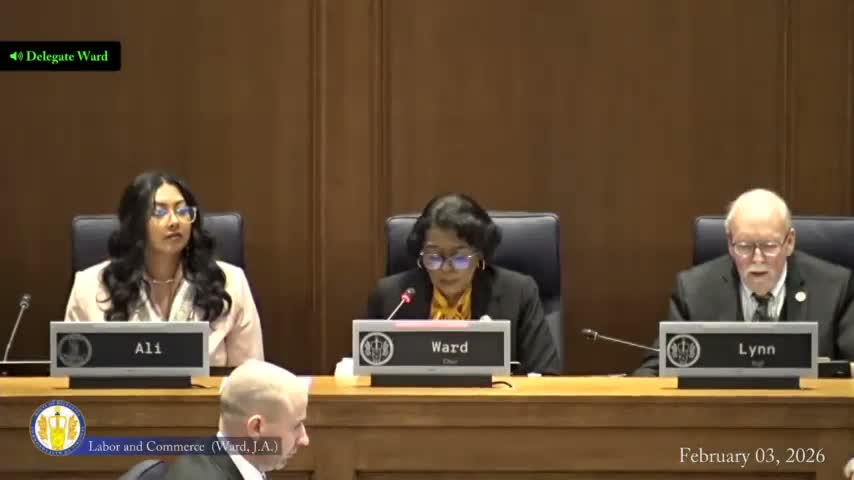
Summary
The State Corporation Commission told the House Labor and Commerce Committee it will create a new GS‑5 rate class for large load customers beginning Jan. 1, 2027, require minimum monthly payments equal to at least 85% of assigned transmission and distribution costs, and impose 14‑year contract and collateral rules for new customers.
Brian Pratt, deputy director at the State Corporation Commission, told the House Committee on Labor and Commerce that the commission's final order in Dominion Energy's 2025 biannual review (case PUR-225-00058) creates a new rate class to ensure large load customers pay costs they cause. "The GS 5 rate class will include all new or existing customers that meet or exceed certain capacity and energy usage thresholds," Pratt said.
The commission adopted several measures aimed at minimizing cost shifting from large users such as hyperscale data centers. Pratt said the SCC will require those customers to "pay at least 85% of the transmission and distribution cost incurred to serve them each month regardless of their actual electricity consumption." The order also establishes contract and collateral expectations for new large customers: new customers taking service on or after 01/01/2027 will generally be required to contract for at least 14 years and, if they lack sufficient credit, may need to guarantee funds upfront to cover "up to 60% of their minimum charges over the life of their 14 year contract." Pratt said existing customers who began service before 01/01/2016 are exempt from those minimum charges.
Pratt described how the commission applied the traditional ratemaking principle of cost causation and noted robust public participation in the proceeding: the commission received hundreds of written comments spanning more than 2,700 pages, heard testimony from 27 public witnesses and considered 15 direct case participants during a nine‑day evidentiary hearing.
The SCC told the committee the GS‑5 rate class is aimed at customers with about 25 megawatts of demand and a load factor of roughly 75% or greater. Pratt described the 85% requirement as a floor: if a customer uses the full contracted demand in a month, the customer would pay the full cost of service; the minimum charge is intended to prevent months when contracted capacity is underutilized from shifting disproportionate costs to other ratepayers.
Committee members asked detailed follow‑up questions. Delegate Singh asked whether the 85% minimum includes all transmission components (overhead, underground, substations); Pratt answered that the floor applies to the transmission and distribution costs assigned to that customer class and described how PJM and FERC allocation processes assign portions of transmission project costs to Dominion and then to its customers. Delegate Shen asked about the residual up to 15% and whether it could be shifted to other ratepayers; Pratt acknowledged that could occur in some instances and repeated that the 85% is a safeguard floor, not an absolute cap on cost recovery.
Members also raised concerns about customer protections and changing technology over long contract terms. In response to a question about how a 14‑year obligation protects ratepayers if demand or technology changes, Pratt pointed to minimum charges and exit fees that could be imposed on customers that terminate contracts prematurely to recover contract costs.
The commission directed Dominion to submit alternative cost allocation proposals in future proceedings (generation allocation proposals in the 2027 biannual review and transmission allocation proposals in its next transmission rider proceeding) and to file the process it uses to interconnect large load customers for SCC review; Dominion submitted the interconnection filing to the SCC the day before this committee hearing.
The SCC presentation and committee exchange also touched on other rate elements that will affect residential customers. During questioning, a committee member cited projected residential bill increases (an $11.24 monthly increase this year and an additional $2.36 next year) and asked about the commission's authorized return on equity. An SCC staff member said the commission set ROE at 9.8% based on the record and expert witness recommendations.
The committee thanked SCC staff for the overview before moving on to subcommittee reports. The SCC presentation does not itself change law; the commission's order and the directed follow‑up filings will guide regulatory proceedings that affect how costs are allocated and recovered.