
Committee backs substitute to curb data-center generator pollution and requires newer permits to meet stricter standards
Get AI-powered insights, summaries, and transcripts
Subscribe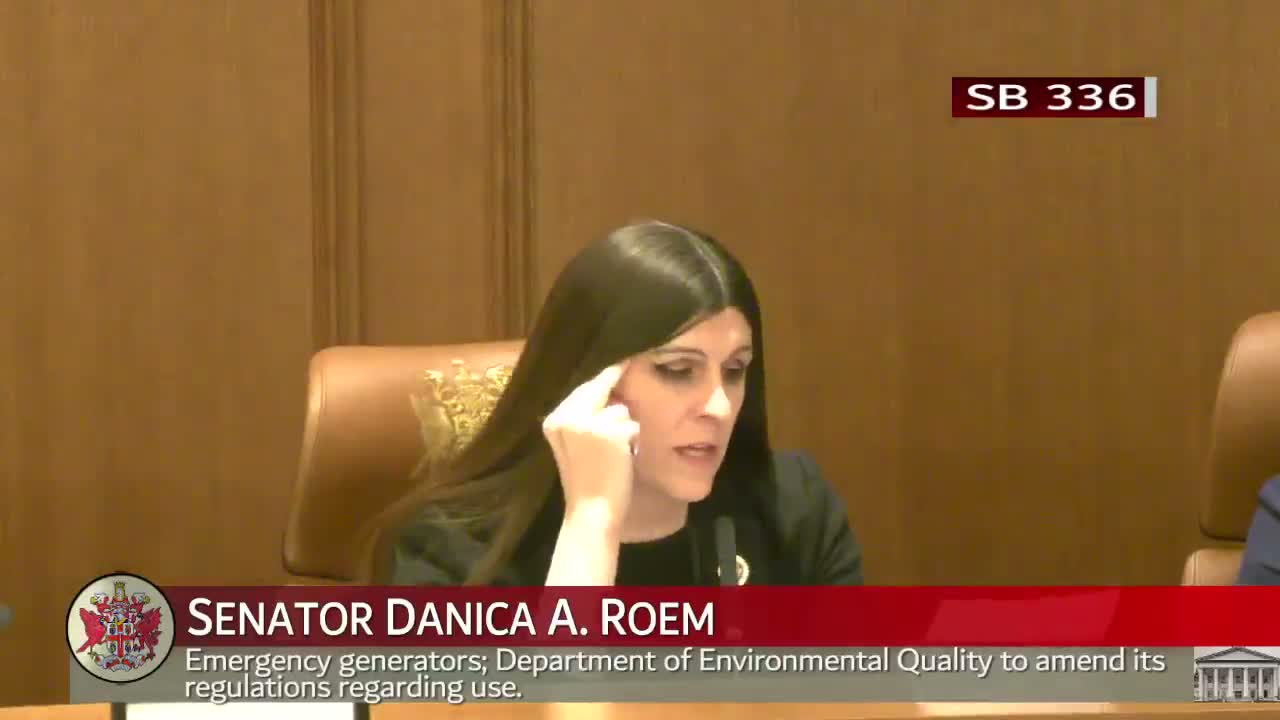
Summary
Sen. Roem'026 offered a substitute limiting use of Tier 2 generators to sudden, unforeseeable outages and phasing in retrofits toward Tier 4-equivalent emissions. DEQ officials told the committee Tier 4-equivalent systems can cut pollutant emissions by roughly 90%. Committee adopted a technical amendment to require site plans approved after July 1, 2026, to use Tier 4 or equivalent.
A committee substitute proposed by Senator Roem would limit the use of lower-specification "Tier 2" diesel generators at data centers to sudden and unforeseeable outage events and require a phased retrofit so that data-center generator fleets approach Tier 4-equivalent emissions.
"If you have a planned outage event ... we don't want that [black] plume happening on any regular basis," Roem said, describing a local incident and arguing for a five-year retrofit trajectory for existing facilities. Roem and other members framed the substitute as a targeted way to reduce localized pollution from clustered data-center sites.
Stephen Rolband (Director, DEQ) provided technical context: DEQ told the committee Tier 4-equivalent controls can reduce pollutants by roughly 90% relative to Tier 2 on average, but retrofits cost money and often require additional site planning because the equipment footprint can be larger. He also noted many data-center minor air permits are effectively long-lived and that the substitute's phased retrofit is technically feasible but requires funding and planning.
Committee members debated whether to limit the measure to data centers or to broader categories (hospitals, prisons, etc.). Advocates said the data-center industry is unusually concentrated in Northern Virginia and that the density creates concentrated emissions and trucking impacts; opponents cautioned about singling out one industry for retrofits when other generator users exist.
To provide clarity for future development, the committee added an amendment to require that any data-center site plans not yet approved by a locality by July 1, 2026, must include Tier 4 or Tier 4-equivalent generators. The committee voted to report the substitute as amended and send it to the Senate Finance Committee for further consideration, and asked staff to work on implementing language and fiscal implications.
The committee's action does not immediately change existing permits that are already constructed and operating; members and DEQ staff noted enforcement and retrofitting timelines would be part of the Finance committee and agency review.
The bill now moves to Senate Finance with an amendment addressing new site plans and with a request for technical and fiscal analyses from DEQ.