Get Full Government Meeting Transcripts, Videos, & Alerts Forever!
Get email alerts on the Grid Reliability topic
No spam. Unsubscribe anytime.
Energy subcommittee presses FERC on grid reliability, data centers and permitting
Summary
An opening statement to a House Energy subcommittee hearing urged the Federal Energy Regulatory Commission to prioritize grid reliability amid rising utility bills, flagged data centers as both a challenge and potential stabilizer, and praised recent FERC steps on permitting while calling for continued focus.
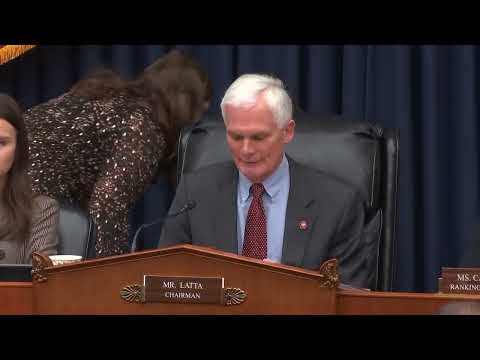
Unidentified Speaker opened a House Energy subcommittee hearing with all five Federal Energy Regulatory Commission commissioners, urging FERC to prioritize its economic regulatory mission to keep electricity, natural gas and oil delivered safely, securely and at reasonable prices. "Our grid is under extreme stress," the speaker said, noting the head of the North American Electric Reliability Corporation had called the situation a "5 alarm fire."
The speaker pointed to recent increases in consumer costs, saying average utility bills rose "11% in 2025 after increasing by 29% in the 4 years prior," and cited a Department of Energy finding that the pace of baseload retirements and load growth could raise the risk of blackouts "by 100 times" by 2030. Those figures were offered as the core rationale for sharper regulatory focus.
Discussing causes, the speaker argued decades of federal and state policy choices shifted investment away from traditional baseload resources toward connecting variable remote wind and solar resources, and said transmission and distribution spending to integrate those resources has been a major upward pressure on costs. The opening statement also said state retail rate cases show transmission development tied to state energy policies, interest rates, and wildfire/disaster mitigation have contributed to price pressures.
On market responses, the speaker noted that higher wholesale prices "should act as a signal for new entrants" but said permitting delays, litigation and some state policies are preventing pipeline construction and slowing market fixes. Framing the issue in geopolitical terms, the speaker invoked the AI competition and asked rhetorically whether Americans "want your family's personal banking or health information stored in communist China?" and argued that growing U.S. data center capacity is tied to national competitiveness.
While warning of possible rate impacts from rapid data-center development, the speaker also said large energy users such as data centers and manufacturers "can help stabilize the grid and make electricity more affordable" if integrated properly. As evidence of administrative action, the opening statement said FERC in 2025 has moved to a more methodical approach for permitting interstate natural gas pipelines and LNG facilities and is working to streamline hydropower licensing to preserve baseload resources.
The speaker also said the commission has advanced work on jurisdictional lines between federal and state authority over colocation and flexible power arrangements and cited ongoing collaboration with the National Association of Regulatory Utility Commissioners to improve federal-state dialogue. The opening concluded that while progress has been made, "more work remains," called the hearing a "pivotal opportunity" to evaluate FERC's role, and yielded back the balance of the speaker's time.