House subcommittee opens markup on five bills to bolster energy grid security and DOE authorities
Loading...
Summary
A House Energy and Commerce subcommittee opened markup on a package of five bills aimed at strengthening physical and cybersecurity protections for the electric grid, expanding Department of Energy emergency leadership, and providing targeted support for small and municipal utilities; no votes are recorded in the provided transcript.
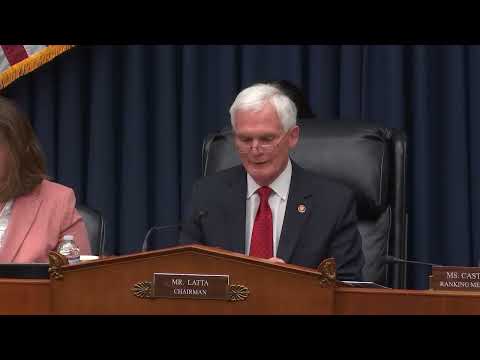
An unidentified representative opened a subcommittee markup announcing the committee will consider five bills intended to update and enhance programs to protect the nation’s electric grid and to strengthen the Department of Energy’s emergency and security authorities. “We will mark up 5 bills that will update and enhance programs to help ensure the physical and cybersecurity of our nation's electric grid,” the speaker said.
The package, described as largely bipartisan in parts, includes measures to improve threat analysis and information sharing, elevate DOE's energy emergency leadership, provide targeted funding and technical assistance to smaller utilities, increase state visibility into local distribution and supply-chain risks, and establish coordination programs for pipeline cybersecurity. “A key ingredient of this program involves two-way sharing of information between grid operators and the intelligence community,” the speaker said, describing one bill as the Energy Threat Analysis Center Act, which would authorize a program to improve coordination on threat analyses affecting the power sector.
Among the bills described, the speaker summarized a measure to require that energy emergency and security functions at DOE be led by an assistant secretary confirmed by the Senate, saying the change would “ensure the department has the focus and accountable leadership that will strengthen intergovernmental and energy sector collaboration.” Another proposal described in the remarks would provide targeted funding and technical assistance so that small utilities, electric cooperatives, and public power agencies — including systems serving military installations — have resources to secure critical systems.
The speaker also highlighted legislation said to build on state energy security plans to expand visibility of potential threats to local electric distribution and supply-chain networks, and a separate bill intended to establish a nonregulatory program improving coordination and assistance across the energy sector, states, and federal government for pipeline and oil-and-gas facility security and resilience.
The opening statement framed the markup against “growing threats to our energy systems,” including “advanced threats from our adversaries.” In a direct quote the speaker said, “communist China remains the most active and persistent threat to American critical infrastructure networks,” a comment the transcript records without immediate rebuttal or response in the provided excerpt.
The transcript provided no formal motions, votes, amendments, or recorded outcomes. The speaker concluded by yielding to the representative from Florida's 14th District for an opening statement, and the markup proceeded from that point in the full hearing record.
The committee’s descriptions in the transcript emphasize improved information sharing, elevation of leadership roles at DOE, targeted assistance to smaller and municipal utilities, greater state-federal coordination, and programs addressing pipeline cybersecurity. The transcript excerpts supplied here do not include bill text, fiscal notes, or committee amendments; those details would be needed to assess implementation, funding, or legal effects.