
Maine committee hears bill to ease disability-retirement rules, raise earnings limit and change offsets
Get AI-powered insights, summaries, and transcripts
Sign Up Free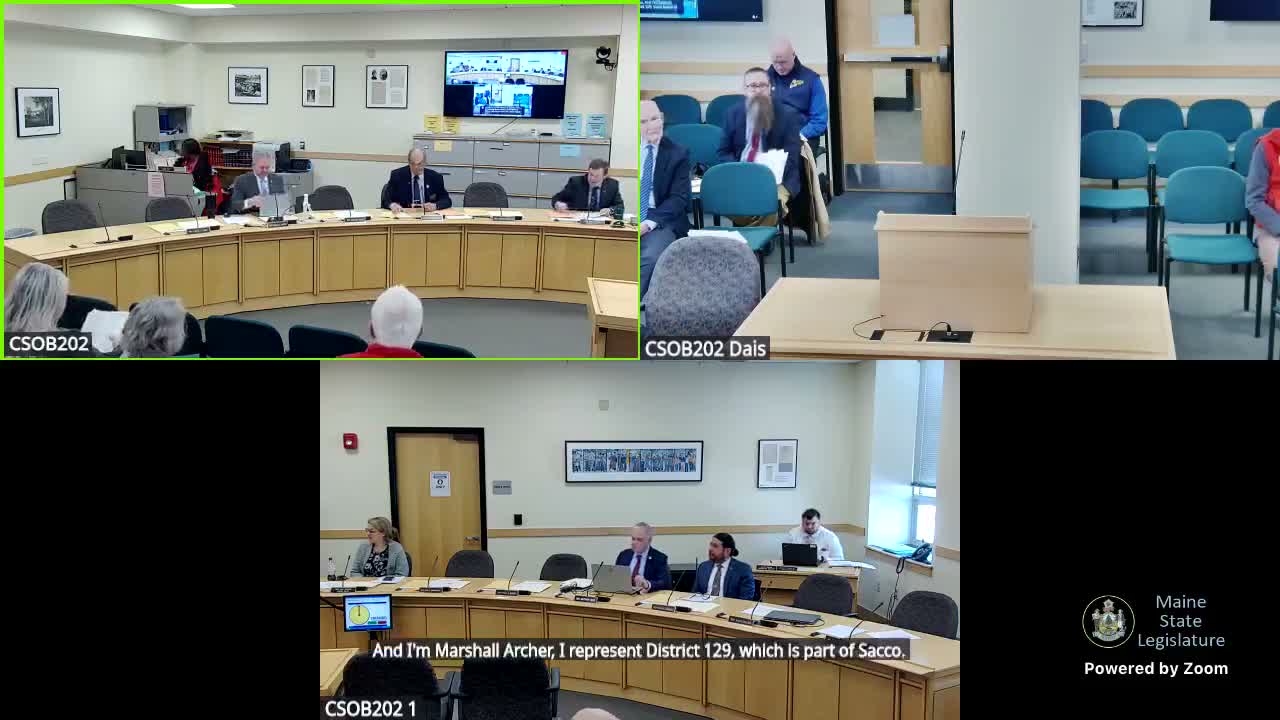
Summary
The Joint Standing Committee on Labor held a public hearing on LD 2169, a MainePERS-sponsored bill that raises the threshold for substantially gainful activity, shifts overpayment recoupment to prospective reductions with a waiver option, and aligns formulas across plans; supporters called it humane and pro-work, while disabled retirees urged repeal of workers' compensation offsets and stronger safeguards against premature termination of benefits.
Senator Mike Tipping presented LD 2169 at a public hearing of the Joint Standing Committee on Labor, describing it as a package of statutory changes to Maine’s disability retirement program that would simplify earnings limits, raise the threshold for substantially gainful activity and modify how overpayments are handled.
Maine Public Employees Retirement System (MainePERS) witness Bill Brown told the committee MainePERS supports the bill and emphasized it would "improve the public employee's disability retirement program by modifying provisions controlling the reduction of benefits and clarifying terminology." Brown said the bill raises the substantially gainful activity amount from 80 percent of average final compensation to 100 percent of the highest of AFC or $35,500 in 2026, adjusted annually by CPI-U, and replaces retroactive recoupment with a waivable, prorated reduction of benefits for the year in which over-earnings occur.
Why it matters: disability retirement provides income to public employees who can no longer work because of a disability. LD 2169 aims to reduce disincentives to return to work while protecting program solvency. MainePERS told the committee the changes would not create an unfunded actuarial liability requiring immediate funding, though some provisions would increase ongoing costs.
Supporters at the hearing argued the changes would be more humane for recipients and encourage return to work. William Lobenstein, president of the Maine Association of Retirees, said the prospective approach "makes it easier for those people receiving benefits." Beth White of the Maine Service Employees Association said the bill would "remove disincentives for returning to work, especially in state service while on disability retirement." Michael Scott of the Professional Firefighters of Maine urged support so first responders who must leave service early can "live with dignity."
Opponents focused on the workers' compensation offset and on how MainePERS staff determine that a retiree is "no longer disabled." Jeanette Crossman read testimony from a retired firefighter, Mark Evers, who urged the committee to repeal the workers' compensation offset and restore benefits for current retirees. Sue Hawes testified that "LD 21 69 fails" because, she said, it would ‘‘entrench harmful substantial gainful activity decision making’’ and permit terminations or reductions based on minimal earnings or perceived job availability rather than demonstrated capacity.
Members asked detailed questions about definitions and implementation. Committee members sought clarification on the distinction between final annual compensation and substantially gainful activity, asked whether police and other covered groups are affected, and pressed MainePERS on the process for waivers and rulemaking. Brown said waiver standards and administrative procedures would be set through rulemaking and that the CEO of MainePERS would have discretion to grant waivers in specified cases.
Quantitative specifics and clarifications discussed in the hearing include: the current statutory disability benefit is 59 percent of a member’s average final compensation; the bill proposes raising the substantially gainful activity threshold from 80 percent to 100 percent or $35,500 (in 2026) adjusted by CPI-U; the bill would change PLD calculations from AAE to AFC; and any waiver process would be created by rule with CEO discretion.
The committee closed the public hearing and moved into work sessions on related retirement bills. The hearing generated both support for the modernization MainePERS proposes and strong opposition calling for repeal of the workers' compensation offset and statutory guardrails to limit eligibility reviews that rely on earnings or inferred job capacity.
The committee did not take a final substantive vote on LD 2169 during the public hearing; members indicated additional rulemaking and drafting will follow in work sessions.
What comes next: the committee will consider draft amendments and rulemaking language in future work sessions, where lawmakers will weigh fiscal impacts and stakeholder proposals for statutory language addressing vocational assessments, waiver criteria and how any changes would apply to current disabled retirees.