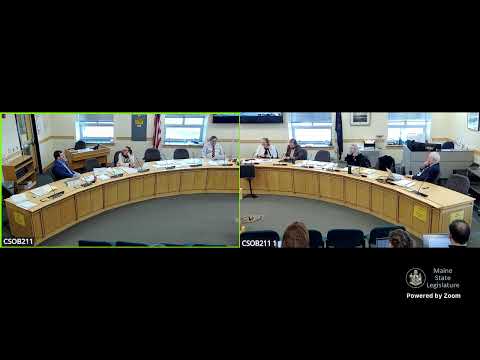
Maine committee advances changes shifting energy office duties to Department of Energy Resources; committee votes on recommendation
Loading...
Summary
The Energy Utilities & Technology Committee reviewed LD 2153, a bill to transfer duties from the governor's energy office to the Department of Energy Resources (DOER), debated confidentiality of procurement materials and the timing of statutory agency review, and voted on a motion not to pass as amended.
The Energy Utilities & Technology Committee spent its meeting reviewing LD 2153, which transfers responsibilities from the governor's energy office to the Department of Energy Resources and makes multiple technical and substantive statutory changes.
Committee analyst Lindsay Laxon told members the bill is divided into Part A (technical replacements of the former office name) and Part B (substantive changes). Laxon said Part B would add DOER to agencies subject to the State Government Evaluation Act, allow unspent general fund balances to carry forward, shift certain duties from the Public Utilities Commission (PUC) to the commissioner of energy resources (including some rulemaking and aspects of the carbon dioxide cap-and-trade program), expand the definition of "primary storage facility" to cover facilities receiving petroleum by rail or truck, and broaden reporting on shortfalls in petroleum product supplies.
Committee members focused on two notable items: procurement confidentiality and the timing of the first full evaluation of DOER under the State Government Evaluation Act (GEA). Laxon flagged that the bill would strike language saying procurement proposals and negotiation materials "may not be disclosed," and suggested an explicit exception that would permit DOER to share materials with the PUC as necessary for the PUC to approve negotiated contracts. Laxon also offered statutory text to allow DOER to make limited information public at the conclusion of a solicitation, such as the identity of the bidder awarded a contract and a bid price.
Caroline Floren of DOER said the department's intent is consistent with current PUC practice and "at the conclusion of a procurement to make public, consistent with what the PUC does now on procurements, the winner, and the winning price." Floren said DOER's Assistant Attorney General had advised that the existing statute likely would not prevent disclosing the winner and price, but that clarifying language would be helpful.
Members also questioned a provision that directs DOER to review the status of hydropower projects on the Saint Croix River by Jan. 1, 2028 and every five years thereafter. Floren said the review obligation had moved between agencies over time and that "no one has conducted that analysis since it was created going back to 2012," so assigning it to an existing legislative committee would restore a periodic oversight report.
On oversight timing, Representative Chris Kessler urged the committee to require an earlier GEA review than the bill's default 2033 date, suggesting a review in the next one-to-two years. After discussion about typical eight-year cycles and the committee's desire for meaningful timing, Kessler moved "not to pass as amended," proposing an earlier review date and including DOER's clarification language on confidentiality. Representative Valley Geiger seconded the motion.
Following a brief caucus, the committee conducted a roll-call vote. The transcript records the roll call as: Representative Ronte yes; Representative McIntyre no; Representative Geiger yes; Representative Foster no; Representative Kessler yes; Representative Sachs yes; Senator Lawrence yes; Senator Harrington yes; Representative Paul no; Representative Webb yes; Representative Wadsworth no. The transcript notes seven votes in favor and four opposed. The transcript does not record an explicit final committee recommendation phrase beyond the roll-call tally in the hearing record.
What happens next: the committee took a short recess and moved on to other agenda items. If the bill advances formally, the reviser's office will print the language and the measure would proceed to a public hearing in the committee.
Sources: Committee hearing transcript; analyst bill summary and DOER comments recorded during the work session. Ending: The committee paused for caucus and transitioned to consideration of LD 1949.