Get Full Government Meeting Transcripts, Videos, & Alerts Forever!
Get email alerts on the Impact Fees topic
No spam. Unsubscribe anytime.
Boerne council adopts impact‑fee change to include state‑mandated water conservation credits
Summary
Council adopted ordinance 2025‑20 to add mandatory language required by the state (Senate Bill 14) offering impact‑fee credits to developers who implement qualifying water‑conservation or reuse measures; staff said the change does not expand existing local incentives.
City staff presented and the council adopted an amendment to the city’s impact‑fee ordinance (Ordinance No. 2025‑20) on Dec. 9, adding language required by a state law to offer impact‑fee credits for water and wastewater conservation and reuse.
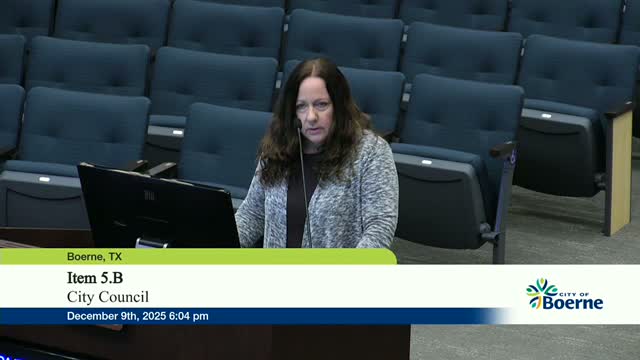
Andrea, a city staff presenter identified by first name in the transcript, told the council the revisions are required by a recent legislative action and must be in place by Jan. 1. “The State mandate requires us to include language in our impact fee ordinance that offers impact fee credits for water and wastewater to developers for conservation efforts,” Andrea said. She said the city already offers conservation credits under its current impact‑fee structure (for example, smaller water meters and irrigation‑only meters) and that the amendment adds the required statutory language rather than increasing incentives.
The presentation cited a recently passed state measure, referenced in the staff presentation as “Senate Bill 14,” which added a section to the impact‑fee chapter of the Texas Local Government Code requiring political subdivisions to offer credits when builders implement qualifying systems that reduce water demand or wastewater flows. Staff said the statute provides limited guidance on measurement and calculation of credits and that the primary intent is to encourage conservation.
A councilor asked whether the change expands incentives; Andrea replied it does not. Following the presentation the council moved to approve the ordinance via a one‑time reading and voted 5–0 to adopt Ordinance No. 2025‑20.
Ending: The ordinance will be in place to meet the state deadline; staff noted they will continue to implement the city's impact‑fee chart and processes for determining meter sizes and existing conservation incentives.