
Committee advances bill raising clerk reimbursement rate, adopts amendment on fee redirects
Get AI-powered insights, summaries, and transcripts
Subscribe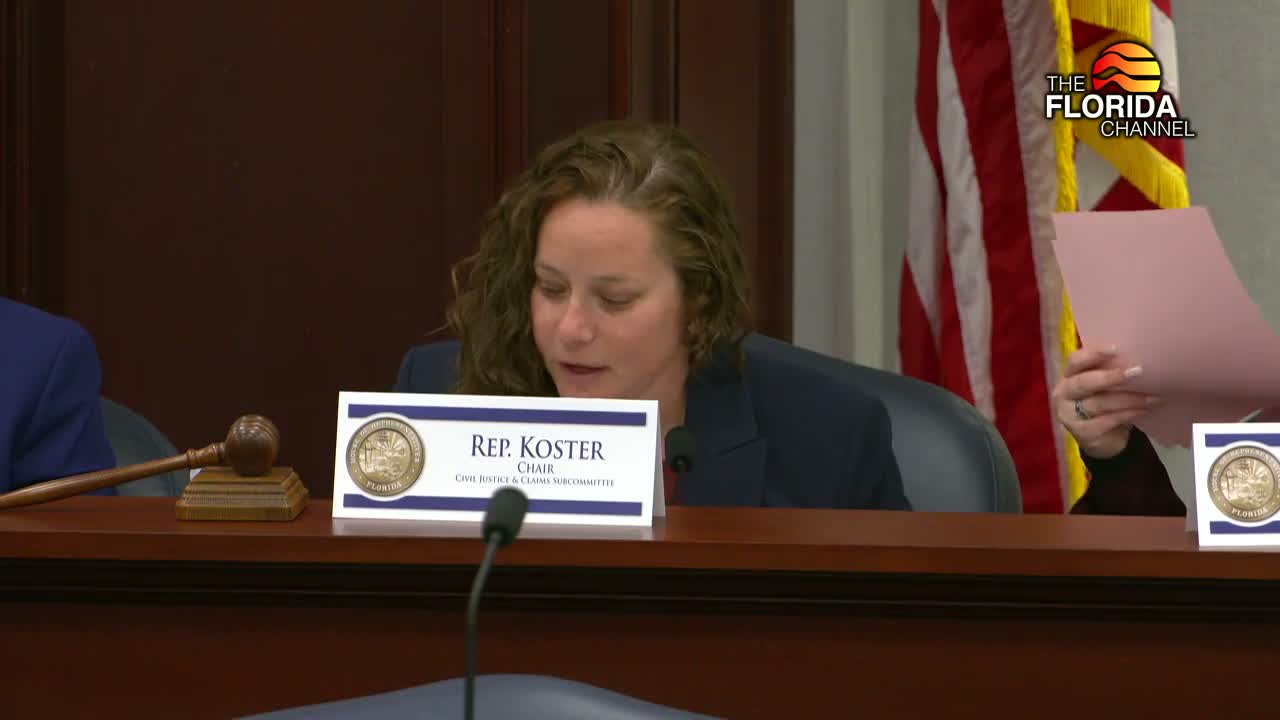
Summary
The Civil Justice and Claims Subcommittee voted to report HB 925 favorably as amended. Sponsor Rep. Tribulski said the bill raises statutory reimbursements to $195 and adds approved civil indigency applications to requests; an adopted amendment removed redirects to general revenue and addressed fee-waiver language.
Representative Tribulski told the Civil Justice and Claims Subcommittee HB 925 would increase the statutory reimbursement rate for clerks to $195 and allow approved civil indigency applications to be included in reimbursement requests, saying clerks have not received a rate adjustment for unfunded fees since 2004. "This bill increases the statutory reimbursement rate to a $195 per partition and adds approved civil indigency application to the same reimbursement request," the sponsor said.
The committee considered amendment barcode 201779, which the chair described as a strike‑all that removes redirects of fees to general revenue and resolves a fee‑waiver single‑subject issue. Tribulski and committee members discussed the civil citation handling and how the amendment addresses both redirects and waivers. Sam Wagner of the Florida League of Cities, appearing for informational purposes, flagged municipal revenue impacts and cited a REC score estimating about $8,200,000 in year‑one fiscal effect for cities.
After brief debate and public waivers from multiple clerks (including Olivia Vero, Doug Chorvat and Tara Green), the committee adopted the amendment and voted on the bill as amended. Zoe called the roll and the committee reported HB 925 favorably as amended by a vote of 16 yeas, 0 nays. The action moves the measure to its next committee stop, as amended.
The bill text raises the reimbursement rate and clarifies which civil indigency applications may be reimbursed; the amendment removes redirects to general revenue and resolves the fee‑waiver drafting concern. The committee did not specify additional fiscal implementation steps in the hearing; members asked staff and the sponsor to continue clarifying municipal impacts before later stages.