Get Full Government Meeting Transcripts, Videos, & Alerts Forever!
Get email alerts on the Active Transportation Prioritization topic
No spam. Unsubscribe anytime.
Denton mobility staff outline data-driven sidewalk and bike‑lane prioritization
Summary
City staff presented a three-step prioritization plan that will score and rank sidewalk and bicycle projects using six criteria — safety, equity, accessibility, connectivity, trip potential and multimodality — with a scored project list due mid‑2026 and implementation planned over 2–6 years.
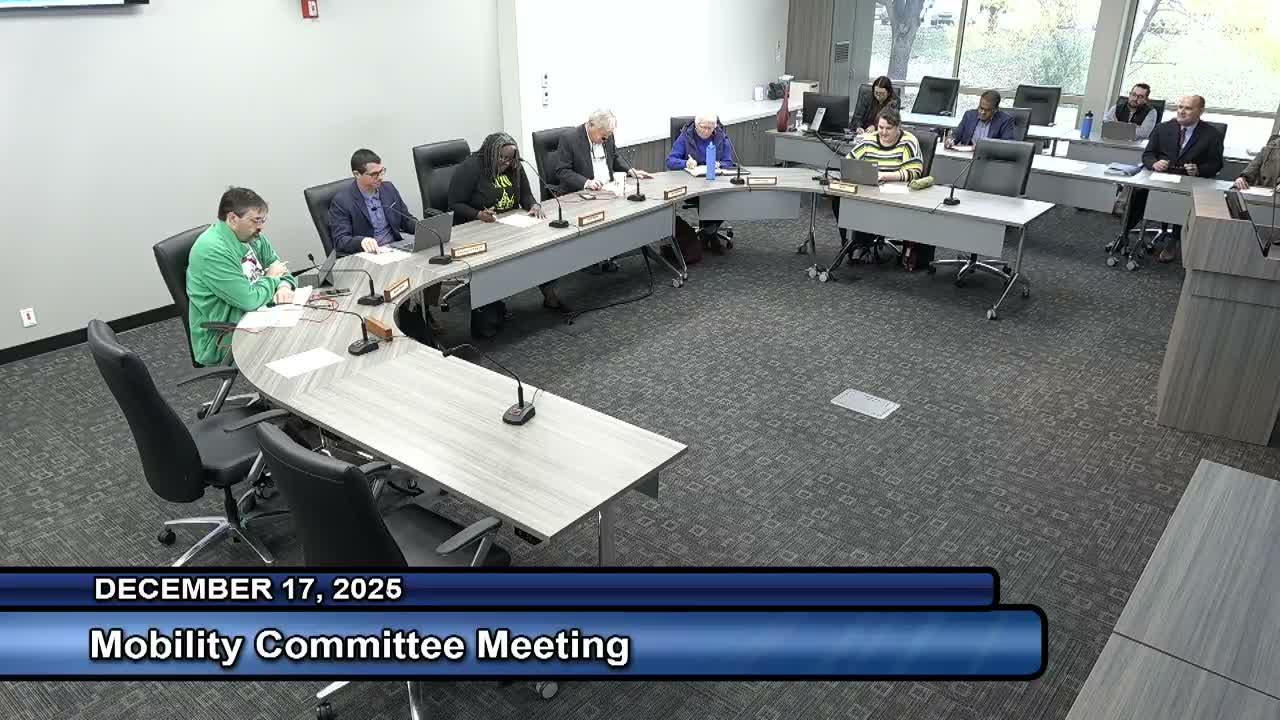
Denton Mobility Committee members heard staff present a data-driven approach on Dec. 17 to prioritize sidewalks and bike lanes across the city.
Roya Etemenani, senior planner for bicycle, pedestrian and ADA programs, told the committee the study uses a three-step method: develop standardized scoring criteria, gather community input to refine and finalize the criteria, and implement the highest-ranked projects. "This study intends to enhance the mobility, accessibility, and equity throughout the city of Denton," Etemenani said.
Etemenani reported staff counts of existing infrastructure as part of the presentation (spoken during the meeting as "around 90 miles of bike lanes" and "around 4 70 miles of sidewalks") and said audits found roughly "35% of these sidewalks are considered with poor, very poor condition," a finding staff said creates accessibility barriers for people with disabilities. The proposed scoring framework includes six criteria: safety, equity, accessibility, connectivity, trip potential and multimodality.
Staff described the data sources they will use to support safety scoring. Farhan, deputy director of transportation services, said formal crash records will come from the CRIS crash database and a newly purchased local crash-reporting system; police and emergency-response reports will also be used. "Denton 311 would be an option" for residents to report missing sidewalks or gaps, Farhan said, and staff said public engagement will capture informal incidents and perceptions that do not appear in crash databases.
Committee members asked for clarifications on how condition indices and inventory counts are calculated. Staff confirmed a sidewalk work-plan layer serves as an operational condition index (OCI) for sidewalks and agreed to provide the committee with the underlying documentation or links showing how the layers and counts are computed. Staff also agreed to follow up with detailed breakout numbers for construction versus developer-installed segments.
Etemenani said staff expect to finalize criteria and scoring by mid‑2026, produce a prioritized and scored project list, and then phase implementation of the highest-priority projects over the following two to six years, with monitoring and adjustments as conditions change. The prioritization outputs will include a priority‑map dashboard, network gap maps and a ranked list of projects intended to guide investment decisions.
The committee did not take an additional formal vote on the prioritization study during the meeting; the presentation was received and staff will return with more detailed documentation and the public‑engagement plan.