Get AI Briefings, Transcripts & Alerts on Local & National Government Meetings — Forever.
Denton council approves Craver Ranch master-plan items after lengthy public hearing
Loading...
Summary
After hours of public testimony and debate, the Denton City Council approved a package of zoning, mobility and municipal-management-district agreements to allow a 2,500-acre Craver Ranch master-planned community, with council split over timing, infrastructure and policy implications.
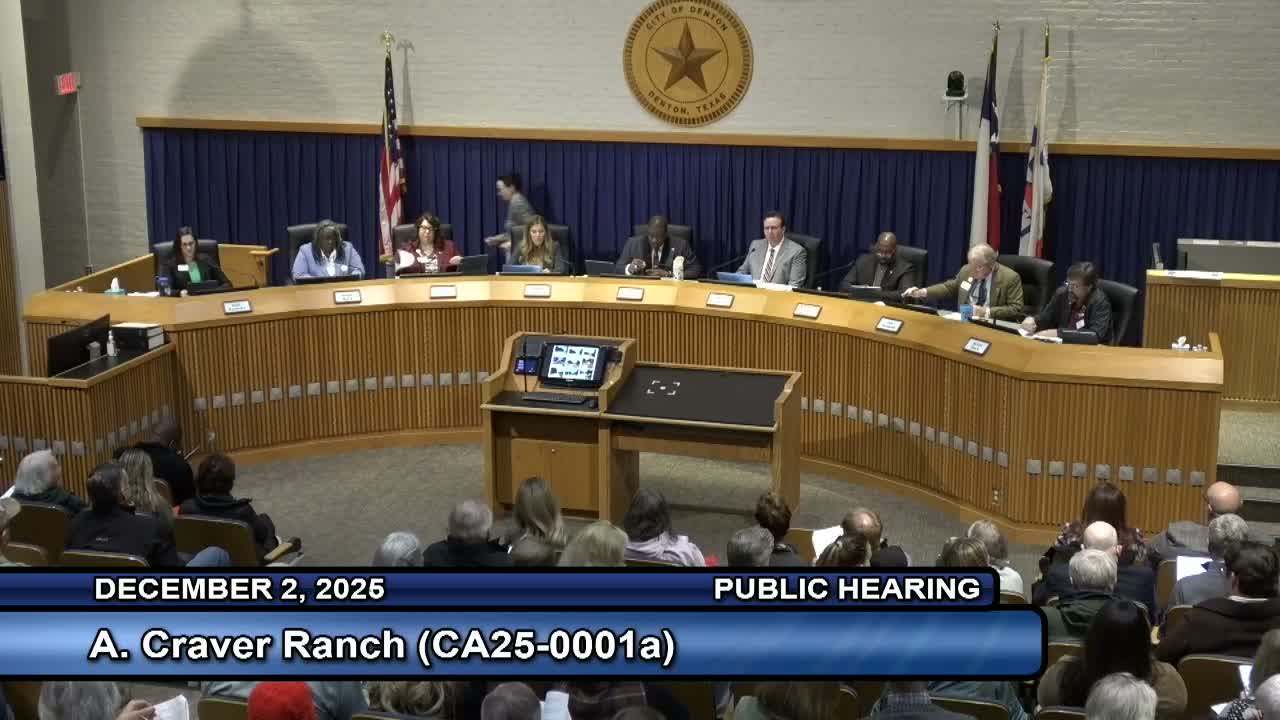
DENTON, Texas — The Denton City Council on Dec. 2 approved a set of ordinances and agreements that clear the way for a 2,500-acre master-planned community known as Craver Ranch, including a comprehensive-plan amendment, a mobility-plan realignment and a Planned Development rezoning. The developer and its municipal management district (MMD) say the project would deliver roads, water and sewer, 13.5 miles of trail and about 350 acres of parks, while financing roughly $462 million in public infrastructure.
Staff and the applicant told the council the proposal includes a mix of housing types, about 1.2 million square feet of commercial space and land for Denton and Sanger independent school districts. Mia Hines, the city’s senior planner, said staff recommended approval after evaluating the proposal against the city’s criteria and planning studies. “The master plan community future land use designation is a category that denotes large-scale developments that are guided by separate development approvals,” Hines said during the presentation (staff presentation: SEG 4660–4699).
Developer counsel Alexa Knight said the team has staged studies and community outreach under the municipal management district framework. She described a central shared park of roughly 340 acres and said the district would fund infrastructure so the city would not have to upfront the full construction cost. “This is a well-appointed plan — heavy on green space — and self-funded infrastructure with the MMD,” Knight said in opening remarks (applicant presentation: SEG 4900–4960).
Neighbors and property owners opposed the changes during an extended public hearing, citing concerns about traffic on FM 2153 and FM 2164, impacts to aquifers and floodplains, the timing of TxDOT’s Outer Loop environmental study, and lack of neighborhood notice. Multiple speakers asked the council to delay action until the draft environmental study for the proposed regional loop is complete and until the city’s next comprehensive-plan update can consider long-term growth scenarios (public comment highlights: SEG 5340–5790 and many others).
Council debate centered on two lines of concern: whether the scale and location constitute “leapfrog” growth that undermines the city’s preferred compact-growth goals in the Denton 2040 plan, and whether the fiscal analysis sufficiently captures long-term replacement and maintenance costs. City staff said the developer would construct major on-site infrastructure and dedicate right-of-way for necessary off-site facilities; the city would maintain roads and utility lines after they are turned over. Staff also noted the developer’s commitments for affordable housing funds and land for public safety and public works facilities (staff summary: SEG 8800–8860).
Council voted on the three items individually. The comprehensive-plan amendment motion passed 5–2; the mobility-plan realignment passed 6–1; and the rezoning to Planned Development passed 5–2. Council members who opposed the measures expressed concern about fiscal risk, infrastructure timing and community input; supporters cited housing supply needs, the developer’s public facilities commitments and the MMD financing model.
What happens next: the project proceeds into the city’s engineering, permitting and phase-by-phase traffic-impact analysis processes. The applicant estimated earliest site construction for Phase 1 at roughly three years out to allow engineering, permitting and coordination with TxDOT and other agencies (applicant timeline: SEG 8090–8096). The council required standard development review for each phase and noted that staff will return to address implementation details and monitoring as the project advances.
The council’s action represents a policy shift on the city’s future land use map in a high-profile location and drew strong neighborhood turnout and lengthy testimony; several citizens urged caution and asked that the city delay until after the Outer Loop environmental study and the next comprehensive-plan update.