Get Full Government Meeting Transcripts, Videos, & Alerts Forever!
Get email alerts on the Housing Adus topic
No spam. Unsubscribe anytime.
Denton tightens ADU rules after contentious debate, keeps first unit by right and requires SUP for any second unit
Summary
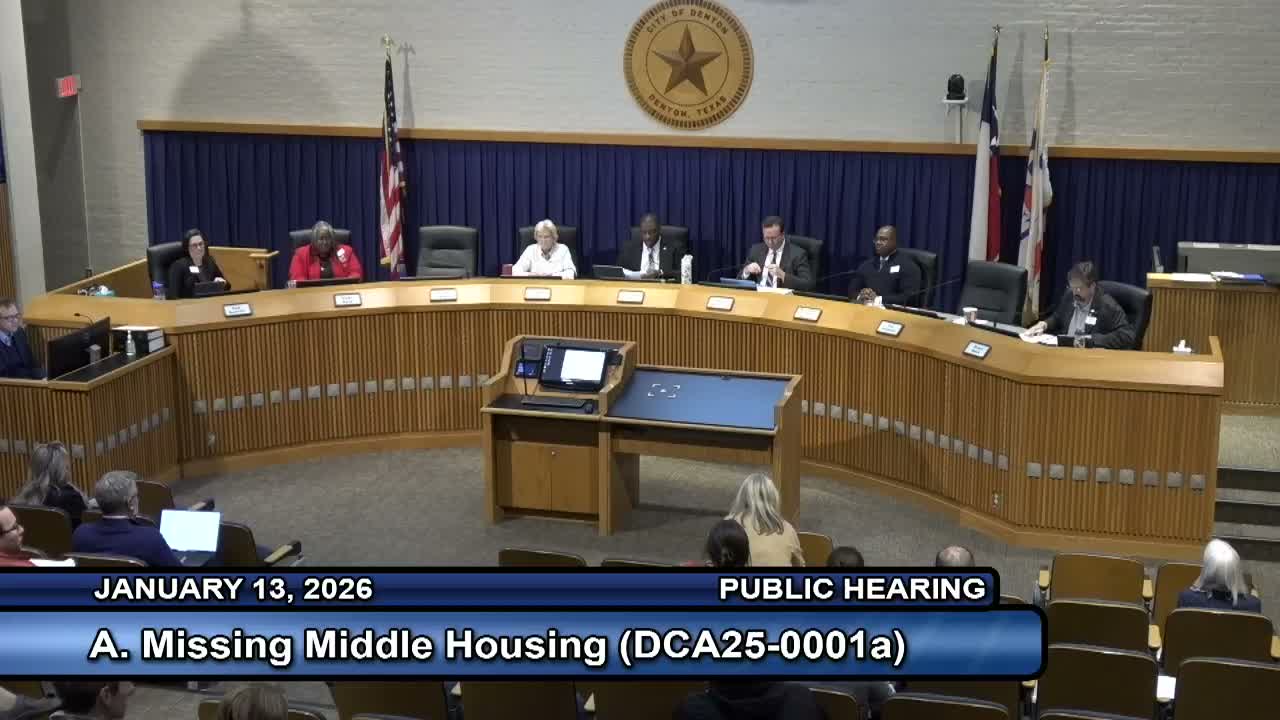
Council approved amendments to allow more ADUs and townhome flexibility while deciding that any second accessory dwelling unit on a lot must go through a special‑use permit (SUP); the vote followed hours of public comment and a 6–1 council vote on the SUP requirement.
Denton City Council adopted revisions to the city’s development code that aim to expand "missing middle" housing options — enabling accessory dwelling units (ADUs) and loosening some townhome rules — and simultaneously added a new procedural control: any second ADU on a lot must be reviewed through a special‑use permit process.
Julie Wyatt, planning staff, told the council the package clarifies townhome lot‑size rules in mixed‑use districts, removes a confusing maximum‑units formula that discouraged townhomes, and refocuses open‑space requirements so larger projects provide usable areas. "A thousand‑square‑foot lot minimum is more appropriate for our mixed‑use districts," Wyatt said, citing downtown precedents and walkability goals.
Angie Manglerus, assistant planning director, explained the ADU changes: ADUs would be allowed accessory to single‑family homes, townhomes, duplexes and triplexes; a single ADU per lot remains permitted by right; maximum ADU size will use a single, clearer standard; and minimum parking requirements for ADUs are removed while ensuring required parking for the primary residence is not lost. Manglerus said the intent is to "remove known barriers to entry" for homeowners who want to add modest rental or family housing.
The proposal won unanimous support from the Planning & Zoning Commission but drew a sharp public debate at the council dais. Supporters — small developers, tenants and housing advocates — said ADUs increase affordable options without the scale impacts of large apartment complexes. "We have a housing crisis," speaker Isaiah Heck told council. Multiple commenters called for pre‑approved ADU designs and faster permitting to keep costs down.
Opponents — largely residents of older, close‑in neighborhoods — warned about privacy, stormwater, parking and neighborhood character. Several displayed photos of recent backyard conversions and urged notice and safeguards. Resident Lenny McAdams said narrower streets in many older neighborhoods make additional on‑street parking a safety risk.
Council members debated compromise language. Several members supported a limited test period with heightened review; Councilmember McGee argued the public has a right to notice and recommended requiring public review for second units. After amendment and discussion, council kept the single ADU‑by‑right standard and voted 6–1 to require a special‑use permit (SUP) for any second ADU on a lot citywide. The SUP requires public notice and review by Planning & Zoning and the council.
Council and staff agreed to revisit the procedural rule if it inhibits the ordinance’s housing goals. Staff will prepare administrative guidance on how the SUP review will work, estimated timelines (staff said an SUP path typically takes 2–4 months and a reduced SUP for ADUs carries a $601 fee), and options such as pre‑approved ADU plans to reduce cost and delay.
The ordinance also leaves other proposed technical changes intact: reduced townhome minimum lot sizes in mixed‑use districts, clarified building coverage allowances, and an exemption from the small open‑space dedication for projects under 3 acres or within a half‑mile of public parkland.
Council’s final action preserves the right of property owners to add one ADU without special council review while introducing neighborhood notice and public review when a property seeks to add a second unit.