Get AI Briefings, Transcripts & Alerts on Local & National Government Meetings — Forever.
Committee advances bill to extend TRIGGER tax credit for New Mexico firms to work with national labs
Loading...
Summary
The House Commerce & Economic Development committee voted 9–1 to pass House Bill 82, which extends and gradually expands the TRIGGER technology‑readiness gross receipts tax credit to help New Mexico small businesses partner with Sandia and Los Alamos National Laboratories and speed commercialization of lab innovations.
The House Commerce & Economic Development Committee voted 9–1 to pass House Bill 82, a measure to extend and incrementally expand the technology‑readiness gross receipts tax credit known as TRIGGER so smaller New Mexico companies can access expertise and facilities at Sandia and Los Alamos national laboratories.
The bill’s sponsor told the committee that HB82 “extends and expands the tax credit that helps New Mexico businesses access the technology expertise and facilities at our national labs, including Sandia and Los Alamos,” and said the change would give firms greater certainty and “gradually expand the annual cap so more companies can participate over time.”
Supporters said the credit lowers the cost barrier for startups and small businesses to test ideas with national‑lab partners. Nora Sackett, director of the Technology and Innovation Office at the New Mexico Economic Development Department, said TRIGGER is “a unique tool that we use frequently to support New Mexico businesses commercializing New Mexico innovation,” and the department strongly supports extending and increasing the program’s annual caps. Kyle Gwen, co‑founder and CEO of Fast Vision, said his company hired eight people after receiving a TRIGGER award.
Labor representatives provided technical background. Candace Siebenvall of Los Alamos National Laboratory and David Kiston of Sandia National Laboratories were on the panel to answer questions about lab capacity and program mechanics.
Committee members probed a backlog created under the current $1 million annual cap and asked whether the bill would simply increase demand. Sponsors said HB82 raises the cap incrementally over four years and keeps reporting requirements so the Legislature can track outcomes.
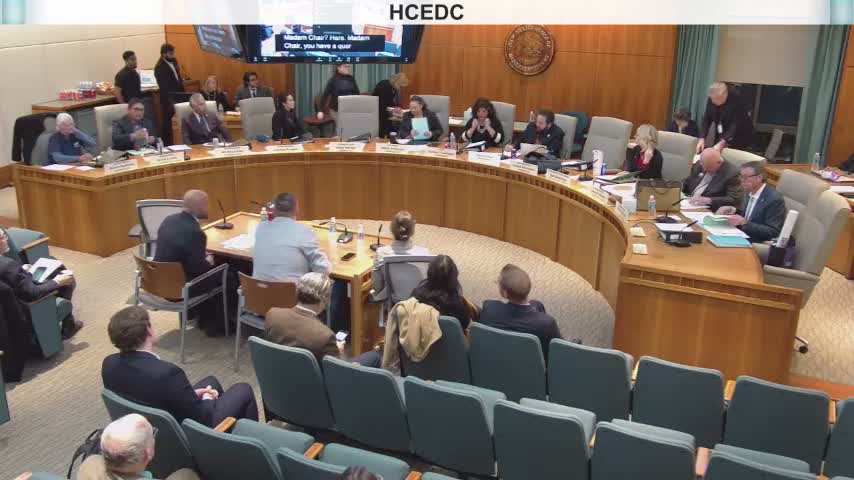
Representative De La Cruz moved passage of the bill; a roll‑call vote recorded nine members in favor and one opposed. The committee’s clerks stated the final tally as 9 yes, 1 no; the bill will advance from committee.
What’s next: HB82 will move to the next floor or committee calendar step as set by House leadership. The committee noted that lab and Economic Development Department staff stood ready to provide additional data if requested.