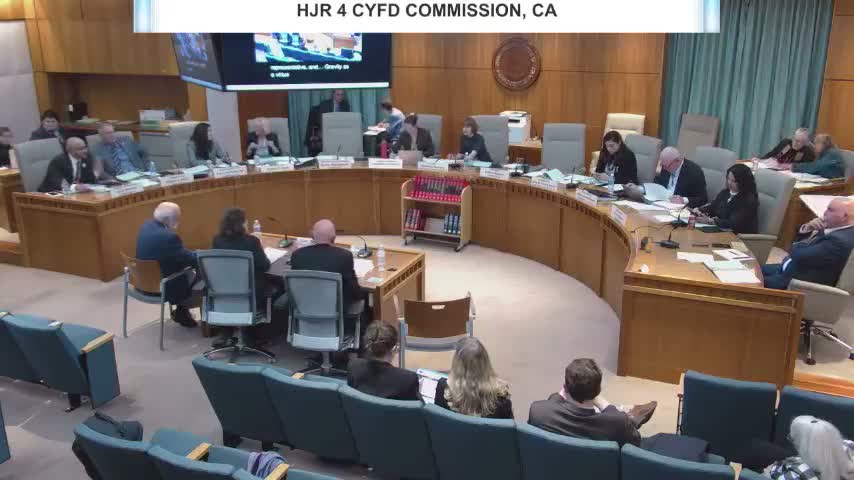
House panel wrestles with constitutional amendment to create independent CYFD commission amid tribal, accountability and timing concerns
Loading...
Summary
Sponsors proposed HJR4 to create a three‑member commission to oversee the Children, Youth and Families Department in response to persistent systemic failures. Proponents argued it would bring stability; opponents raised concerns about embedding governance in the constitution without enabling legislation, tribal co‑governance, removal mechanisms and accountability. The committee debated amendments, rejected a motion to table, and the sponsor agreed to roll the item for additional drafting (including a possible move to a 2028 ballot).
Representative Chavez introduced House Joint Resolution 4 proposing a constitutional amendment to create an independent commission to oversee CYFD. Sponsors said the change responds to long‑running failures documented in the Kevin S. litigation, recurring leadership turnover, and recent child‑protection crises; the proposed commission would have three members appointed by the governor, speaker of the House, and president pro tem of the Senate, serve staggered six‑year terms, and be staffed with child‑welfare experts.
Proponents and experts said a commission could provide continuity, professionalize leadership and preserve successful initiatives. Opponents—including Deputy Secretary Kathy Kunkel (CYFD) and Donna Lynn Lorenzo of Indigenous Family Solutions—argued that no state uses this governance model for child welfare successfully at scale, warned about embedding structural changes in the constitution without explicit enabling legislation, and said the proposal lacks explicit tribal co‑governance and equity safeguards required under the Indian Child Welfare Act and state law.
Members questioned who would initiate removal proceedings, how staggered terms would be set, whether members would be paid or part‑time, how existing federal and state child‑welfare initiatives would be preserved, and how the commission would interact with enabling statutes. Several members suggested delaying the ballot date to give the legislature time to pass enabling legislation; others stressed urgency to address ongoing harms to children. A motion to temporarily table the resolution was made and rejected in committee roll call.
After extended debate the sponsor agreed to roll HJR4 so staff and sponsors can refine enabling language, address tribal and removal questions, consider expanding membership and possibly move the ballot date to 2028 to allow more drafting time. No final committee recommendation was recorded; the item will return for further drafting.