
Committee gives due pass to school-restraint bill after hours of testimony on training, safety and rural concerns
Get AI-powered insights, summaries, and transcripts
Subscribe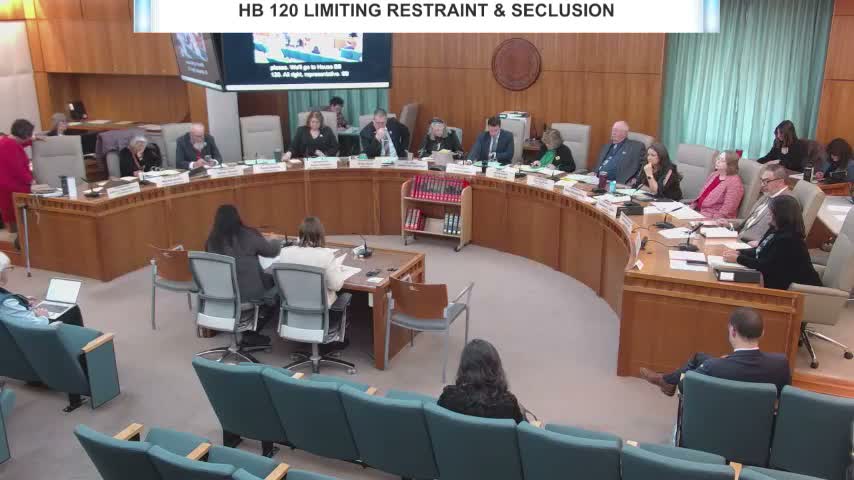
Summary
House Bill 120, which narrows when physical restraint and seclusion may be used in schools and mandates training, documentation and review, received extensive testimony from advocates and educators; the committee recorded a due pass by roll call (7–2–5). Supporters said the bill protects students and clarifies practice; opponents warned of unfunded mandates and risks for small or rural districts.
Representative Guarola introduced House Bill 120 as a measure to clarify restraint and seclusion rules, require trainings and consistent documentation, and prioritize prevention and de-escalation. Mary Andrews of the Legislative Education Study Committee said the bill incorporates recommendations from a working group organized by the Developmental Disabilities Council and references Senate Memorial 68.
Disability advocates and educators described repeated harms from restraint and seclusion. Laurel Nesbitt, an attorney with Disability Rights New Mexico, praised the bill’s reporting, documentation and review provisions and urged a due pass, while flagging a technical inconsistency in the fiscal-impact report: she said a three-day written documentation requirement in section H(2) is inconsistent with an existing rule and should be two days.
Supporters emphasized prevention and training. Amanda Parker of Future Focused Education said the bill limits physical restraint to cases of imminent danger only after less-restrictive interventions fail: “Physical restraint may be used only when a student poses an imminent danger and all other less restrictive interventions have failed,” she told the committee. AFT New Mexico and other unions urged the committee to pass the bill citing staff safety and the need for clear rules.
Opponents raised implementation and safety concerns. Evan Schutz of the New Mexico Coalition of Education Leaders said HB120, as drafted, would create an unfunded mandate and pose heavy burdens on districts with 1,000 students or fewer. Several committee members recounted violent incidents in which staff and security intervened and asked how the bill applies in large, rural or understaffed campuses where school resource officers may be unavailable.
Sponsors and supporters responded that the bill does not remove authority to act in imminent-danger situations and that it is meant to bring clarity and training that already exist in part in current law. The bill adds specificity—training minimums, documentation and mandatory review when restraint occurs more than once for a student—to reduce repeated use and ensure root causes are addressed.
A due-pass motion was made and, after a roll-call vote, the committee recorded a due pass for House Bill 120 by a vote of 7–2–5. The committee discussion made clear that negotiations on technical language, funding implications and cross-cutting legal rules are likely as the bill moves forward.