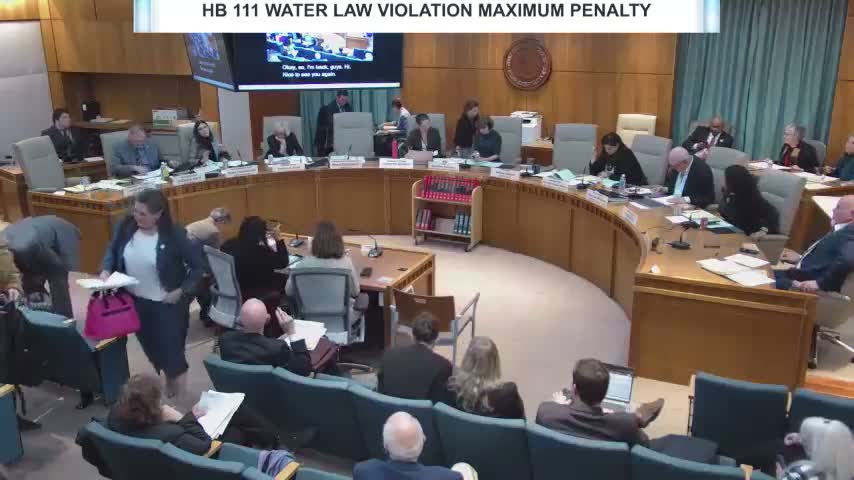
House panel backs tougher penalties for illegal water use, updating century‑old fines
Loading...
Summary
Lawmakers advanced HB111 to increase penalties for illegal water diversion, making fines accrue upon notice and setting penalties at twice the economic benefit or $25 per barrel (whichever is greater). The committee gave the bill a due‑pass recommendation after broad support from water districts, conservation groups and former state engineers.
House Bill 111 would modernize maximum penalties for water code violations that the sponsor described as using penalties written nearly 120 years ago. The bill increases civil penalties, allows penalties to begin accruing upon notice of violation (rather than waiting for a final compliance order), and sets a penalty for sale of illegally diverted water at twice the economic benefit or $25 per barrel, whichever is greater.
Stakeholders who spoke in favor included Jason Espinosa for the San Juan Water Commission, Anjali Bean of Western Resource Advocates (testifying for multiple conservation groups), John Thompson of the Middle Rio Grande Conservancy District and former State Engineer Mike Hammond. Testimony emphasized that existing penalties are not a deterrent, that illegal drilling and sale of water to oil, gas and certain cultivation operations are ongoing problems, and that the Office of the State Engineer needs stronger enforcement tools.
Committee members asked for examples of problem areas and the general counsel noted hotspots where illegal activity has become profitable. After public comment and questioning, Representative Hall moved for a committee recommendation of due pass. The roll call produced nine yes votes and the committee advanced HB111 out of committee with that recommendation.