
Committee advances $25 million starter‑home program to incentivize smaller builds
Get AI-powered insights, summaries, and transcripts
Subscribe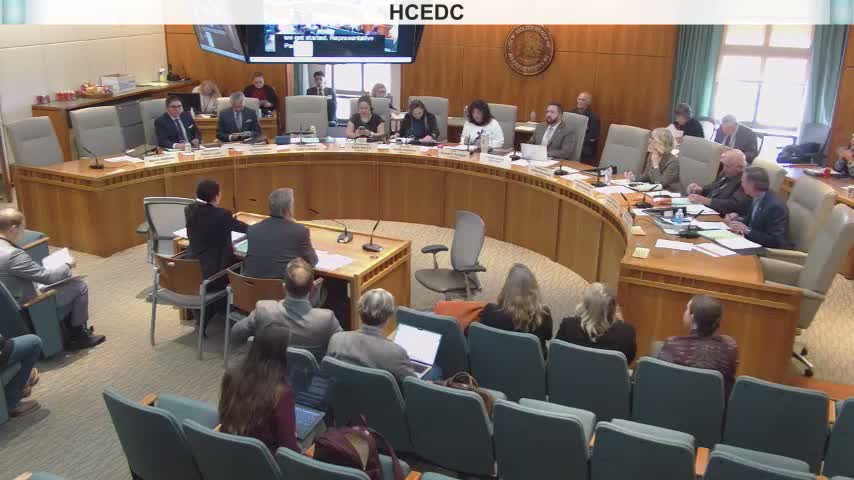
Summary
The House Commerce Committee voted 9–1 to give HB200 a due pass as amended; the bill would create a $25 million MFA‑administered fund providing 0% subordinate loans (estimated $50,000 per unit) to spur builders to produce smaller starter homes and recycle funds when homes are resold.
The House Commerce Committee advanced House Bill 200 on a 9–1 vote after testimony from builders, lenders and workforce advocates supporting the measure to increase construction of entry‑level homes.
Sponsor testimony and witnesses described HB200 as a $25 million appropriation—on top of $10 million already in the budget—that would provide zero‑interest subordinate loans to builders or buyers for smaller homes. Mike Loft, CEO of HomeWise, said the program would help "break that bottleneck in the housing spectrum" by encouraging production of smaller homes and freeing up rental units for others.
The bill sets technical eligibility limits for the homes: a maximum lot size of 5,000 square feet and a square‑footage threshold the sponsor discussed with the committee. Sponsor testimony and experts described the program as part of the capital stack for projects: "those $50,000 get... given at first to the home builder... that $50,000 gets recycled back into the fund," the sponsor told the committee. Loft added that historically fewer new homes have been built at typical entry‑level sizes, citing HomeWise figures showing a sharp decline in two‑ and three‑bedroom new builds.
Supporters included the New Mexico Home Builders Association, the New Mexico Chamber of Commerce, Abrazo Homes, the New Mexico Association of Realtors, Santa Fe Public Schools board member Sarah Bose, Albuquerque Health Care for the Homeless and the Department of Workforce Solutions Office of Housing. Miles Conway, CEO of the Home Builders Association, told the committee the industry backs an "all the above approach" to address an estimated 30,000 unit shortfall.
Committee members asked detailed questions about program design and outcomes. Representative Murphy pressed whether a $25 million appropriation would meaningfully address supply constraints, noting program math that a $50,000 assistance amount could yield about 500 homes: "will that really make much of a difference in terms of what we have as a deficiency in the state?" the representative asked. The sponsor and HomeWise said the fund is designed to be recycled—assistance may be assumable on resale if the new buyer qualifies—and that MFA would issue rules governing implementation and timelines for builders to complete projects.
Members also raised concerns about geographic equity and tribal uptake. Representative Lapton asked whether dollars would be targeted to rural or tribal areas; the HomeWise witness said HUD 184 and other mortgage products can facilitate financing on tribal lands but that the bill itself does not set a geographic allocation. Representative Mason asked about enforcement if a homeowner stopped occupying the home; HomeWise said a subordinate lien would be recorded and that occupying the house as a primary residence is a program requirement, with loan repayment due on sale or if the owner moves out.
The committee adopted a manager's amendment to clarify procurement language for MFA participation, noting MFA is a quasi‑governmental entity with its own procurement policies. After adopting the amendment and taking public testimony, an unidentified member moved for a due pass as amended; the motion was seconded and the committee clerk recorded the roll call as 9 yes and 1 no.
Next steps: HB200 received a due pass out of committee and will move to the House floor process as determined by legislative scheduling.