
Committee advances bill to standardize meter‑mounted solar devices after amendment fight
Get AI-powered insights, summaries, and transcripts
Subscribe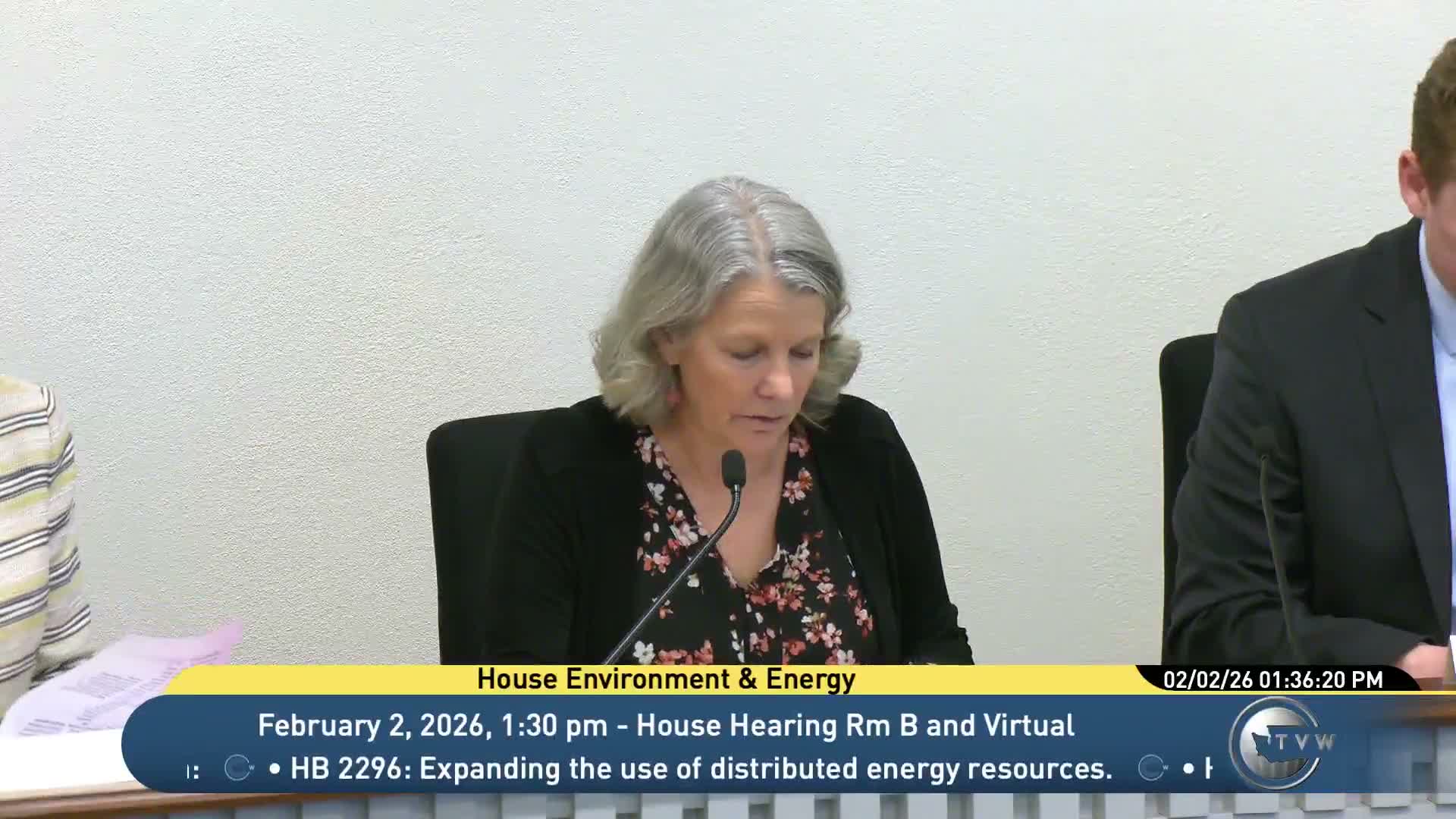
Summary
The House committee reported substitute House Bill 2,296 out with a due‑pass recommendation after debate over cost recovery and local control; one amendment to require homeowners to pay full installation costs failed and a local‑control amendment was not adopted.
The House committee on (legislative hearing) on Feb. 3 reported substitute House Bill 2,296 out of committee with a due‑pass recommendation after extended debate over how utilities and customers share costs for meter‑mounted devices.
Megan McFadden, committee staff, summarized the substitute (H‑3,331.2) and said it preserves most prior language while clarifying that a qualified utility employee may remove noncompliant meter‑mounted devices, that a utility representative may inspect and approve a device on a customer’s premises, and that the Utilities and Transportation Commission may modify proposed rules under certain conditions without restarting rulemaking.
Representative Dye moved Amendment McFadden 141 to make it mandatory that a homeowner pay the full cost of installation so those costs would not be borne by ratepayers. “...they would pay for the full cost of that installation so that it doesn't end up being a part of the regular operations of the utility causing ratepayers to have to pay more,” Dye said. The amendment failed on a voice vote.
Representative Hall, sponsor of the proposed substitute, urged members to allow flexibility for utilities to recover costs according to individual business models. “It just allows a little bit more flexibility depending on individual business models,” Hall said, asking members to reject the mandatory recovery amendment and support the substitute.
Representative Stevie moved Amendment 142 to restore local government authority by removing the bill’s prohibition on local jurisdictions restricting meter‑mounted devices; proponents of the bill said municipalities had not requested such prohibitions and that the devices increase household access to distributed solar. The committee did not adopt the amendment.
In closing remarks, Hall described the technology as a way to reduce barriers for homeowners and asked for a yes vote. Stevie said the bill has potential but “there's so much that we don't know” and said he would vote no while remaining engaged through the interim.
On the roll call, staff announced 14 ayes and 7 nays, with the committee reporting the substitute House Bill 2,296 out of committee with a due‑pass recommendation.
What happens next: the substitute moves to the next legislative stage for consideration by the full chamber.