
Senate committee debates tribal seats on Board of Natural Resources, approves substitute
Get AI-powered insights, summaries, and transcripts
Subscribe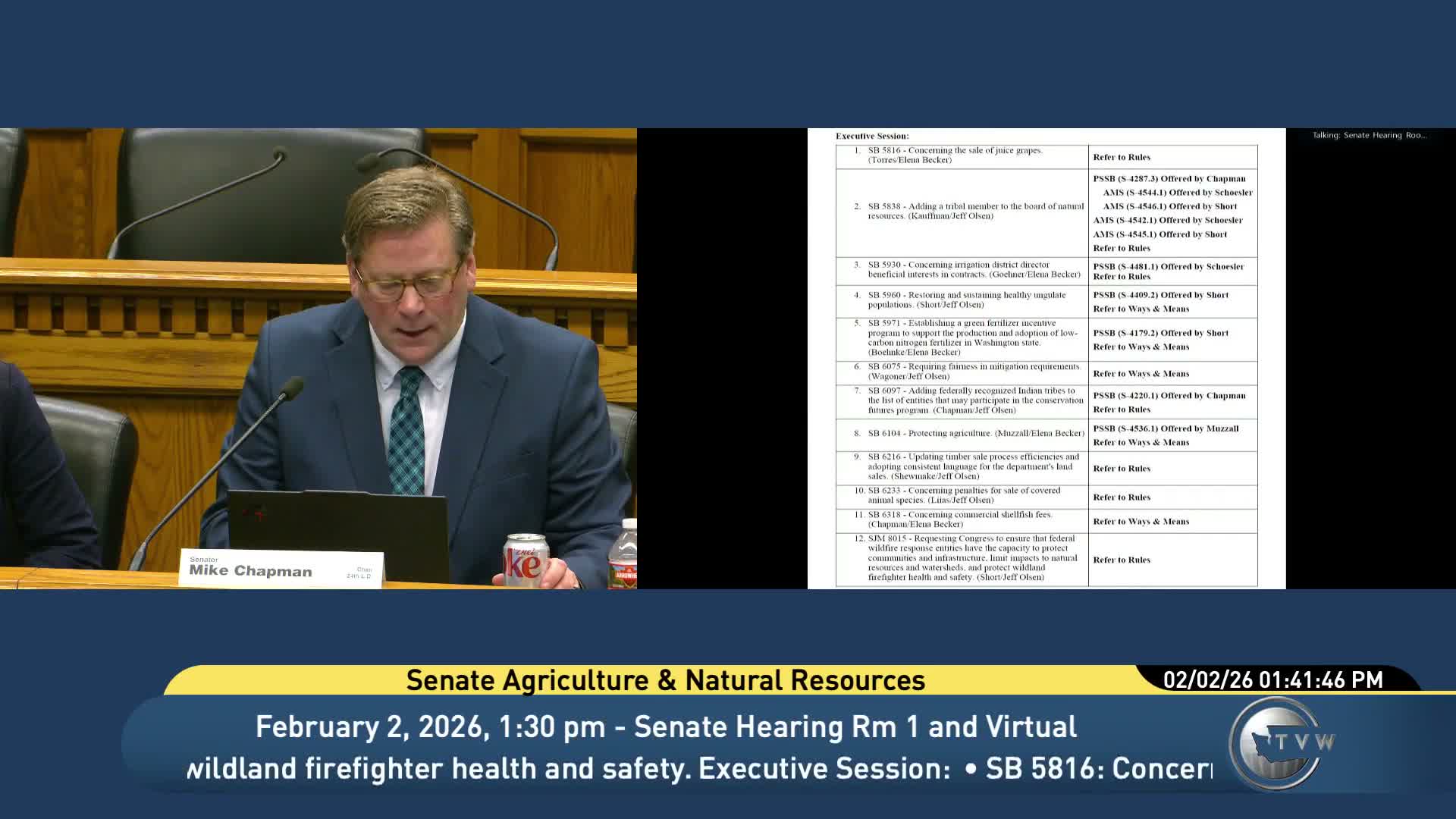
Summary
The Senate Agriculture & Natural Resources Committee advanced a proposed substitute to add tribal representation to the Board of Natural Resources after floor debate over whether appointments should require forest-management experience or rotate between eastern and western Washington; the substitute passed and the bill moves forward subject to signature.
The Senate Agriculture and Natural Resources Committee voted to advance a proposed substitute to Senate Bill 5838 that changes how tribal representation is added to the Board of Natural Resources.
The bill originally would add a tribal member to the board; staff said the governor would appoint a tribal representative with a term starting July 1, 2026, and that the appointee must be a member of a federally recognized tribe. Committee staff identified a proposed substitute (S-4287.3) that would add a second tribal member and specify one representing Eastern Washington and one representing Western Washington. Two competing amendments were considered: S-4546.1, offered to require tribal appointees be from tribes that actively manage forest resources, and S-4544.1, which would retain a single tribal seat but require the governor to alternate appointments between Eastern and Western Washington.
Supporters of the amendment limiting appointees to tribes active in forest management argued that expertise in timber management is important for a board that governs state trust forest lands. "If we are gonna have tribal membership, I think that the level of expertise is important," a senator supporting S-4546.1 said, urging that nominees have timber management experience.
Opponents worried the expertise requirement would create conflicts of interest. One senator argued the amendment could place a competitor on a board that decides sales or non-sales of timber and said, "There's a conflict of interest ... somebody from that type of tribe is actually a competitor and now will be having representation on a board where decisions about sales or not sales may compete with their own interests." That amendment, S-4546.1, failed on a committee vote. The alternative amendment that would have limited representation to a single rotating seat (S-4544.1) also failed.
After discussion and a short recess to resolve procedural confusion, the committee moved the proposed substitute and voted to recommend the bill be sent to the Rules Committee. The Chair recorded the action as "passed subject to signature." No fiscal note beyond per-diem and travel for additional members was reported by staff.
The committee's debate highlighted two persistent tensions in proposals to add tribal members to state boards: balancing subject-matter expertise against concerns about conflicts of interest, and ensuring geographic representation across the state's eastern and western forestry contexts. The committee advanced the substitute; the bill will proceed to the next stage for consideration.