Get Full Government Meeting Transcripts, Videos, & Alerts Forever!
Get email alerts on the Flood Response topic
No spam. Unsubscribe anytime.
Emergency managers outline December 2025 floods: thousands affected, early damage estimates tens of millions
Summary
Emergency management officials recounted December atmospheric‑river impacts—about 4,000 homes affected, roughly 100,000 residents evacuated at peak, one fatality and hundreds of rescues—and described response actions, federal assistance requests, and capability gaps in local capacity and statewide alerting.
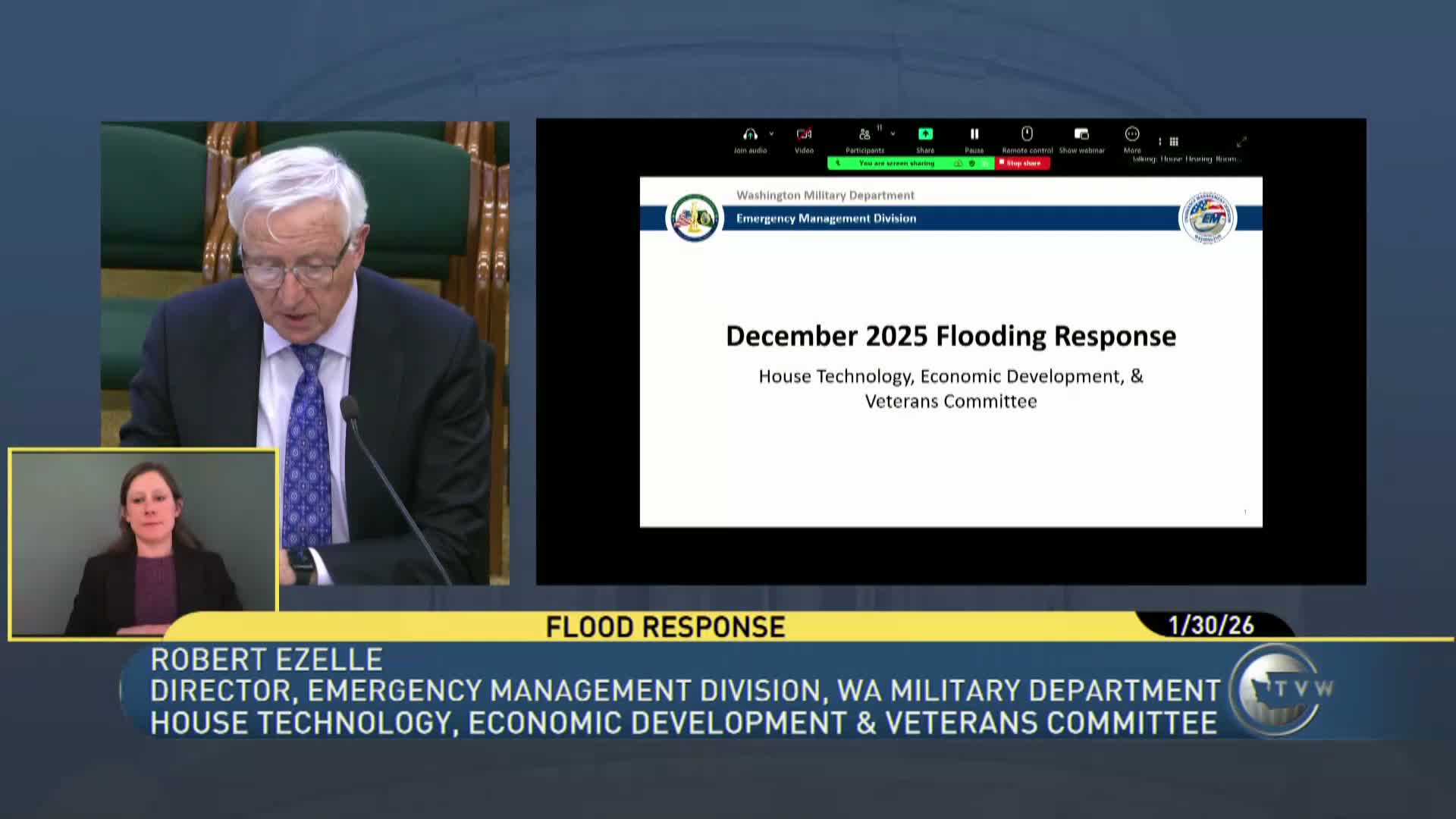
Robert Hazell, director of the Washington State Emergency Management Division, briefed the committee on the December 2025 atmospheric river events that caused widespread flooding across the state.
Hazell said 20–40 inches of rain fell in places, 33 rivers flooded (18 exceeding major flood stage) and three rivers set records. He reported about 4,000 homes were impacted (approximately 440 with moderate or major damage), about 100,000 residents were under evacuation orders at the peak, there was one confirmed fatality and roughly 380 rescues. "So, a lot going on," Hazell told the committee as he walked through impacts and mitigation successes.
The state activated the emergency operations center, coordinated with the Army Corps, National Weather Service and FEMA, and secured a presidential emergency declaration on Dec. 12 for urban search and rescue and other federal assistance. Hazell said the governor provided $2.5 million for state individual assistance and $1 million for DSHS disaster cash assistance (the latter fully expended); household needs grants, rental assistance and temporary sheltering programs are being established.
Hazell cautioned that damage collection is ongoing but early estimates for validated infrastructure damages could be in the $80–100 million range or higher. He flagged capability gaps: uneven local emergency management capacity, inconsistent search and rescue resources, antiquated EOC technology, limited statewide multilingual alerting and the need for sustained mitigation funding.
Committee members praised the response coordination and asked for follow‑up on federal public assistance timelines, insurance coverage estimates and options for statewide alerting. No formal committee action was taken during the briefing.