Committee hears testimony to allow elective coronary interventions at ambulatory surgical centers
Loading...
Summary
Supporters told the House Health Care Committee HB 2,545 would expand access and lower costs by letting selected ambulatory surgical facilities perform elective percutaneous coronary interventions (PCIs); opponents urged study of systemwide volume, hospital capacity and patient-safety implications.
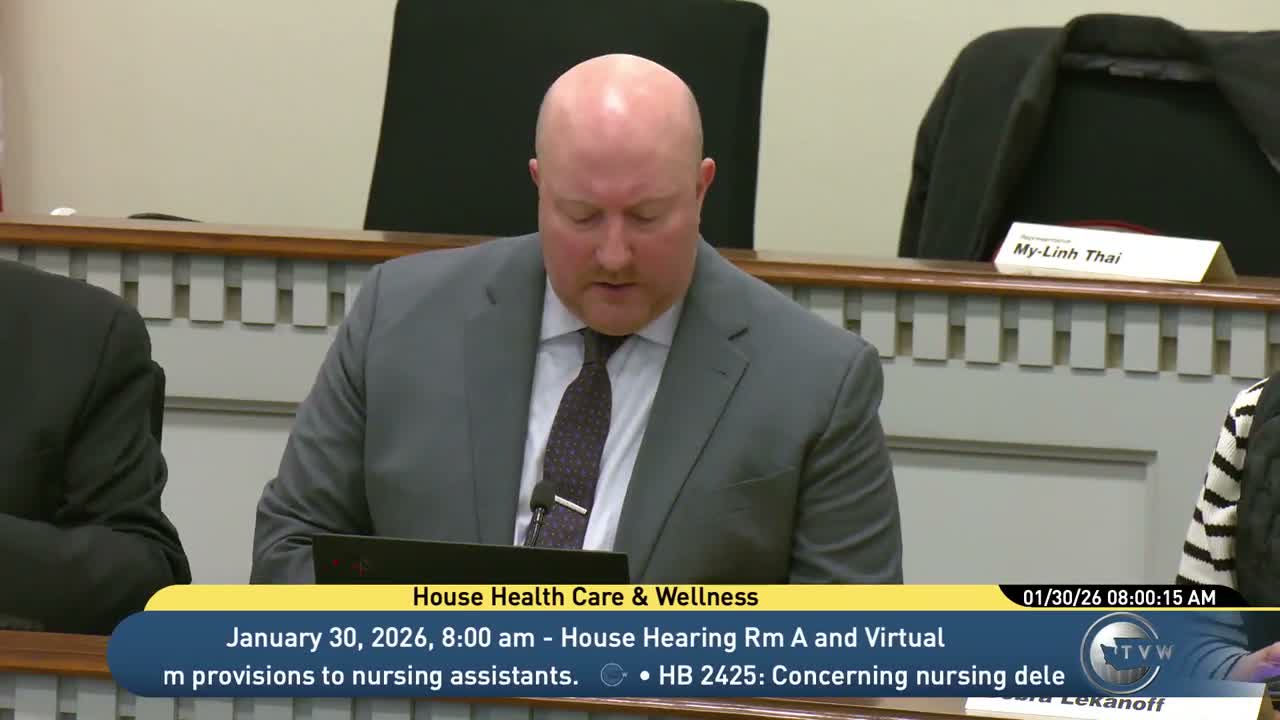
Supporters and clinicians urged the House Health Care and Wellness Committee on Friday to let some ambulatory surgical facilities (ASCs) perform elective percutaneous coronary interventions, or PCIs, arguing the move would expand access and lower costs.
Lisonbee Ryan, staff to the committee, summarized House Bill 2,545 and said it would direct the Department of Health to adopt rules by July 1, 2027, to allow a certificate of need for elective PCIs at ASCs. The staff summary noted existing rules govern CON issuance for hospital-based PCIs and that elective PCIs are nonemergency tertiary outpatient procedures.
Roman Daniels Brown of the Washington Ambulatory Surgery Center Association testified in favor, saying the bill would let ASCs with strong records perform PCI safely, citing Medicare’s 2020 decision to reimburse PCIs in ASCs and a Medicare estimate that procedures in ASCs cost roughly 36–47% less than in hospitals. He said ASCs already must meet CON-related charity-care and Medicaid participation requirements.
Cardiology clinicians speaking in support emphasized patient selection and facility readiness. Dr. Amir Khairani, chief of cardiology at Kaiser Permanente, described long-standing ASC interventional practice at Kaiser and said ASCs can improve access in underserved areas. Interventional cardiologists who testified, including Dr. Mortada Shams and Rick Rosso, cited consensus guidance from cardiology societies and said ASCs can serve low‑risk elective patients while preserving hospital capacity for higher‑risk and emergency cases.
Opponents and cautioning witnesses urged more careful study of systemwide effects. Lisa Thatcher asked the committee to require a study first, noting minimum annual volumes (cited in testimony as about 200 cases per hospital or 50 per individual provider) are tied to proficiency and to supporting a hospital’s emergency PCI infrastructure. She warned that spreading elective PCI across more sites could dilute volumes that subsidize on‑call staffing and cardiac ICU capacity.
Committee members flagged two implementation issues during questioning: workforce capacity to staff ASC-based PCIs and the prospect of extensive Department of Health rulemaking needed to implement any change. Supporters requested DOH share its concerns and indicated willingness to coordinate on staffing and implementation details.
The prime sponsor said she visited ASCs and, based on clinical briefings and other states’ experience, believes outcomes are comparable and costs are lower; she urged the committee to move the bill forward.
The committee closed public testimony on HB 2,545 and proceeded to the next agenda item.
The next procedural step for HB 2,545 is rulemaking by the Department of Health if the Legislature grants the authority; testimony identified remaining questions about minimum volumes, workforce sufficiency and the scope of any DOH rules.