
Assembly approves study of road-user charge after heated debate over ‘mileage tax’
Get AI-powered insights, summaries, and transcripts
Subscribe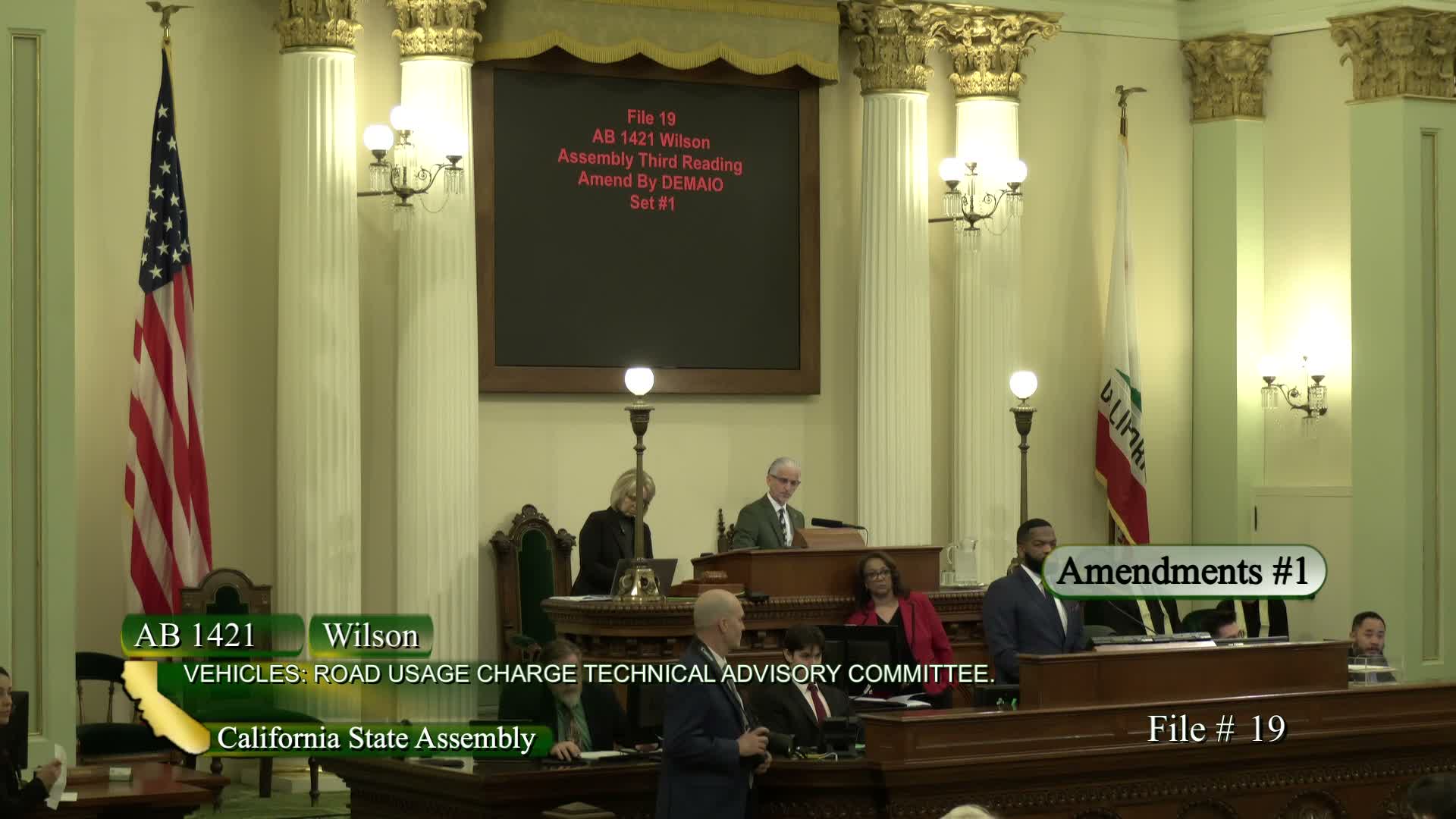
Summary
Lawmakers approved AB 14 21 to direct research into a road-user charge after floor debate centered on whether the measure would amount to a new tax on drivers; the Assembly tabled amendments and then passed the bill, 43–18.
SACRAMENTO — The California State Assembly voted to advance AB 14 21 on Jan. 20, directing research into a potential statewide road-user charge — a mileage-based funding approach proponents say is needed to shore up transportation funding as more drivers switch to zero-emission vehicles.
Assemblymember Wilson, the bill’s author, said AB 14 21 “creates a transparent, research-driven process to evaluate the advantages, disadvantages, and inevitable trade-offs of a road user charge” and emphasized safeguards for affordability and privacy. He told colleagues the bill is not a new tax but a study and planning tool to help the Legislature weigh future options.
Opponents, led by Assemblymember De Maio, framed the bill as the first step toward a full mileage tax that would disproportionately affect working-class Californians. “A mileage tax would just be the final straw that breaks the camel’s back,” De Maio said, citing San Diego County staff analyses that he said estimated a 6¢–9¢ per-mile rate that could cost drivers $900–$1,200 a year.
The Assembly first rejected (by laying on the table) an amendment from De Maio intended to prohibit local mileage taxes and remove the statewide study approach; that procedural motion to table passed, 43–21. After extended remarks from the author and back-and-forth on enforcement and double-taxing safeguards, the Assembly approved AB 14 21 on final passage, 43–18.
Supporters said the bill will allow policymakers to gather data, hold regional town halls and evaluate pilot programs before considering any policy that would directly charge motorists. Wilson said he will seek further amendments in the Senate to address remaining concerns, including explicit direction on avoiding double taxation.
The Assembly’s passage sends the bill to the Senate for further consideration.