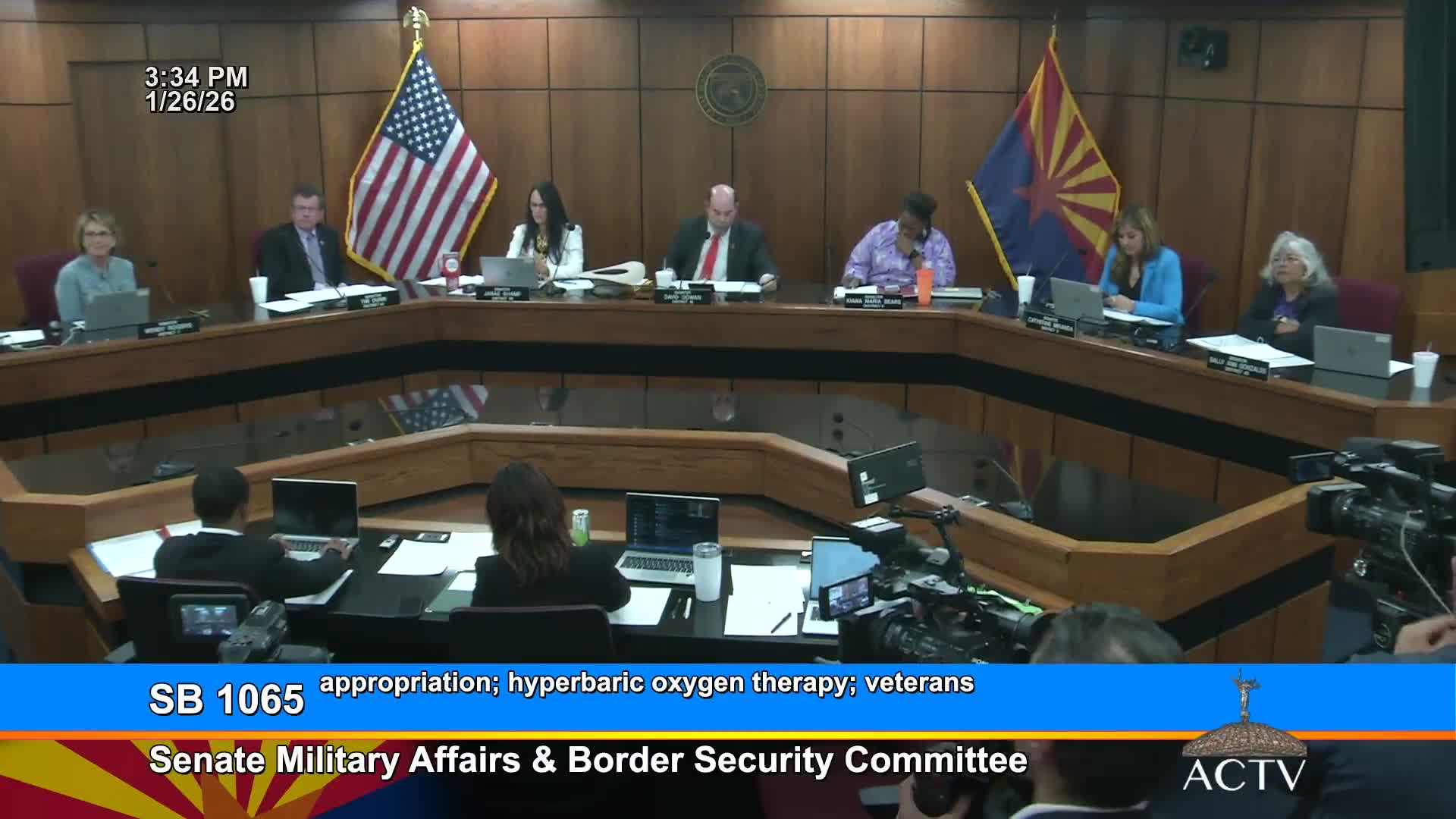
Committee approves $3 million for hyperbaric oxygen therapy pilot for veterans
Loading...
Summary
Senate Bill 10-65, proposing $3,000,000 for a hyperbaric oxygen therapy program for veterans, passed the Military Affairs and Border Security Committee unanimously (7–0). Supporters hailed potential benefits for PTSD; members asked how participants would be selected and raised budget questions.
The Arizona Senate Military Affairs and Border Security Committee unanimously recommended Senate Bill 10-65, which would appropriate $3,000,000 in fiscal year 2027 from the state general fund to a Hyperbaric Oxygen Therapy for Military Veterans Fund.
Senator Wendy Rogers, who presented the bill, described hyperbaric oxygen therapy (HBOT) as a treatment in which a patient enters a pressurized chamber and receives enriched oxygen over repeated sessions. Rogers told the committee the therapy typically involves "30 to 40 dives" and called it "curative and doesn’t need to be repeated," saying it can help veterans recover from post‑traumatic stress disorder without drugs.
Committee members broadly supported the concept but pressed for details. Senator Catherine Miranda asked where the $3,000,000 figure came from and stressed budget constraints, saying the state’s revenue picture is "looking really slim" as the legislature proceeds. Senator Gonzales asked how veterans would be selected for the program; Rogers responded that veterans would apply and be assessed for suitability before receiving treatment.
Members noted the item is a budget appropriation that could be adjusted in later stages. Several senators explained they supported advancing the measure out of committee while reserving further questions for the floor or appropriations negotiations.
The committee voted 7–0 to give SB 10-65 a due-pass recommendation. Proponents said the pilot could help veterans with PTSD and serve as a model if outcomes justify additional funding; critics were not recorded in opposition during the committee hearing.
The bill now proceeds to the next step in the legislative process, where lawmakers and budget negotiators will review cost, eligibility, and implementation details.