Arizona committee advances bill that would explicitly name Sharia as "foreign law"
Loading...
Summary
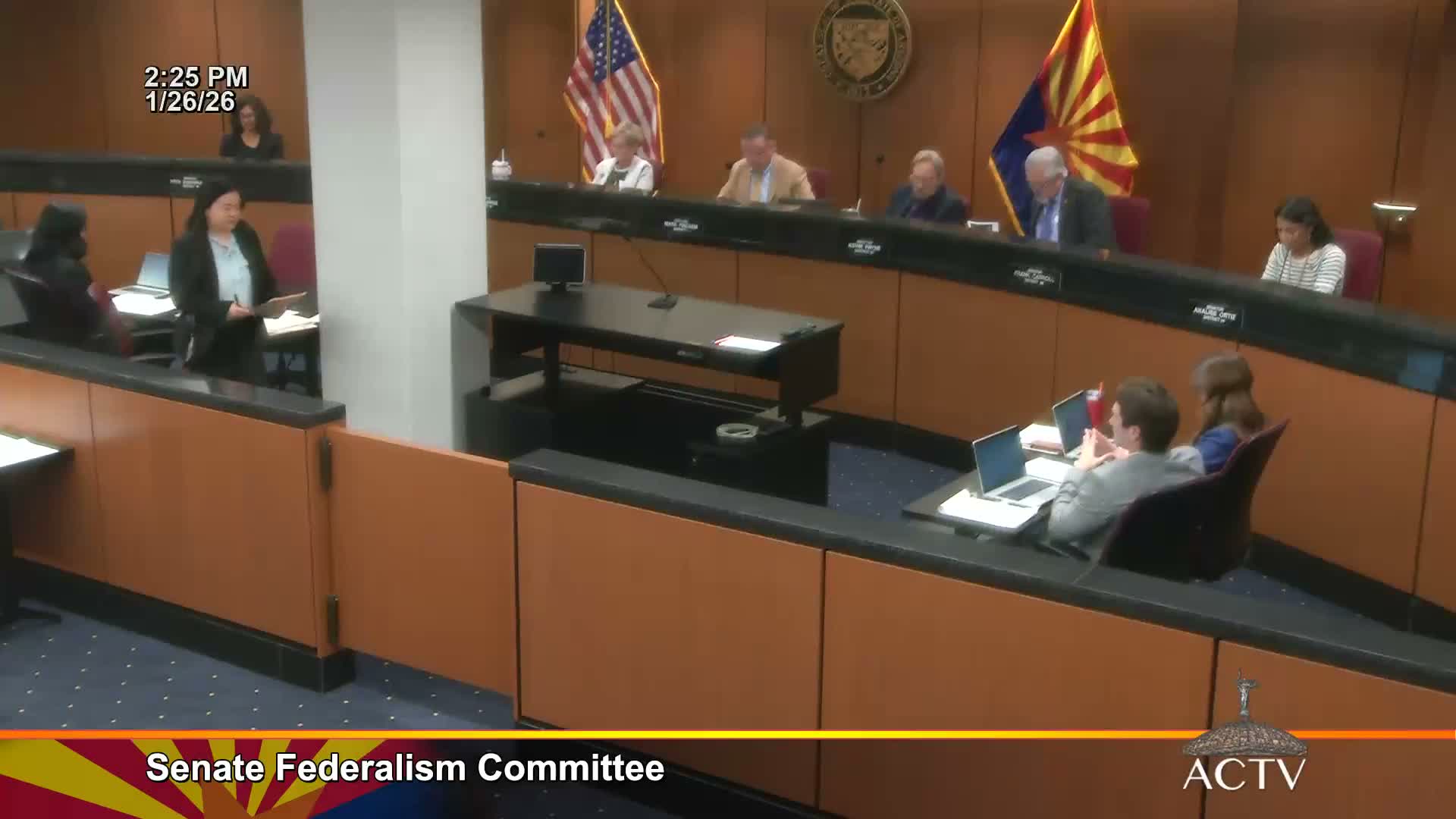
The Senate Federalism Committee gave SB1018 a due-pass recommendation after testimony both for and against. Sponsor Sen. Schamp said the change clarifies that courts should not enforce foreign legal systems that conflict with the U.S. or Arizona constitutions; civil-rights groups said the measure is discriminatory and likely unconstitutional.
Senator Schamp urged the committee to give Senate Bill 1018 a due-pass recommendation, saying the bill amends Arizona’s foreign-law definition to explicitly state that "foreign law means Sharia law or any law, rule, legal code, or system other than the Constitution, our laws and ratified treaties of the United States and its territories or the constitution and laws of the state." She said the measure is narrow and defensive, aimed at ensuring Arizona courts apply American law and not parallel legal systems.
The bill’s sponsor told the panel it would not ban private religious practice. "This language does not ban private religious practices. It does not discriminate against any faith," Schamp said, adding the change was requested by some Arizonans seeking clarity and that similar measures exist in more than a dozen states.
Supporters who testified said the bill would protect women and children from practices that, in their view, some foreign courts have treated as legally permissible. Jeff Schwartz, who spoke on his own behalf, said he had been told by a broker about a proposed Phoenix-area development he said was intended to be governed by Sharia law and that he had informed the governor’s office and the state land commissioner. "We cannot allow creation of enclaves where alternative legal systems are encouraged, tolerated, or quietly implemented," Schwartz said.
Opponents, including Marilyn Rodriguez of the ACLU of Arizona, said the bill echoed model legislation promoted years ago and that courts have struck down similar bans as unconstitutional when they singled out Islam. "This proposal does not protect American values, it betrays them," Rodriguez testified, citing a federal appeals court decision that invalidated an Oklahoma ban.
Committee members were split. Some expressed concern that the bill singled out a particular religion and lacked definitions; others said existing statutes leave gaps that this bill closes. After members explained their votes, the committee recorded 4 ayes and 3 nays and gave SB1018 a due-pass recommendation.
The committee also heard testimony from Sherry Sapir, who argued the bill would affirm that practices such as child marriage or honor killings should never be treated as legally permissible under U.S. or Arizona law. Sapir said the measure does not criminalize belief or worship and urged approval to protect vulnerable people.
Next steps: SB1018 will move forward with the committee’s due-pass recommendation to the Senate; the sponsor said she would provide the committee examples and documentation about the cases she referenced when asked for evidence.