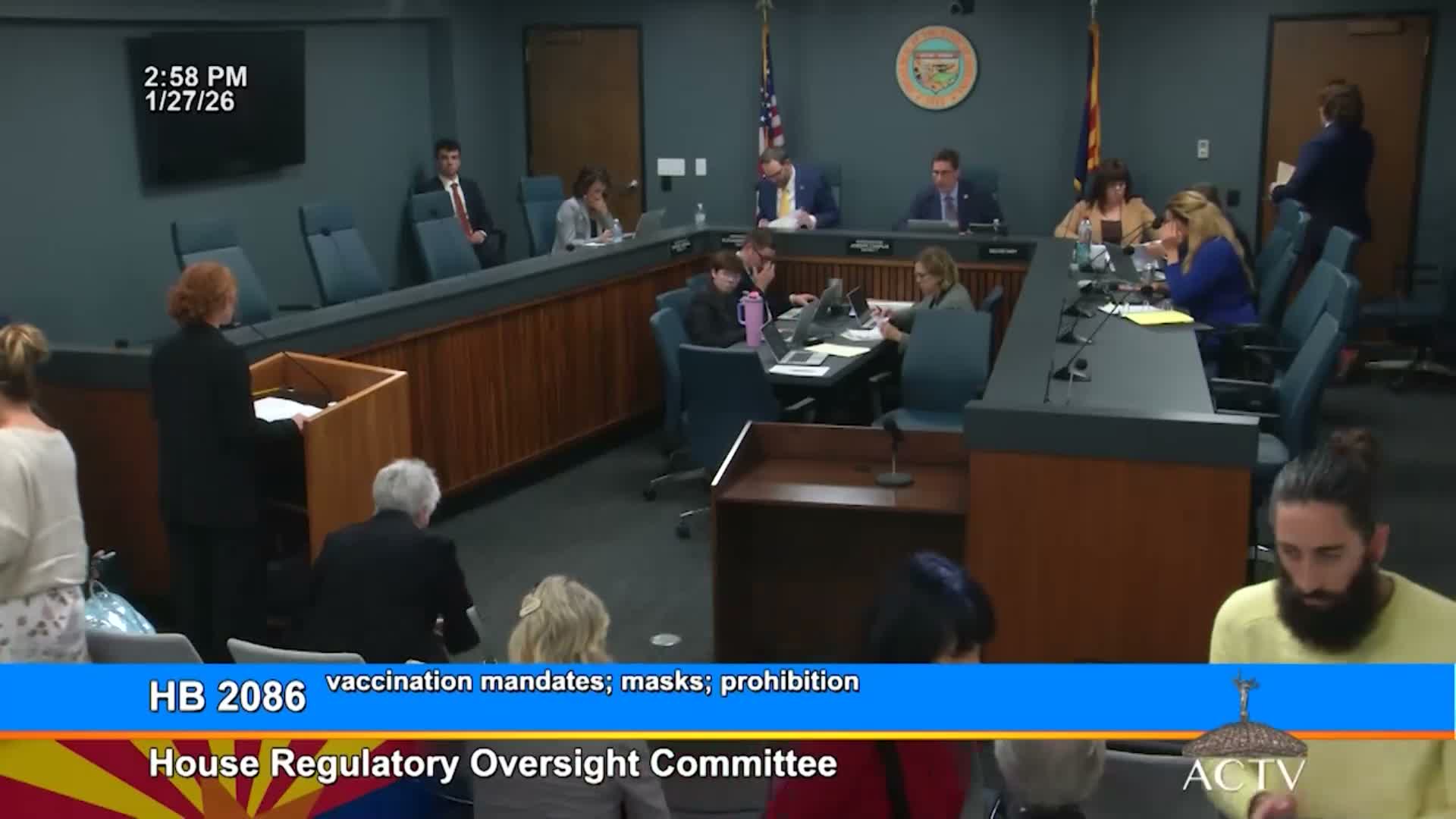
Committee advances bill barring most business vaccine and mask requirements, supporters cite state authority
Loading...
Summary
HB2086, which would prohibit most businesses from requiring vaccinations or masking (with limited workplace-safety exceptions), received a due-pass recommendation (3–2). Debate focused on individual liberty, federal coercion via grants, and state public-health authority (Jacobson).
The House Regulatory Oversight Committee voted 3–2 to advance House Bill 20-86, a measure that would generally bar businesses, schools and other entities from requiring vaccination or masks to enter premises or to be employed, with limited exceptions for longstanding workplace safety and infection-control measures.
Sponsor Representative Powell presented the bill as a protection of bodily autonomy and property rights, saying it prohibits a government entity from requiring a resident to receive a vaccination and limits private businesses from imposing vaccine or mask requirements except where long-established safety rules apply.
Opponents, including pediatrician Dr. Regan Hill and advocacy organizations, argued the bill would create significant public-health risks. Hill testified that vaccines are safe and effective and that weakening requirements for vaccination or masking could reduce herd immunity and place vulnerable populations at higher risk. Ashley Chambers of Arizona Families for Vaccines said the bill would impede private businesses’ ability to set safety standards and could be an overreach into private-sector decisions.
Lawmakers and witnesses also debated legal dynamics. Several committee members and witnesses referenced Jacobson (the century-old case on state police power in public health) and discussed whether state action is sufficient to counter federal mandates or coercion tied to federal grants and contracts. Proponents argued state police power and practical limits on federal reach justified the bill as a defense against entwinement and coercion, while opponents warned of supremacy-clause conflicts.
After testimony and extensive questioning—much of it focused on statutory definitions and potential unintended consequences—the committee voted to give HB2086 a due-pass recommendation, with several members saying the bill’s language on 'interventions' should be clarified before further consideration.