Committee backs $500,000 study for SR 64 after mayors and public‑safety officials describe dangerous stretch to Grand Canyon
Loading...
Summary
The committee gave Senate Bill 11‑54 a due‑pass recommendation to fund a $500,000 ADOT traffic and safety study of State Route 64 from Williams to the Grand Canyon after testimony from local mayors, the Coconino County sheriff and volunteer fire officials describing rising tourist traffic and repeated accidents.
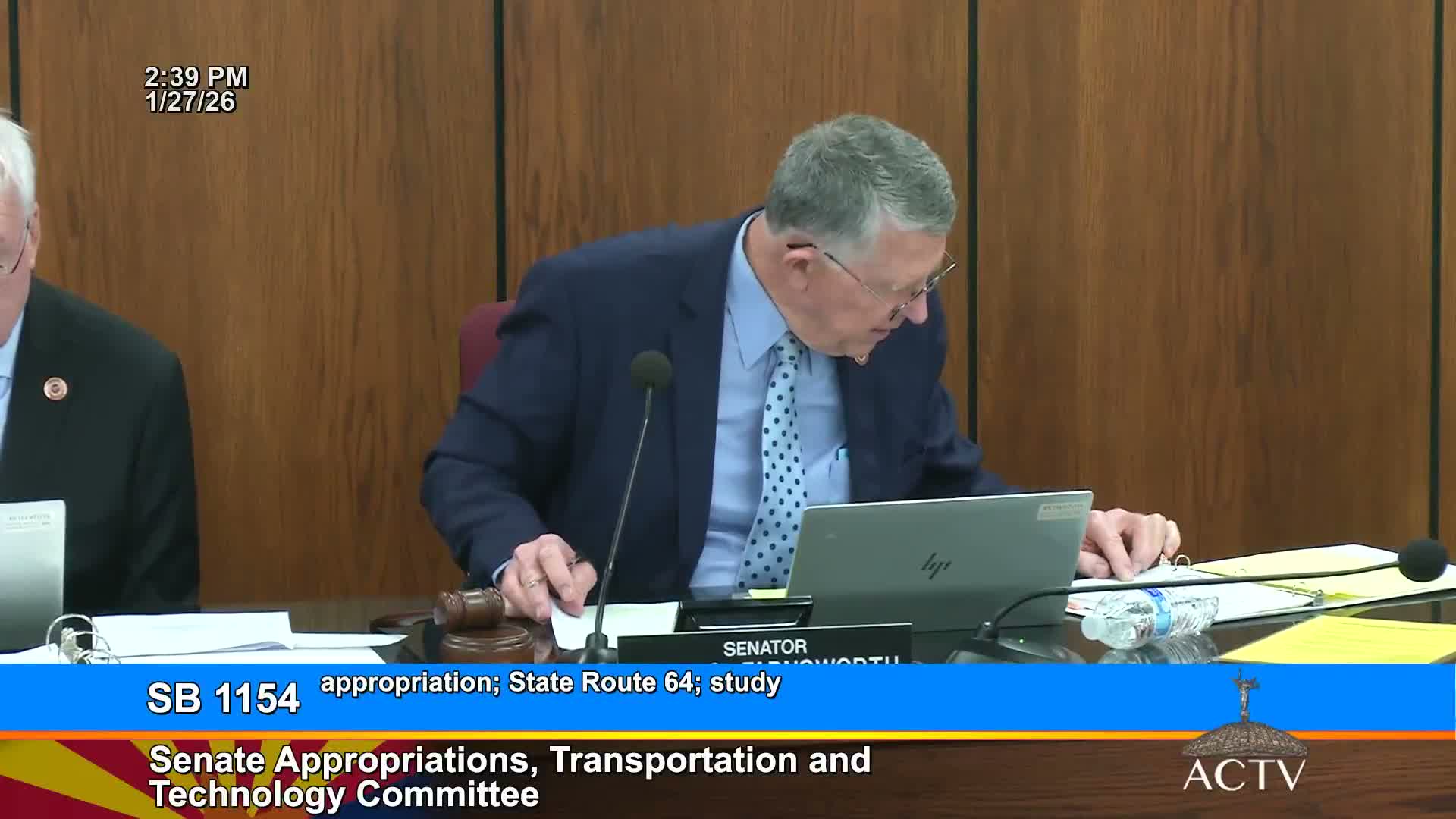
Senate Bill 11‑54, which would appropriate $500,000 from the state general fund in FY2027 to the Arizona Department of Transportation for a traffic and safety study of State Route 64 between Williams and the Grand Canyon, received a due‑pass recommendation from the Senate Health and Human Services Committee.
Sponsor Sen. Wendy Rogers told the committee that SR 64 is the gateway to Grand Canyon National Park and that the corridor has an unusually high number of deaths and crashes affecting residents and visitors. Don Dent, mayor of Williams, described growing local subdivisions and increased tourist traffic; "It is time that we study this road and improve this road," he said.
Clairene Veil, mayor of Tusayan, urged widening to a four‑lane highway with shoulders, saying ADOT has right of way and local partners are ready to help. Coconino County Sheriff Brett Axland said annual visitation has risen from about 3 million in 2020 to roughly 5 million in 2024 and cited recent crash statistics supporting the need for a study. High Country Fire Chief Robert Trotter, representing a volunteer department that covers 31 miles of SR 64, said his unit averages about 35 injury crashes and four fatalities a year on its stretch.
Members concentrated discussion on whether the general fund was the proper source for the appropriation. Several senators said they would prefer highway user revenue or HEERF funds; others argued the needs are urgent and the appropriation can help move projects forward. After debate, the committee gave the bill a due‑pass recommendation by roll call (6 ayes, 4 noes, 0 not voting).
The study would be an initial step to identify safety improvements; any construction or design work would require additional funding and coordination with ADOT and local governments.