
Senate committee backs $3 million amendment to fund radiation‑protection systems for rural cath labs
Get AI-powered insights, summaries, and transcripts
Subscribe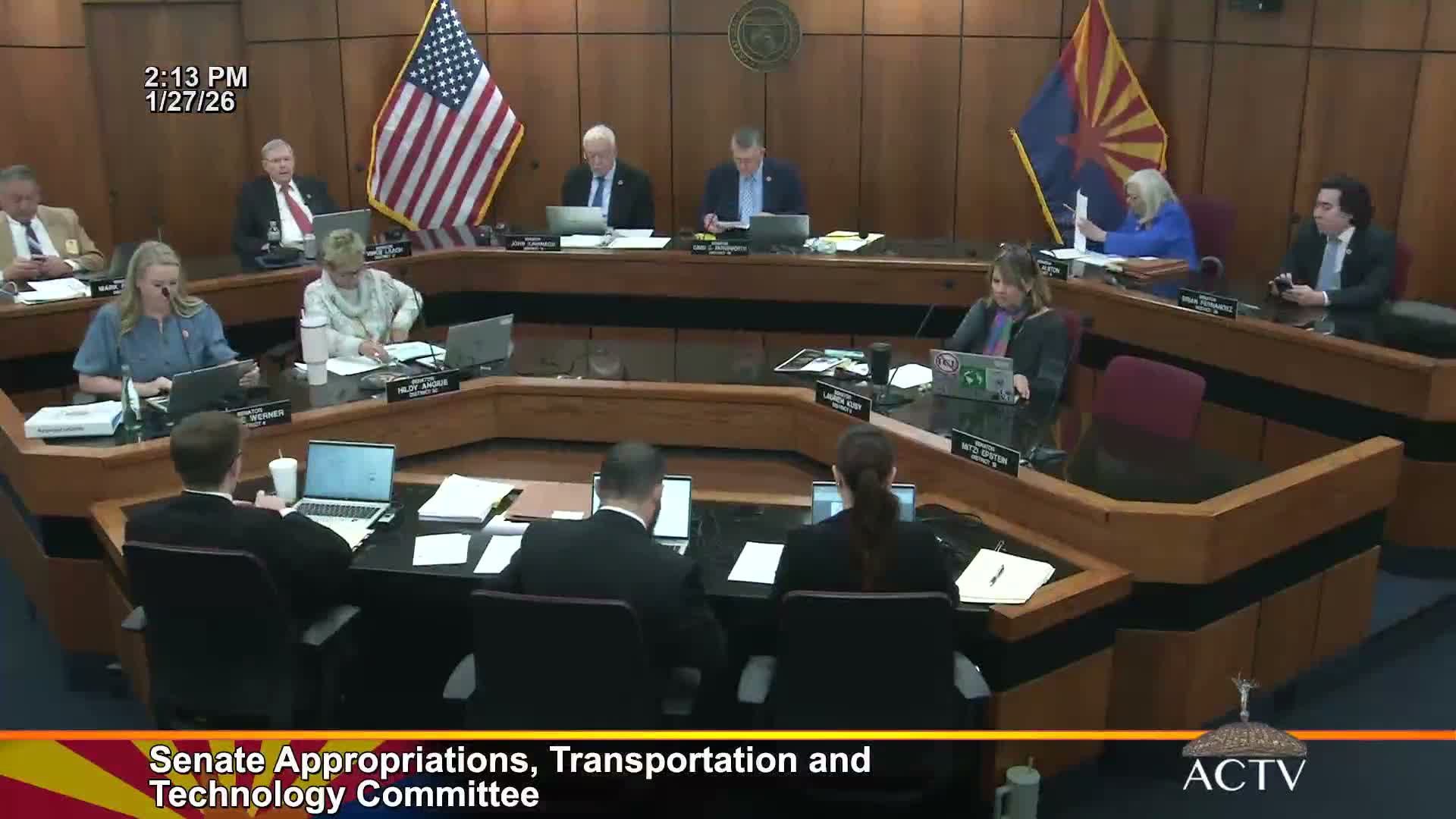
Summary
The Arizona Senate Health and Human Services Committee gave Senate Bill 11‑18 a due‑pass recommendation after adopting an amendment that specifies a $3 million FY2027 appropriation to the Department of Health Services to fund installation grants for enhanced radiation protection systems in cardiac catheterization rooms at rural hospitals.
Senate Bill 11‑18, which would establish a grant program to help rural hospitals install enhanced radiation protection systems in cardiac catheterization procedure rooms, received a due‑pass recommendation by the Arizona Senate Health and Human Services Committee after the panel adopted an amendment specifying a $3 million appropriation.
McKenna Scouten, a research intern for the committee, summarized the bill’s intent: to appropriate funds from the state general fund to the Department of Health Services to establish grants to offset the cost of installing radiation‑protection systems. The committee adopted the Warner amendment (dated 01/26/2026) that sets the appropriation at $3,000,000 and narrows the grant to cardiac catheterization procedure rooms.
Dr. David Ryzik, an interventional cardiologist who has practiced in Scottsdale and Phoenix for more than three decades, told the committee that staff working in catheterization laboratories face daily exposure to ionizing radiation. He described the limitations of lead aprons and cited peer‑reviewed studies he said show enhanced radiation protection devices (ERPDs) can reduce healthcare worker exposure by more than 99 percent. "These ERPDs would allow us to in essence take our kevlar off and would give us more protection for those areas that our lead aprons do not cover," Ryzik said.
Members asked about device effectiveness and cost. Committee discussion established that the devices are FDA‑cleared, that several peer‑reviewed studies were cited by witnesses and that the average unit price discussed in testimony ranged roughly from $120,000 to $150,000. Sponsor Senator Werner said the appropriation targets rural hospitals that otherwise lack resources to install the systems.
Vice Chair moved that SB 11‑18 receive a due‑pass recommendation and that the Werner amendment be adopted; the committee approved the amendment and then voted to give the bill a due‑pass recommendation. The roll call returned 10 ayes, 0 noes, 0 not voting.
The measure now proceeds with a committee recommendation; the appropriation level and program details would be finalized in the budget and any implementing rules if the bill advances.