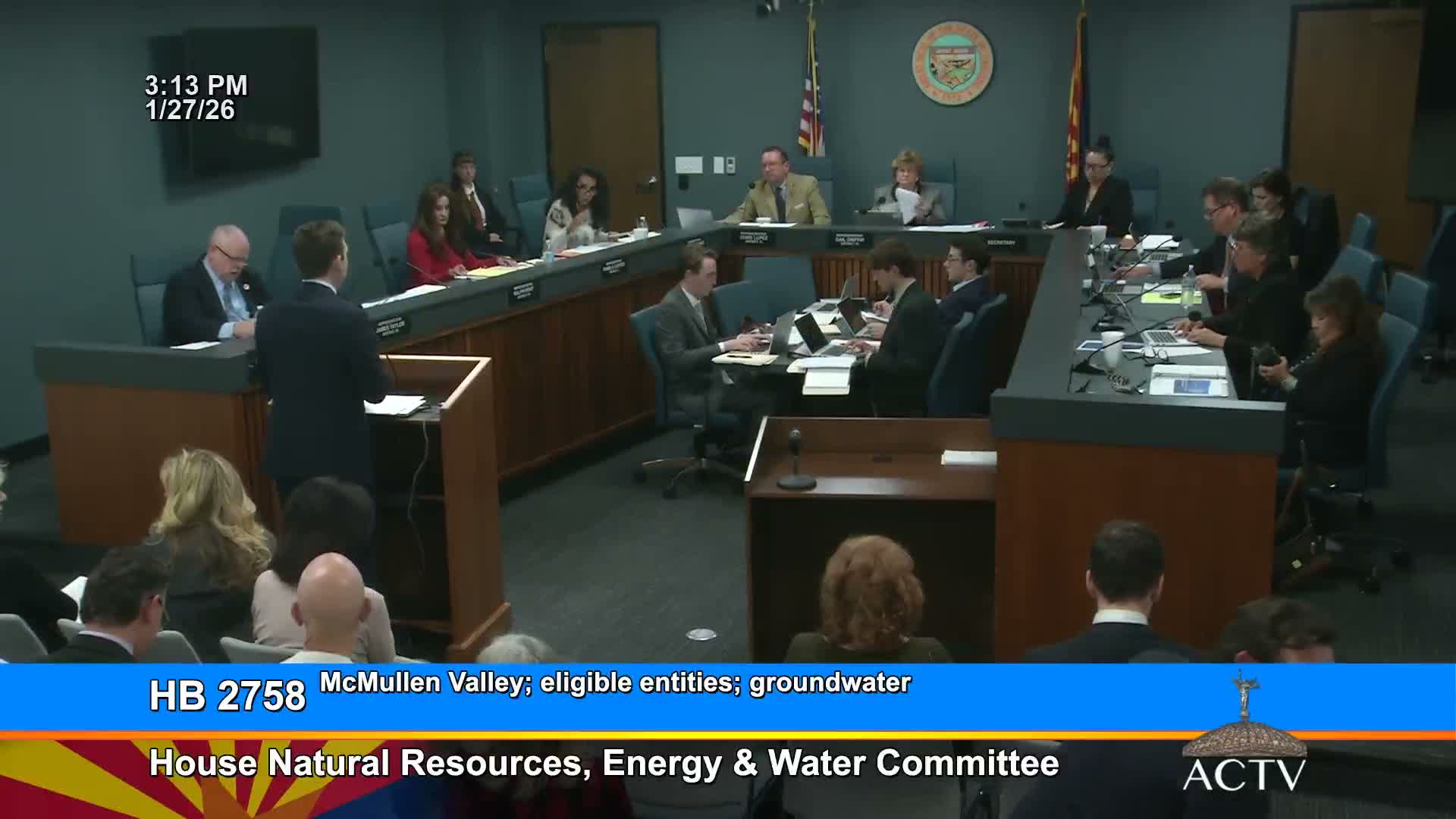
House committee advances package of water bills; McMullen Valley groundwater transfer wins close vote after heated debate
Loading...
Summary
The Natural Resource, Energy and Water Committee advanced a package of water bills on Jan. 22, most with due‑pass recommendations. The most contested, HB2758 (McMullen Valley groundwater transfer), passed as amended after residents and environmental groups warned of well failures and 'sacrifice zones.'
The Arizona House Natural Resource, Energy and Water Committee voted on Jan. 22 to advance a package of water bills after hours of testimony that ranged from technical briefings to emotional pleas from rural residents.
Most consequential was House Bill 2758, which would allow eligible entities to withdraw groundwater from the McMullen Valley Groundwater Basin and transport it to eligible locations under ADWR oversight. Proponents — including the bill’s lobbyist Stan Barnes and municipal water interests — said the measure mirrors earlier transfer statutes, contains guardrails (pumping depth and rate limits, hydrological studies, monthly reporting), and would bring private capital to stabilize the basin and provide local mitigation. Opponents, including La Paz County officials, Sierra Club and numerous residents, said the bill would accelerate aquifer decline, favor out‑of‑state investors and leave families without water. After the committee adopted a Griffin amendment (01/22/2026 12:30PM) that increased a La Paz County annual transportation limit from 10% to 50% and added conditions for sale/lease from historically irrigated acres, the committee returned HB2758 with a due pass recommendation (6 ayes, 4 nays).
Votes at a glance (committee actions and outcomes):
- HB2758 (McMullen Valley transfers) — adopted Griffin amendment; returned with due pass recommendation (6 ayes, 4 nays). - HB2098 (County water augmentation authority) — returned with due pass recommendation (10 ayes, 0 nays). - HB2185 (HOA overseeding prohibition during governor‑declared drought emergency) — Griffin amendment narrowed definition to gubernatorial declaration; returned with due pass recommendation (10 ayes, 0 nays). - HB2328 (Prohibit higher outside‑city water rates in large counties) — returned with due pass recommendation (6 ayes, 4 nays). - HB2798 (appropriation to UArizona/AGS for nuclear materials study) — amendment set appropriation to $100,000; returned with due pass recommendation (7 ayes, 3 nays). - HB2055 (Brackish groundwater recovery program under WIFA) — returned with due pass recommendation (6 ayes, 4 nays); WIFA raised concerns about using the long‑term augmentation fund for grants and suggested limiting scope to the in‑state split. - HB2056 (ADWR feasibility study for selected brackish desalination sites) — returned with due pass recommendation (6 ayes, 4 nays). - HB2052 (limit lost and unaccounted for water to 8% for designated providers) — Griffin amendment narrowed scope to certain designated providers; returned with due pass recommendation after discussion (vote recorded as passed as amended). - HB2042 (ban on solar radiation management activities and restrictions on public funding for SRM) — returned with due pass recommendation (6 ayes, 4 nays) after extensive public testimony expressing health and environmental concerns.
What proponents said: Supporters of the McMullen Valley transfer emphasized legal precedents for inter‑basin transfers, the existence of statutory guardrails, required ADWR hydrologic approval and monitoring, and private investment to build pumps, pipes and treatment facilities. Housing and municipal groups urged use of designated transfer basins to secure bulk water for new designated providers and housing affordability.
What opponents said: Rural residents, tribal representatives and environmental groups argued the bill would concentrate impacts on La Paz County and other rural communities, causing private wells to go dry, accelerating land subsidence, and prioritizing investor profit over local water security. WIFA and utilities groups cautioned that some proposals could divert funds from revolving loan programs or cause rate impacts if infrastructure replacements are forced quickly.
Procedural note: Several bills were amended on the floor of the committee before roll calls. Committee members repeatedly asked for follow‑up work and stakeholder engagement, and ADWR/WIFA representatives volunteered to work on technical fixes before later stages of the legislation.
Representative action and quotes: After nearly three hours of testimony on HB2758, Chairman Griffin said the bill would "help the residents" if local commitments materialize, while Representative Contreras voted no on HB2758 citing concerns about promises that were not yet in writing. "If nothing happens, then things continue to get worse," proponent Stan Barnes told the committee.
Ending: All bills advanced in committee will move to subsequent legislative steps (floor calendars or other committees as required); members signaled further oversight and stakeholder work, especially on HB2758 and measures involving WIFA funding and loss reduction rules.
Quote: "If nothing happens, the status quo in McMullen Valley with alfalfa farming drawing down the aquifer will lead to domestic wells going dry," Stan Barnes said during testimony.