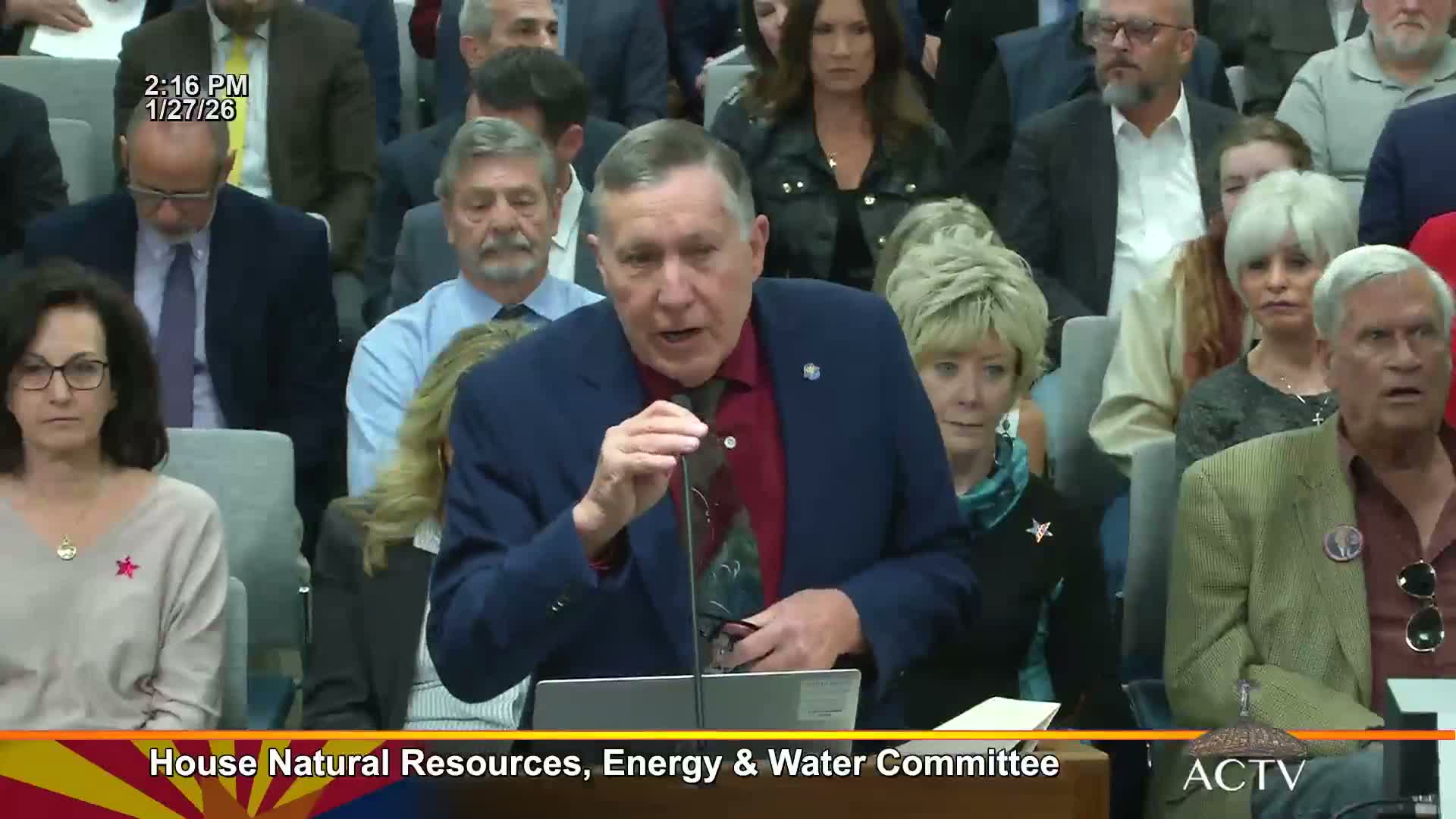
Arizona water director says Lower Basin has done ‘heavy lifting,’ warns post‑2026 Colorado River talks far from agreement
Loading...
Summary
Arizona Department of Water Resources Director Tom Buschatsky told the House Natural Resource, Energy and Water Committee that current negotiations over post‑2026 Colorado River operations remain distant from a deal, urging movement of water from Upper Basin reservoirs and warning that Arizona has already borne the largest cuts.
Tom Buschatsky, director of the Arizona Department of Water Resources, told the House Natural Resource, Energy and Water Committee on Jan. 22 that negotiations over post‑2026 Colorado River operations are still far from a workable deal and warned that Arizona has shouldered “the heavy lifting” on voluntary and mandatory water reductions.
Buschatsky said federal and interstate talks have focused on how to allocate further cuts once the current 2007 and 2019 operating guidelines expire in 2026. He outlined a scenario in which the lower‑basin parties — Arizona, California, Nevada and Mexico — would reduce consumptive use in roughly the following amounts: Arizona 760,000 acre‑feet, California 440,000 acre‑feet, Mexico 250,000 acre‑feet and Nevada 50,000 acre‑feet. “Our goal through 2026 was to conserve an additional 3,000,000 acre‑feet over and above the mandatory cuts,” Buschatsky said, adding that contracts in place through 2026 may push that number to about 3,700,000 acre‑feet of reductions.
Why it matters: Lake Powell and Lake Mead are at historically low elevations, and operating criteria beyond 2026 will determine allocations, mandatory reductions and emergency releases. Buschatsky noted Lake Powell was about 27% full and Lake Mead about 33% at the time of his slides, and said shortfalls and evaporation create a structural deficit that has to be addressed to avoid “dead pool” conditions where reservoirs contain water but cannot release it.
Buschatsky criticized the Bureau of Reclamation’s draft supplemental environmental impact statement for post‑2026 operations, saying it placed nearly all the burden on Lower Basin states and did not include a compact‑compliance alternative that would analyze what the Upper Basin would have to contribute to ensure the 10‑year rolling average delivery obligations under the 1922 Compact and subsequent law. He said Arizona has asked the Bureau to model how much Upper Basin reservoir releases and Upper Basin cuts would be required to sustain the Lower Basin delivery obligations; that analysis was not in the draft EIS.
On tribal settlements and domestic impacts, Buschatsky said a pending congressional settlement that would allocate roughly 47,000 acre‑feet of Upper Basin water to Arizona tribes has been stalled by the four Upper Basin states. He urged continued state coordination and a bipartisan, visible message to federal officials: “We’ve done the heavy lifting,” he said. “We need the Upper Basin water to move, and we need a reasonably equitable volume of water moving from Lake Powell to Lake Mead.”
Members pressed the director on leverage and next steps. Buschatsky said Arizona has been engaging its congressional delegation and that governors were expected to meet with Interior Department leadership in Washington, D.C., at a session called by the secretary. He described a three‑part set of criteria Arizona wants to see in any deal: (1) a meaningful volume of water released from reservoirs above Lake Powell to move to Lake Mead, (2) Upper Basin cuts and conservation that are durable and proportionate, and (3) federal action that respects compact obligations and tribal rights.
The director also reviewed the basin’s water‑use sectors and noted that Arizona’s reductions since 2014 total several million acre‑feet. “There’s been a lot of different mechanisms to create these reductions,” he told lawmakers. “Arizona yet again has done the heavy lifting. Forty‑seven percent of the water reductions in those conservation programs have come from our farmers, from our cities, and from our tribes.”
What’s next: Buschatsky said the state must continue preparing for reductions whether an equitable agreement is reached or the federal government imposes cuts, and promised to return with additional briefings. The committee scheduled follow‑up discussions and indicated additional hearings on Colorado River policy will continue during the session.
Quote: “We’ve done the heavy lifting,” Buschatsky said. “We need that upper basin water to move, and we need a reasonably equitable volume of water moving from Lake Powell to Lake Mead.”
Ending: The committee did not take formal action on Colorado River policy at the hearing; members signaled they will continue oversight and coordination with ADWR as interstate negotiations and federal rulemaking proceed.