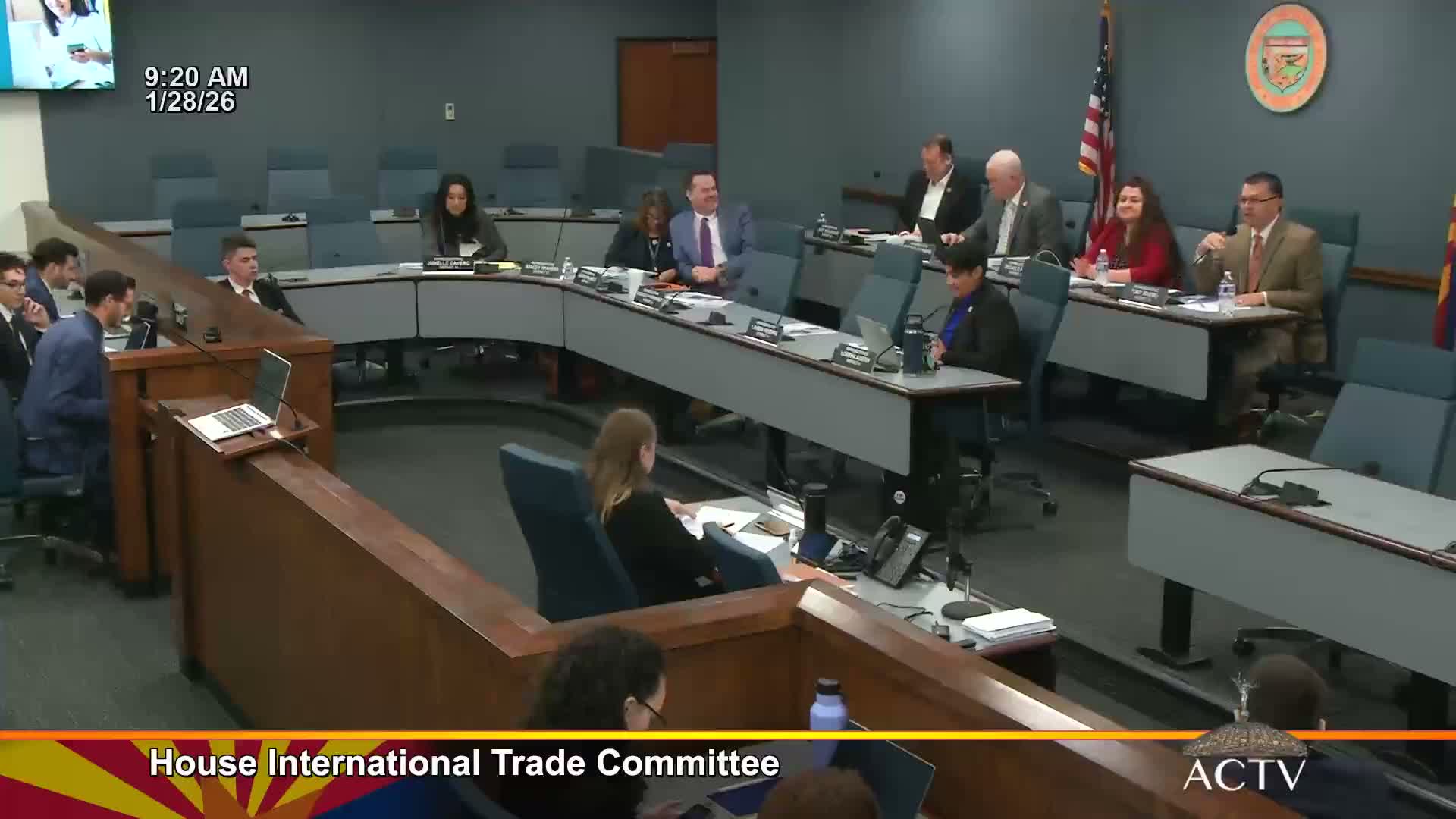
Nogales stakeholders tell Arizona trade committee local workforce, ports and procurement must scale with trade and mining growth
Loading...
Summary
Nogales Santa Cruz County leaders told the Arizona House International Trade Committee that ports, roads, workforce training and procurement programs must expand to capture economic benefits from mining and produce trade; they pitched partnerships with the county college and industry to prepare local businesses and workers.
Olivia Aniza Kramer, president and CEO of the Nogales Santa Cruz County Chamber of Commerce, told the Arizona House International Trade Committee that her border county plays an outsized role in regional trade and is working to convert that position into jobs and long‑term business growth.
"We operate by our numbers," Kramer said, describing partnerships with the Santa Cruz County Provisional Community College District and private firms to deliver supply‑chain, digital marketing and technical training. She said the Chamber offers Grow with Google certificates locally and has a procurement navigation program tied to South 32 mining activity to help small businesses compete for long‑term contracts.
Kramer and Chamber staff urged state investment in infrastructure that accommodates heavy trailer traffic and makes ports of entry more pedestrian and business friendly. When asked what the state could do, Kramer cited highways and walkable port access as priorities that would benefit both freight movement and international tourism.
Greg Lucero, president of the Santa Cruz County Provisional Community College Board, told the committee the county’s provisional college contracts educational services through Pima College and faces limits that raise program costs. He said Pima charges a roughly 26% administrative fee on top of service costs, which constrains expansion of targeted workforce programs.
Lucero outlined the district’s training priorities — AI, advanced manufacturing and stackable credentials for electricians, HVAC technicians and other trades — and said the college currently serves about 600 students but measures roughly 200 full‑time‑equivalent students (FTSE). He said the district aims to reach the roughly 450 FTSE threshold needed to seek accreditation within about two years, which could unlock new funding.
Committee members pressed presenters on housing, health care and how to retain talent; Kramer said limited housing development and local amenities make recruitment a challenge and that community reinvestment and targeted education are key. Kramer also cited recent tourism outreach numbers — about 2,500 visitors and roughly 4,500 social interactions online in the last year — as evidence the region can expand visitor and retail activity if infrastructure and amenities improve.
The committee did not take formal action. Chair Tony Rivero said he is interested in continuing conversations off the record with stakeholders and exploring federal advocacy where appropriate.