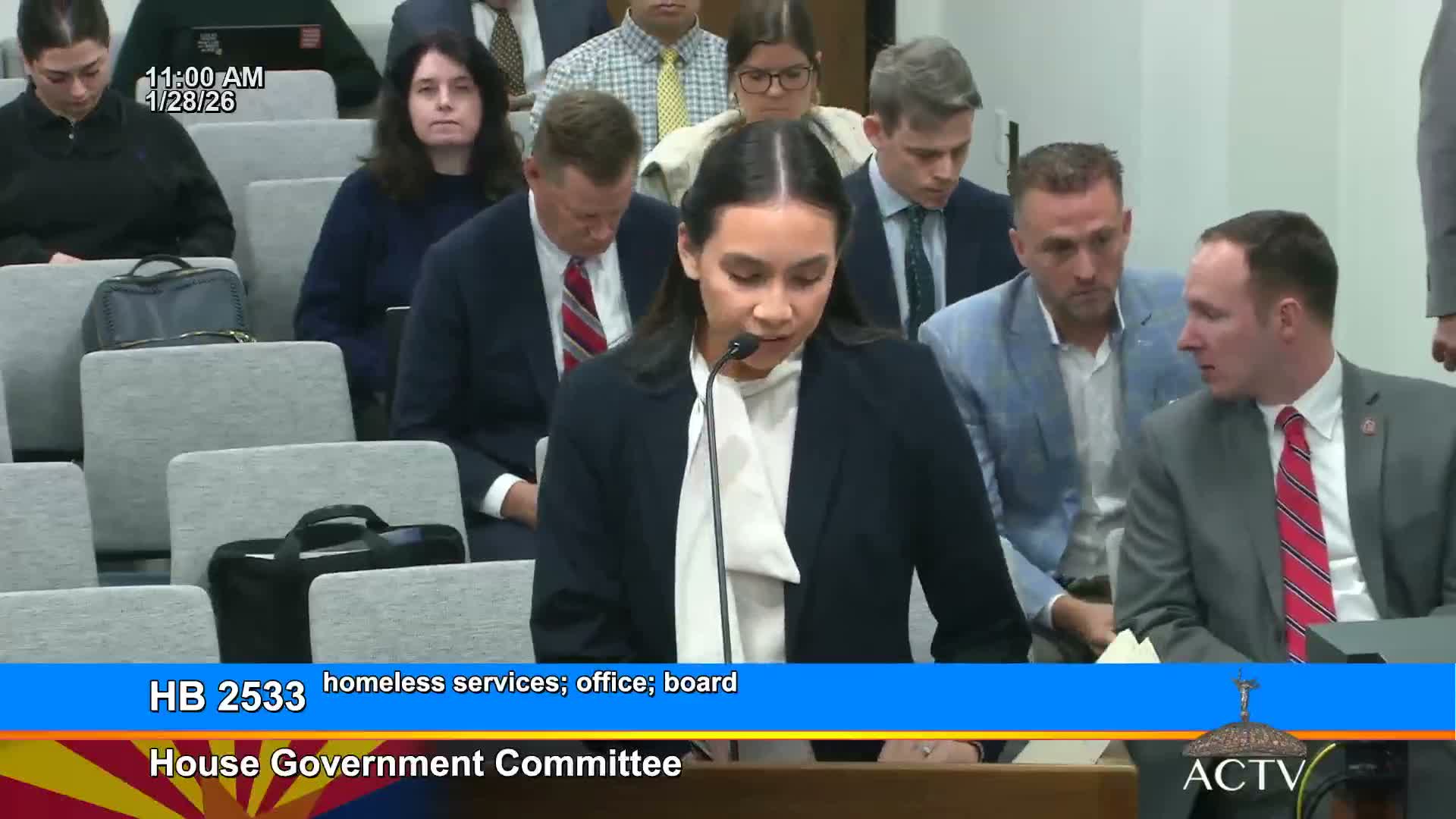
Committee advances bill to create state Office of Homeless Services after lengthy debate over local control and data integration
Loading...
Summary
Rep. Matt Gress told the committee the bill would centralize homeless services coordination and data; proponents argued coordination could improve outcomes and federal flexibility, while opponents pressed for local control safeguards and clarity on HMIS integration and costs. Committee passed HB2533 with amendments (4‑3).
House Bill 2533, which would establish an Office of Homeless Services, an Arizona Homeless Services Board, an ombudsman, and a Property Loss Homelessness Compensation Fund, received a due‑pass recommendation from the House Government Committee on Jan. 27 after extensive testimony.
Sponsor Rep. Matt Gress told the committee the intent is to bring statewide coordination to homelessness policy — aligning Continuums of Care, aggregating outcomes and making federal dollars and program performance more transparent. He described the current state role as ‘‘largely absent’’ and said centralized oversight could reduce duplication and better connect housing with treatment services.
Supporters including policy experts said a coordinated state office could promote outcome‑focused grants, integrate housing with behavioral health and substance‑use treatment, and use data to measure return on investments. A witness from a policy institute cited federal funding figures and argued the state needs centralized direction to convert spending into reduced street homelessness.
Opponents and several members asked for clarity on how the proposed office would respect local Continuums of Care’s federal role, how data sharing with three different HMIS platforms (Maricopa, Pima, and the state) would be funded and implemented, and whether the office would duplicate local responsibilities. Members pressed the sponsor on statistics and for concrete examples of how the office would avoid stepping on local authority.
An amendment to modify director duties, annual reporting language and some board responsibilities was adopted in committee. The committee returned HB2533 with a due‑pass recommendation, sending the amended bill forward for additional consideration.
The hearing included lengthy exchanges about federal HUD program rules, HMIS reporting burdens, and the potential to tie housing resources to treatment for high‑acuity populations; committee members said fiscal impact and data‑integration costs would need to be refined in subsequent steps of the legislative process.