House committee backs bill to bar local shopping‑cart and movable‑property penalties after heated debate
Loading...
Summary
The House Government Committee returned HB2460 with a due‑pass recommendation (4‑3) after testimony from retailers and municipalities split over whether local ordinances that shift costs to businesses are appropriate or whether statewide preemption would strip municipalities of tools to address blight.
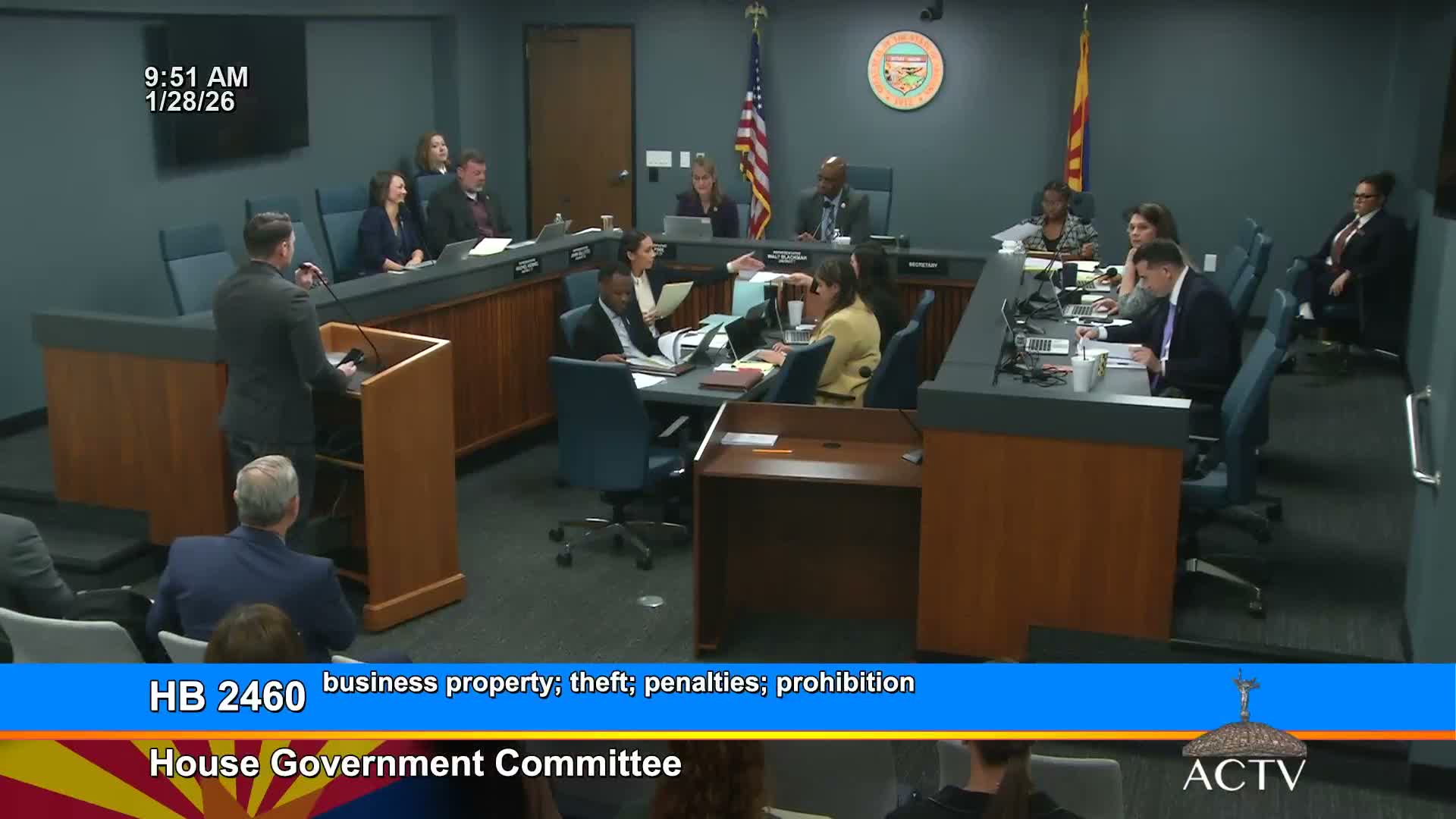
The Arizona House Government Committee on Jan. 27 voted 4‑3 to return House Bill 2460 with a due‑pass recommendation after a contentious hearing that pitted retailers and business advocates against cities and towns.
Sponsor testimony argued some municipalities have adopted ordinances that effectively penalize businesses for theft or abandonment of shopping carts and other movable property, imposing costs such as wheel‑lock technology or retrieval services on retailers. The sponsor said the bill would prevent counties and municipalities from adopting rules that impose penalties on businesses for theft of their movable property.
Marshall Pimentel of the League of Arizona Cities and Towns told the committee the bill’s preemption language is broad and could unintentionally limit local government authority on matters beyond shopping carts — for example, rules related to permitted events or scooter and shared device parking. He said at least six or seven larger cities have adopted ordinances tailored to local conditions, and those local solutions reflect collaboration with businesses to respond to neighborhood hazards.
Tom Dorn, speaking for the City of Phoenix, described the operational burdens cities face in picking up and storing thousands of carts annually and explained Phoenix’s stakeholder process for its ordinance. He said the fee is intended to recover administrative costs when retailers fail to retrieve impounded carts and that large cities have experienced thousands of abandoned carts each year.
Supporters of the bill argued ordinances can amount to an added tax on businesses and ultimately consumers; opponents said the measure represents a state preemption of local control and could strip cities of necessary nuisance tools.
After discussion that included examples of ordinance scope and concern for small towns without the same infrastructure as large cities, the committee voted to give HB2460 a due‑pass recommendation, clearing the bill to proceed in the legislative process.
The committee’s action was procedural (return with due‑pass) and did not amend the bill’s text during the hearing; committee staff noted the bill would include a severability clause and that the bill’s language currently applies broadly to theft of movable business property.
The chair said the committee will continue to review the bill as it goes through subsequent legislative steps.