
Committee advances bill to restrict certain Chinese‑made equipment from Arizona critical infrastructure
Get AI-powered insights, summaries, and transcripts
Subscribe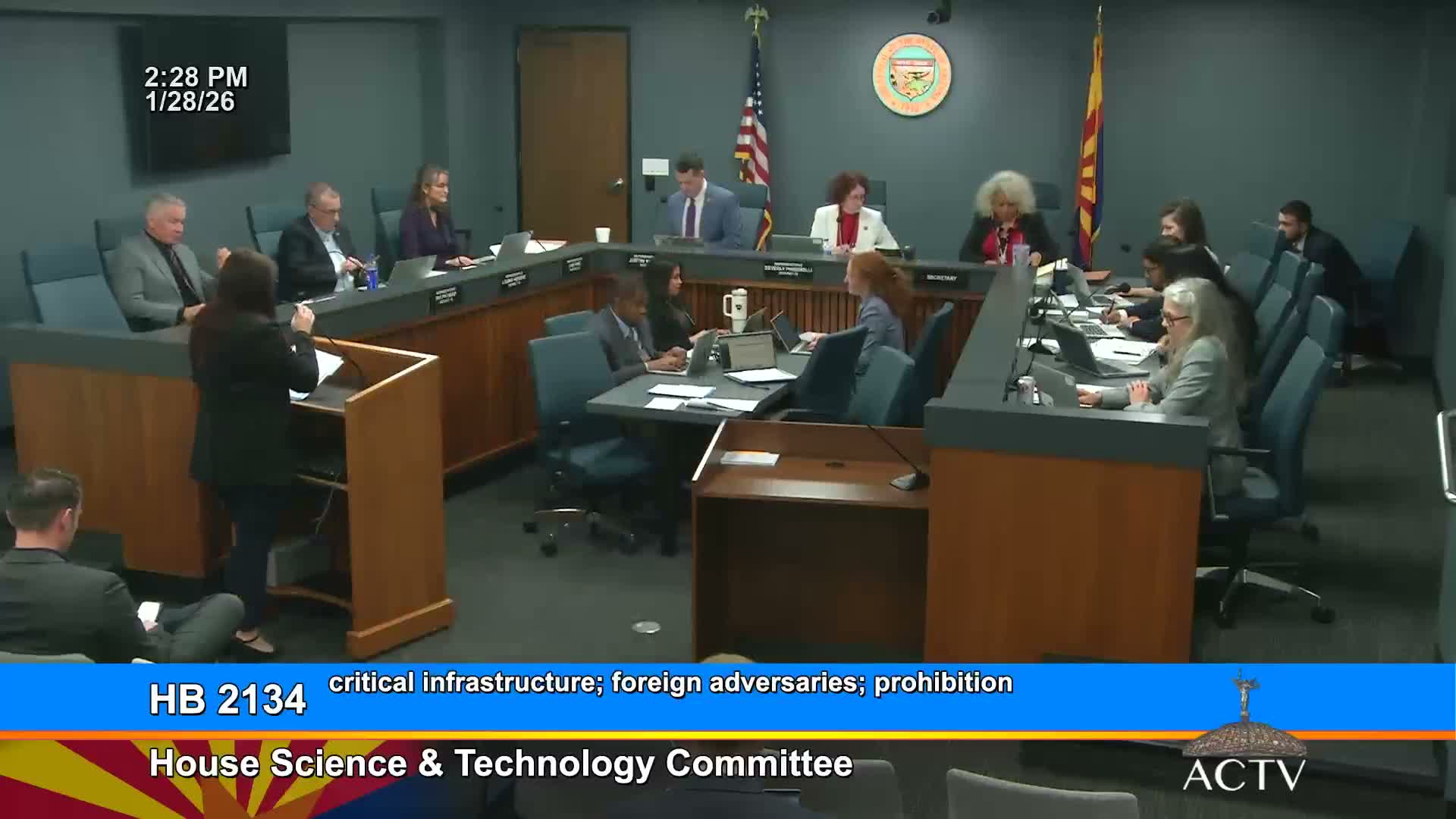
Summary
Lawmakers returned HB 21‑34 with a due‑pass recommendation after debate about national security threats and substantial implementation costs for regulators. Supporters said a prospective prohibition and reporting requirements will protect infrastructure; Corporation Commission testified it would need staff and funding to implement.
The Arizona House Committee on Science and Technology on Jan. 27 advanced House Bill 21‑34, which would restrict government entities and critical communications providers from entering contracts with certain Chinese companies that have access to critical infrastructure and would add reporting requirements about the location of prohibited equipment.
Sponsor Representative Nick Cutter told the committee the measure is intended to prevent remote compromise of essential systems. "China is a threat," he said, arguing states should act if federal action is insufficient. Cutter said the bill is intended to be prospective — applying to new procurements — and that the bill includes safe‑haven language to avoid immediate removal where a replacement is not feasible.
Legal and industry witnesses said states are already litigating or investigating related issues. Bo Royston, an attorney with Fusion Law and a former Arizona Attorney General staffer, said parts of the National Defense Authorization Act already prohibit certain equipment at the federal level and that the state bill would provide a parallel, prospective safeguard.
Michael Lucci, representing State Armour, cited news reports and security analyses he said show solar inverters, certain batteries and security cameras can present remote‑access risks and argued for a state list and a short phase‑in period to avoid later costly replacements.
Doug Clark, executive director of the Arizona Corporation Commission, told the committee that ACC staffers have reviewed prior versions and that implementation would require new positions and likely an initial outlay tied to consultants. Clark said ACC is neutral at this stage but noted the utilities division is currently handling major rate cases and that extra workload would require either additional staff or a delayed implementation schedule.
Members split on implementation and cost concerns. Several said they supported the goal but were not comfortable with the mechanics as written; others said the state must act to reduce risks to dams, power plants and other critical infrastructure. The committee ultimately returned the bill with a due‑pass recommendation (5 ayes, 4 nays).