
Committee adopts amendment to route EV charging TPT revenue to highway fund; DOR told to begin separate accounting
Get AI-powered insights, summaries, and transcripts
Subscribe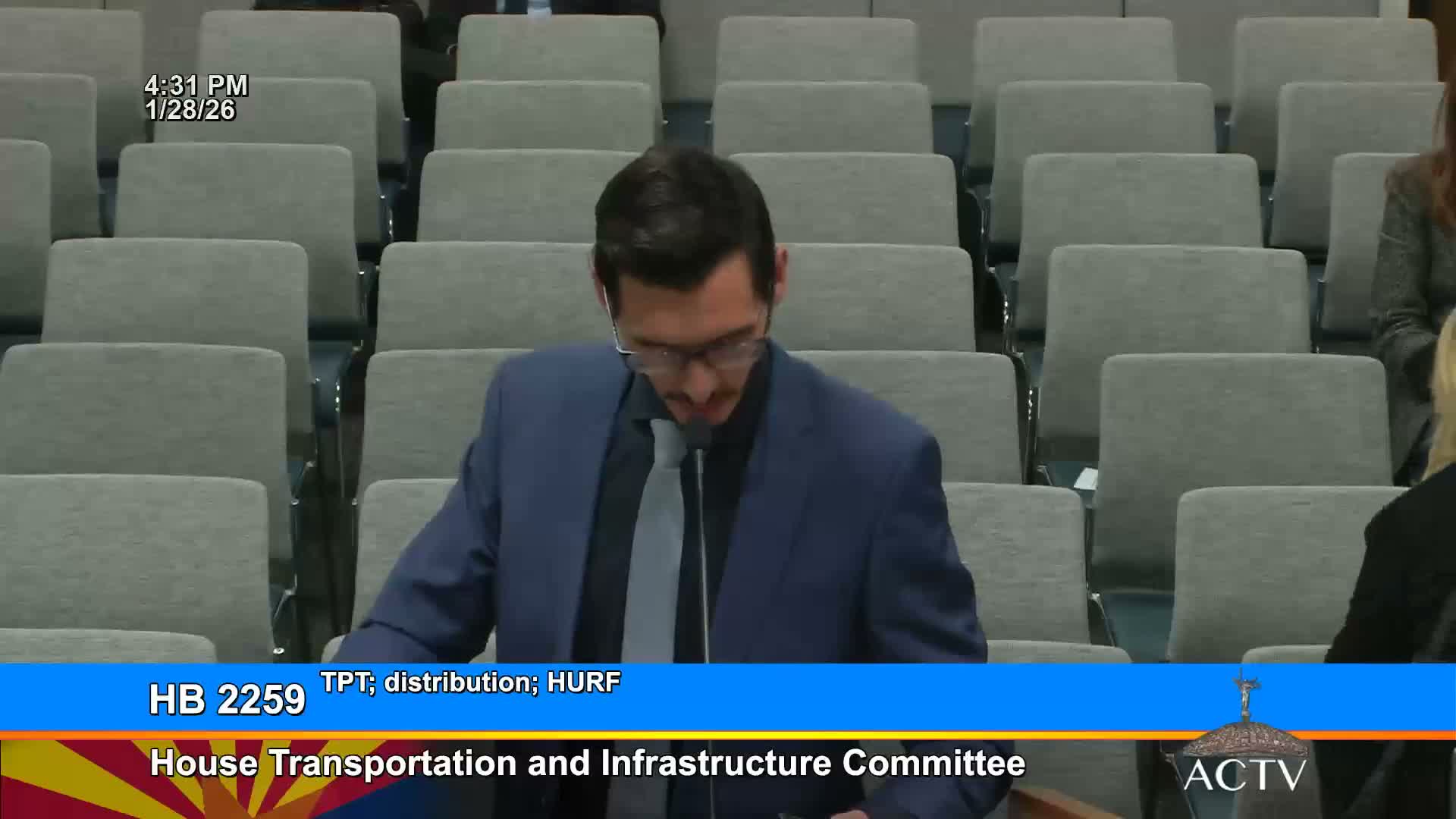
Summary
The committee adopted an amendment requiring Department of Revenue accounting of transaction-privilege-tax receipts from EV charging stations and directed the general-fund portion to the Highway User Revenue Fund (HEERF). DOR staff said the agency does not currently track those receipts separately.
The committee adopted a sponsor amendment on HB2259 that directs the Department of Revenue to separately account for transaction-privilege-tax (TPT) revenues collected under the "personal property rental" classification from persons leasing or renting public electric-vehicle charging stations and to deposit the general-fund share into the Highway User Revenue Fund (HEERF). The chair's amendment, dated 01/26/2026, increased the percentage in committee from 10% to 100% and was adopted on voice vote.
Vince Perez, a Ways & Means research analyst and former DOR staffer, told the committee that DOR currently does not separately track TPT receipts specifically from EV charging stations and that the bill would compel DOR to create a subclassification for reporting. Perez said the change would allow the legislature to know how much revenue those stations generate and to route the appropriate share into HEERF.
Sponsor rationale: The sponsor argued that EV drivers use state roads but do not pay gasoline taxes and that TPT charged at EV charging stations is analogous to fuel taxes and should be directed to road funding. "If we're collecting a tax, shouldn't that go to HEERF?" the sponsor asked, noting past sweeps of transportation funds into the general fund during fiscal stress.
Issues raised: Members asked for revenue estimates and tribal-land considerations; committee members and DOR staff said estimates are not yet available because DOR does not currently separate those receipts. Members suggested carve-outs or mechanisms for stations located on tribal lands if the owner is tribal government or a tribal entity.
Next steps: DOR will be asked to develop separate accounting and report back with revenue estimates and recommendations for tribal-ownership handling; the bill as amended was returned with a due-pass recommendation.